Your off-the-shelf CRM isn’t just a software choice; it’s a ceiling on your potential. Whilst these platforms promise ease, they often force your team into rigid structures, fragmented data, and escalating monthly “taxes” per user. Knowing when to build a custom crm is no longer a luxury for the elite. It’s a strategic necessity for any UK business that values precision, efficiency, and growth. You’ve likely felt the frustration of manual data entry or the sting of per-seat price hikes that punish your success.
We agree that your technology should adapt to your vision, not the other way around. In this article, you’ll discover why generic subscriptions often hinder your momentum and learn the exact criteria to help you pivot toward a bespoke system. We’ll provide a clear “go/no-go” framework to help you eliminate redundant tasks and build a system that scales effortlessly. By the end, you’ll have the clarity to decide if it’s time to stop renting your infrastructure and start owning your innovation.
Key Takeaways
- Identify why reflexive SaaS subscriptions often act as a growth ceiling rather than a foundation for your unique business logic.
- Apply the “70% Rule” and other critical indicators to help you decide exactly when to build a custom crm instead of paying for unused features.
- Use the “Golden Thread” framework to map your customer journey and pinpoint exactly where manual data entry is leaking profit.
- Discover how bespoke systems eliminate “workflow friction” and allow your team to move faster than competitors stuck on generic platforms.
- Shift from renting rigid software to owning a scalable asset that evolves alongside your business without per-user price hikes.
Myth: A Subscription CRM is Always the Safest Starting Point
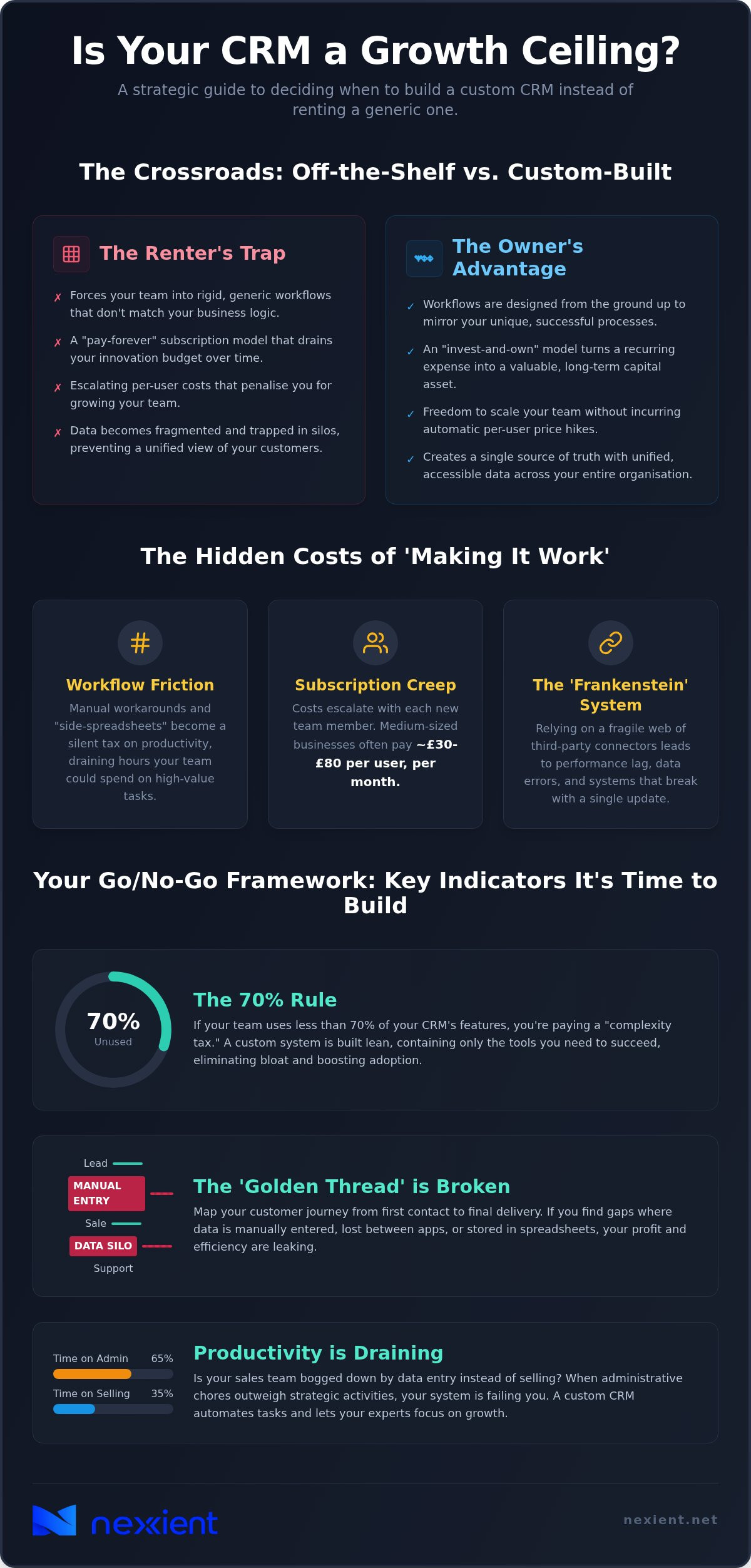
Reflexively choosing a monthly subscription feels like the path of least resistance. It’s the “Safe Default” trap. Many leaders in Worcestershire assume that because a platform is popular, it’s the right fit for their specific growth trajectory. However, understanding when to build a custom crm requires looking past the brand names and auditing your actual operational needs. A generic tool might offer a thousand features, but if your team only requires ten, you’re paying a “complexity tax” that slows down your daily momentum. True safety lies in a system that supports your work, not one that forces you to change it.
What is a Custom CRM?
A bespoke customer relationship management system is not just a modified version of an existing app. It is a tool designed from the ground up to mirror your unique business logic; the specific rules and sequences that make your company successful. Most businesses begin with Software as a Service (SaaS). This refers to software that is hosted by a provider and accessed via the internet for a monthly fee. Whilst these platforms allow you to “customise” fields, they still force you to work within their rigid architectural boundaries. By choosing Custom CRM Systems, you secure full ownership of your intellectual property. This means you own the software itself, turning an expense into a long-term capital asset that you can modify as your market evolves. You define the flow, the data structure, and the user experience.
The Illusion of the Low Barrier to Entry
Providers often lure businesses with low entry prices. These costs quickly escalate as you unlock “Pro” features or add more users. By 2026, the global CRM market is projected to reach approximately $126 billion, driven largely by these recurring fees. This “pay-forever” model can lead to subscription fatigue, where your innovation budget is drained by software that doesn’t quite fit. Contrast this with an “invest-and-own” strategy. You commit to a focused development phase to create a lean, high-performance tool. Evaluating when to build a custom crm is about identifying that break-even point where ownership becomes more profitable than endless renting.
Adopt the mindset of a Visionary Architect. See your CRM as a strategic foundation rather than a line item on a bank statement. When you build, you aren’t just buying code; you’re codifying your competitive advantage. You move away from being a mere bill-payer to being the owner of a precise engine designed for growth.
The Hidden Cost of ‘Making it Work’ with Generic Software
“Making it work” is a dangerous phrase for a growing company. It usually signals that your team is using manual workarounds to bypass a software’s rigid structure. This “Workflow Friction” acts as a silent tax, killing productivity whilst your staff juggle “side-spreadsheets” just to keep track of basic tasks. When information is scattered across multiple tools, you face the high cost of data fragmentation. Customer insights become trapped in silos that don’t communicate, making it impossible to see the full picture of your sales pipeline. Determining when to build a custom crm requires a hard look at these invisible drains on your time and energy.
The training burden is equally heavy. Generic User Interface and User Experience (UI/UX) designs are created for the average user, not your specific team. This clutter forces new hires to spend days mastering complex, irrelevant features. The opportunity cost is clear. Every hour your team spends fighting the software is an hour they aren’t spending on growth. If your sales reps spend more time on data entry than on selling, the system is failing you. A streamlined tool allows your experts to focus on digital craftsmanship and strategic thinking rather than administrative chores.
Subscription Creep and the ‘Per-Seat’ Problem
In the Software as a Service (SaaS) model, where you rent access to tools over the internet, every new hire becomes a financial penalty. As your team expands, your monthly “tax” grows automatically. Verified data for 2026 suggests that medium-sized businesses pay between $40 and $100 per user each month for standard CRM access. For a 10-person team, this represents a significant five-year commitment that often exceeds the price of a tailored solution. By choosing Nexient’s custom systems, you invest in a scalable asset rather than a recurring debt. You gain the freedom to grow your headcount without worrying about a ballooning software bill. Ownership allows you to focus on performance, not licensing tiers.
The ‘Frankenstein’ Integration Myth
Many businesses rely on third-party connectors to link their apps. This often creates a “Frankenstein” system; a fragile web of dependencies that can break with a single update. These layers of “plug-ins” and connectors lead to performance lag and data errors. A unified data-driven application handles your processes natively, ensuring your information flows smoothly without external help. If you find yourself constantly fixing broken links between apps, it is a strong signal for when to build a custom crm that truly belongs to you. You deserve a platform that feels stable, secure, and entirely within your control.
If your current setup feels like a house of cards, it might be time to explore a more stable foundation for your data.
The Tipping Point: When to Pivot to Bespoke Development
Knowing when to build a custom crm often comes down to a single question: is the software serving you, or are you serving the software? Many businesses reach a tipping point where the friction of using a generic tool outweighs the convenience of the subscription. This transition isn’t just about the size of your company; it’s about the complexity of your vision. If your current platform feels like a cage rather than a foundation, you’ve likely hit the ceiling of what off-the-shelf solutions can provide.
Consider the 70% Rule. If you find your team only utilises 30% of a platform’s bloated feature set whilst you pay for 100% of the capacity, you’re subsidising tools you don’t need. Similarly, watch for the Workaround Indicator. If a simple task like logging a specific lead type sparks a 10-minute internal debate on “how to enter this in the CRM,” your system is no longer fit for purpose. You aren’t just losing time; you’re losing the clean, actionable data required for strategic growth.
Compliance often acts as the final trigger for a pivot. Whilst generic platforms claim to be global, they often lack the granular control needed for rigorous UK GDPR standards or specific industry audits. A bespoke build allows you to bake these requirements directly into the architecture. This ensures data residency and deletion protocols are handled automatically, protecting your reputation and your customers’ trust. Deciding when to build a custom crm means choosing a system that respects both your workflow and your legal obligations.
Signs Your Business Has Outgrown the ‘Buy’ Model
Operational red flags are the first signs that you’ve hit the limit. If your team is manually duplicating data between systems or spending hours each Friday compiling manual reports, your growth is being throttled. “Good enough” software is the enemy of high performance. To understand how tailored digital assets drive expansion, consult our bespoke web design guide for a deeper look at custom business growth. Common indicators include:
- Frequent data entry errors caused by complex, irrelevant fields.
- Inability to automate unique, high-value business processes.
- Fragmented customer views that require multiple browser tabs to piece together.
Buy vs. Build: A Strategic Comparison
A strategic choice between SaaS and bespoke development hinges on three pillars: scalability, cost, and process fit. SaaS offers a quick start but often leads to “process drift,” where you change your successful workflows to match the software’s limitations. Bespoke systems, however, allow for a clean design that focuses strictly on what matters to your bottom line. As a Visionary Architect, you should build for the future you want, not just the problems you have today. This approach ensures your system remains an asset for years, adapting whilst your competitors struggle with rigid, outdated platforms.
Auditing Your Workflows: A Framework for Strategic Decision Making
Deciding when to build a custom crm requires moving beyond frustration and into structured analysis. You need a clear, objective way to measure the gap between what you have and what you need. This framework allows you to audit your internal processes, identify hidden costs, and build a business case for bespoke development. Map, measure, and master your data flow to ensure your next technology investment is a strategic win for your bottom line.
- Step 1: Map the ‘Golden Thread’. Trace the exact path a lead takes through your business. Identify every touchpoint, from the initial enquiry to the final invoice. If this path feels jagged, interrupted, or inconsistent, your software is likely the primary bottleneck.
- Step 2: Identify ‘Value-Leaking’ Steps. Look for moments where data is manually copied, emailed, or written down. These are points where human error thrives and valuable customer insights vanish into thin air.
- Step 3: Define your ‘Non-Negotiables’. Pinpoint the three features that would give you an unfair advantage. These are usually the unique processes that generic platforms cannot support without expensive, fragile plugins.
- Step 4: Calculate the ‘Friction Factor’. Track every minute your team spends fighting the interface or fixing sync errors. When you multiply these lost hours by your team’s hourly rate, the “low cost” of a subscription often reveals itself as a massive financial drain.
Designing for the User, Not the Database
Adoption is the ultimate metric of success. If a system is difficult to navigate, your sales team will revert to spreadsheets. There is a persistent myth that custom software is “clunky” compared to polished subscription platforms. In reality, bespoke builds allow for a level of precision that generic tools cannot match. Nexient focuses on User Interface (UI), which is the visual layout of the software, and User Experience (UX), which refers to how intuitive and efficient the system feels to use. We remove unnecessary clutter, ensuring your team only sees the data they need to close the deal. Understanding when to build a custom crm is also about recognising when your team’s creative energy is being stifled by a cluttered, generic dashboard. When the interface follows the natural behaviour of the user, efficiency skyrockets.
Preparing for a Bespoke Build
Success starts with practical strategy. Before a single line of code is written, you must understand the daily reality of your staff. An actionable task for any leader is to create a ‘Day in the Life’ document for your most frequent CRM users. Record their clicks, their complaints, and their clever workarounds. This document becomes the blueprint for your new system, ensuring it solves real-world problems. The same professional web design principles that make a website convert apply to your internal tools. You’re building a digital environment where your Worcestershire team can thrive and your vision can grow.
Ready to stop fighting your software and start scaling your operations? Book a workflow audit with us today to see if a bespoke system is your next logical step.
Beyond the Dashboard: Building a Custom CRM that Drives Growth
A bespoke system is more than a utility; it is a competitive lever. Whilst your competitors struggle with the generic constraints of mass-market software, a custom build allows you to move with precision and speed. This is the “Unfair Advantage” of digital sovereignty. By owning your architecture, you ensure that every feature serves a specific goal, allowing you to outpace rivals who are bogged down by software that wasn’t built for their specific market. Recognising when to build a custom crm is about realising that your internal tools should be as unique as your business model.
Future-proofing is another critical pillar. In a shifting market, your software must evolve whilst your business pivots. Generic platforms often lock you into their roadmap, forcing you to wait for updates that may never come. With a bespoke solution, integration becomes a choice rather than a crutch. You connect to the tools you love, such as specific accounting software or marketing platforms, without being forced into an ecosystem that doesn’t serve your long-term interests. The Nexient approach combines high-level digital craftsmanship with deep business intelligence to ensure your system delivers tangible, measurable results.
Turning Data into Business Intelligence
Custom reporting provides clarity that generic dashboards simply cannot replicate. Instead of wading through a sea of irrelevant metrics, you gain a “single source of truth” for every customer interaction. This level of detail allows you to identify trends, predict behaviours, and allocate resources with total confidence. For firms looking to enhance their local Worcestershire presence or expand onto the national stage, this intelligence is vital. It transforms raw data into a strategic map, showing you exactly where your next growth opportunity lies.
Your Next Steps Toward Digital Sovereignty
It is time to stop viewing software as a recurring commodity and start seeing it as a high-performance investment. Digital sovereignty means taking control of the tools that power your growth. If you are ready to move beyond the limitations of off-the-shelf defaults, the path forward starts with a clear audit of your current capabilities. We invite you to a strategy session where we can examine your digital stack and identify the “value-leaking” steps mentioned earlier in this guide. Understanding when to build a custom crm is the first step toward reclaiming your operational freedom.
Take the first step toward a system that truly belongs to you. You can book a consultation with Nexient to explore your custom CRM potential and discover how a bespoke build can accelerate your trajectory. Don’t let generic software dictate your limits; build the foundation your vision deserves.
Reclaiming Your Digital Sovereignty
Choosing to move beyond generic software is a defining moment for any ambitious company. You’ve seen how subscription “taxes” and rigid workflows act as a silent ceiling on your momentum. By auditing your processes and identifying where value is leaking, you gain the clarity needed to decide when to build a custom crm. Owning your infrastructure isn’t just about saving money; it’s about codifying your unique competitive advantage into a high-performance engine that grows with you.
Our bespoke systems are built in England with a focus on strategic UI/UX to ensure your team actually adopts and enjoys the tools you provide. You can eliminate per-user price hikes and reclaim control over your data flow. It’s time to stop adapting your vision to fit a software’s limitations and start building a foundation that supports your future. Accelerate your growth with a custom CRM designed by Nexient. Your vision deserves a platform that is as precise, powerful, and professional as your business itself.
Frequently Asked Questions
How much does it cost to build a custom CRM compared to a SaaS subscription?
Building a custom CRM involves a higher upfront investment but eliminates the recurring “per-seat” tax found in SaaS models. Whilst a subscription might look cheaper initially, the total cost of ownership over three to five years often swings in favour of bespoke development. You pay for the engineering once and own the asset forever. This allows your Worcestershire business to scale its headcount without the financial penalty of increasing software bills.
How long does the bespoke CRM development process typically take?
A typical bespoke project takes between three to six months depending on the complexity of your workflows. We follow a methodical process that starts with strategic planning and user interface design before moving into the actual build. This timeline ensures we map your “Golden Thread” accurately and create a system that your team will actually use. Rushing the process leads to technical debt, so we prioritise precision over shortcuts to deliver a stable, long-term asset.
Can a custom CRM integrate with my existing accounting software like Xero or Sage?
Yes, a custom system can integrate seamlessly with accounting tools like Xero or Sage. We use secure connectors to ensure your CRM and finance software “talk” to each other, eliminating the need for manual data entry between platforms. This native connectivity is a key reason for when to build a custom crm, as it allows you to choose the best-in-class tools for every department without creating fragmented data silos that hinder your growth.
Do I need an in-house IT team to maintain a bespoke CRM system?
You don’t need an in-house IT team to manage a system designed by Nexient. We build our data-driven applications to be intuitive and self-sustaining for non-technical users. Whilst we handle the initial engineering and any major future updates, the day-to-day operation is designed for maximum team adoption. This allows you to focus on your business strategy whilst we ensure the underlying technology remains robust, reliable, and secure for your Worcestershire operations.
Is a custom CRM more secure than a well-known platform like HubSpot or Salesforce?
Custom systems often provide superior security because they aren’t high-profile targets for mass-market exploits. Unlike major platforms that are targeted by hackers due to their massive user bases, your bespoke CRM is a unique architecture. We implement specific security protocols tailored to your data residency needs, ensuring your UK GDPR compliance is baked into the system from the first line of code. You gain total control over who accesses your most sensitive information.
What happens if our business processes change after the CRM is built?
Bespoke software is designed to be adaptable and scalable as your business evolves. Unlike rigid off-the-shelf platforms, a custom build can be modified to reflect new workflows or service offerings. This flexibility is a core part of our “Visionary Architect” approach. We build a foundation that is stable yet fluid, allowing you to pivot your strategy in the Worcestershire market without being held back by outdated software constraints or feature limitations.
Can I migrate my existing data from a SaaS platform to a new bespoke CRM?
Migrating your existing data is a standard part of our development phase. We map your current records from platforms like HubSpot or simple spreadsheets into the new system to ensure no information is lost. This process cleanses your data, removing duplicates and ensuring a “single source of truth” from day one. Deciding when to build a custom crm is often the perfect time to audit and improve the quality of your customer insights for better decision-making.
Is bespoke software only for large corporations, or can small UK firms benefit too?
Small and medium-sized UK firms often see the greatest relative benefit from bespoke tools. By eliminating monthly subscription fees and automating manual tasks, smaller teams can punch well above their weight. In Worcestershire, local firms use custom systems to gain a competitive edge over larger rivals stuck on generic platforms. You don’t need a corporate budget to invest in technology that mirrors your unique business logic and drives long-term efficiency.