
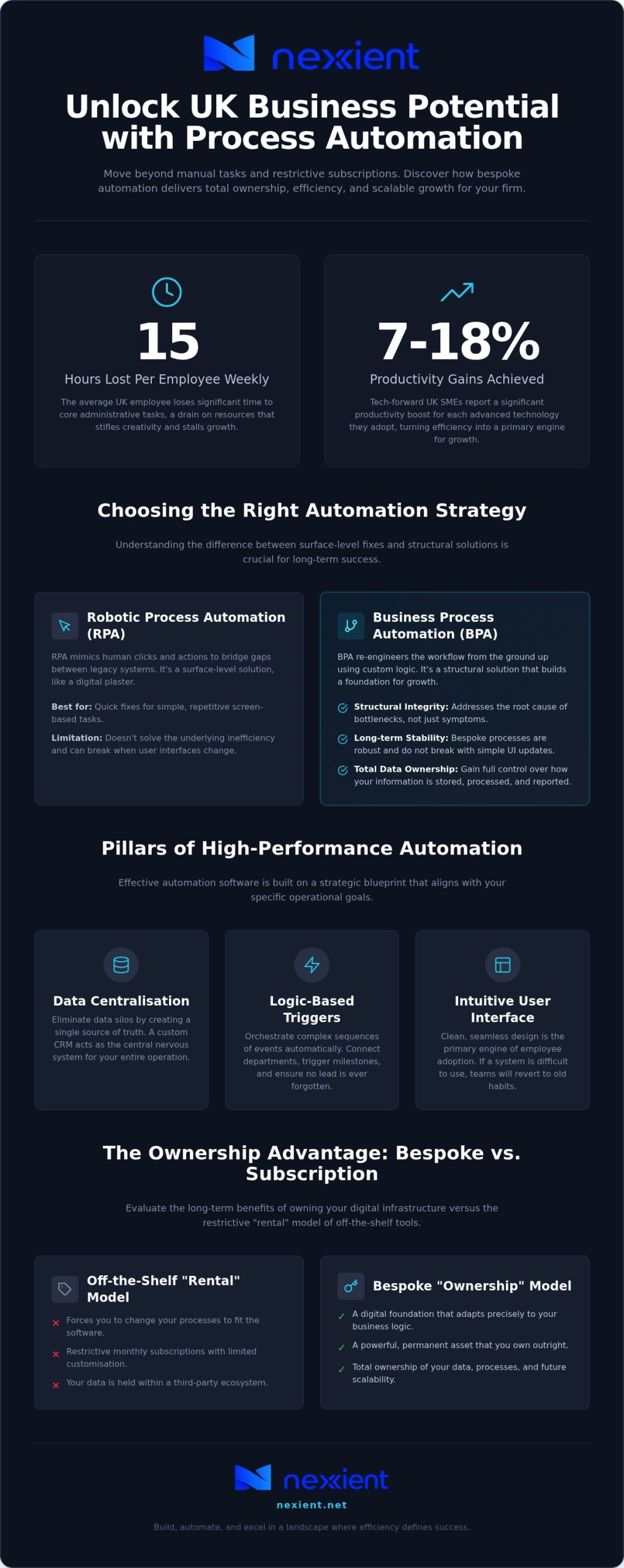
Did you know that the average UK employee still loses 15 hours every single week to core administrative tasks? It’s a staggering drain on resources that stifles creativity, stalls growth, and creates unnecessary friction within your team. You likely feel the weight of these manual inefficiencies every day; whether it’s fighting with disconnected data silos or paying for expensive monthly subscriptions that don’t quite match your unique business logic. Investing in high-quality business process automation software UK is no longer just an option for the elite. It’s a strategic necessity for any firm looking to scale.
We understand the frustration of outgrowing off-the-shelf tools that force you to change how you work. You deserve a system that adapts to you; a digital foundation that is precise, powerful, and permanent. This guide reveals how to reclaim your time and achieve the 7 to 18% productivity gains reported by tech-forward SMEs. We’ll explore how to move away from restrictive subscription models and towards bespoke web applications that give you total ownership of your data. Discover how to build, automate, and excel in a landscape where efficiency defines success.
Key Takeaways
- Learn how to distinguish between simple task automation and strategic business process automation software UK to build a more resilient and scalable operation.
- Identify the three core pillars of high-performance systems: centralising your data, creating logic-based triggers, and prioritising a clean interface for seamless employee adoption.
- Evaluate the long-term financial and operational benefits of owning your digital infrastructure versus the restrictive “rental” model of off-the-shelf subscriptions.
- Follow a structured five-step implementation plan to audit your current manual workflows and pinpoint exactly where bottlenecks are stalling your growth.
- Discover how a bespoke data-driven web application can provide total ownership of your business logic and unlock measurable productivity gains.
Beyond the Buzzwords: Defining Business Process Automation for UK Firms
Understanding Business Process Automation (BPA) begins with a fundamental shift in perspective. It’s not just about replacing a few keystrokes; it’s the strategic use of software to execute complex, recurring workflows. Whilst simple task automation might handle a single notification, comprehensive business process automation software UK orchestrates entire sequences of events. It connects your sales data to your finance team, triggers project milestones, and ensures no lead is ever forgotten. This is digital craftsmanship applied to the very bones of your business logic.
We approach this as a Visionary Architect would. Instead of applying digital plasters to broken systems, we build foundations that support long-term growth. This methodology moves beyond the surface to create a unified digital ecosystem where information flows without friction. By designing for the future, you allow your team to focus on high-value strategy rather than low-value admin.
Why UK Businesses are Prioritising Automation in 2026
The economic climate in 2026 has made operational efficiency the primary engine for business growth. Rising labour costs and a tighter talent market mean that firms must empower the staff they already have. According to GOV.UK (2025), UK SMEs gain a 7% to 18% productivity boost for each advanced technology they adopt. Beyond the balance sheet, automation has become essential for supporting remote and hybrid working patterns amongst UK teams. It provides a digital centre of gravity, ensuring everyone stays aligned and accountable without the need for constant manual check-ins. By automating the routine, you give your team the space to perform at their highest level.
The Crucial Difference Between RPA and BPA
Choosing the right path requires understanding the distinction between Robotic Process Automation (RPA) and BPA. RPA is often defined as mimicking human clicks; it’s a surface-level solution designed to bridge gaps between old systems. Whilst useful, it doesn’t solve the underlying inefficiency. BPA, however, involves re-engineering the workflow from the ground up using custom systems. This offers several distinct advantages for growing firms:
- Structural Integrity: BPA addresses the root cause of bottlenecks rather than just the symptoms.
- Long-term Stability: Bespoke processes don’t break when a UI element changes, unlike many RPA bots.
- Data Ownership: You gain total control over how information is stored, processed, and reported.
By rebuilding processes around modern logic, you ensure your business process automation software UK remains a powerful asset that evolves alongside your vision. To begin your transition, start by auditing your current workflows to decide if you need a quick RPA fix or a structural BPA solution that engineers lasting growth.
Essential Features of High-Performance Automation Software
High-performance business process automation software UK requires more than just functional code. It demands a strategic blueprint that aligns with your specific goals. At its heart, effective automation relies on three core pillars: data centralisation, logic-based triggers, and comprehensive reporting. Without these, you aren’t truly automating; you’re simply moving manual work from one screen to another. A clean User Interface (UI) is equally vital for success. If your team finds the software difficult or frustrating to navigate, they’ll inevitably revert to old, manual habits. Intuitive design isn’t a luxury; it’s the primary engine of employee adoption.
Connectivity defines the modern digital workspace. We use Application Programming Interfaces (APIs) as digital bridges to link your disparate tools into a single, cohesive unit. This allows data to travel instantly between your email, accounting, and project management platforms. Whilst many platforms offer basic connections, they often lack the custom logic needed for complex UK operations. As explored in research on AI-Powered Business Process Automation, the most effective systems augment human capability by handling the “how” whilst leaving the strategic “why” to your experts.
Seamless Data Integration and Custom CRM Logic
Custom CRM systems act as the central nervous system for your automation. In many UK offices, data silos create friction; sales teams don’t know what finance has invoiced, and marketing lacks visibility on customer support tickets. By centralising this information, you eliminate the “silo effect” and create a single source of truth. This real-time business intelligence allows you to make decisions based on facts rather than guesswork. If you’re ready to move beyond spreadsheets, exploring a data-driven application is the first step towards total operational clarity.
Scalability and Avoiding Technical Debt
Building for today is easy, but building for five years from now requires foresight. We focus on avoiding “technical debt,” which is the hidden cost of fixing quick-and-dirty software solutions later. Taking shortcuts today often leads to expensive, disruptive rewrites tomorrow. Scalable architecture ensures your software grows alongside your firm without losing performance or stability. Clean code is the foundation of this longevity. It ensures your system remains fast, secure, and easy to update as your business logic evolves. Prioritising quality at the start prevents your digital infrastructure from becoming a bottleneck in the future.
Bespoke Development vs. Off-the-Shelf Software: Making the Right Choice
Choosing the right business process automation software UK represents a fundamental fork in your operational road. One path leads to the “rental” model of Software-as-a-Service (SaaS), whilst the other leads to the “ownership” model of bespoke development. Whilst SaaS tools offer a quick start, they often come with “feature bloat”—a cluttered interface filled with complex tools your team will never use. Bespoke software, by contrast, is lean, precise, and engineered specifically for your unique business logic. This digital craftsmanship ensures that every button and workflow serves a purpose, driving efficiency without the noise of generic platforms.
Strategic Business process automation (BPA) requires a system that adapts to you, not the other way around. When you analyse the total cost of ownership over a three to five-year period, the financial narrative often shifts in favour of custom builds. Initial development costs are offset by the elimination of recurring monthly fees that never end. Additionally, custom-built, UK-hosted solutions provide superior security; they aren’t “mass targets” for hackers in the same way generic, global platforms often are. You gain a fortress designed specifically for your data.
When Subscription Models Become a Liability
Standard subscription models often hide a sting in the tail: per-user pricing. As your team grows, your software bill explodes, effectively penalising your success. This often leads to “vendor lock-in,” where your business data is trapped within a proprietary ecosystem that’s difficult and expensive to leave. Most firms find they fall victim to the “80/20 rule,” paying for 100% of a massive tool whilst only ever needing 20% of its functionality. To take control, start by performing a subscription audit: list every tool you pay for, the total monthly cost, and the percentage of features your team actually uses every day.
Total Ownership and Intellectual Property
Bespoke software isn’t just a tool; it’s a capital asset that sits on your balance sheet. Investing in data-driven web applications creates a unique piece of intellectual property that your rivals simply cannot buy. This provides a significant competitive advantage, as your internal processes remain a secret rather than a public commodity. By owning your digital infrastructure, you gain the freedom to pivot, scale, and innovate on your own terms. You transition from being a tenant in someone else’s software to being the architect of your own digital future.
Transitioning to Automation: A Strategic 5-Step Implementation Plan
Adopting high-performance business process automation software UK requires more than just a software purchase; it demands a deliberate, structured transition. We view this process as an architectural project where the foundation must be solid before the structure can rise. Success isn’t found in automating a broken process, but in re-engineering that process to be leaner and more resilient. To achieve the 7 to 18% productivity gains seen by tech-forward UK SMEs, you must follow a roadmap that moves from current manual frustrations to a future of effortless flow.
Our implementation framework consists of five essential stages:
- Step 1: Audit and Map: Document your current “as-is” manual processes. You can’t improve what you haven’t clearly defined.
- Step 2: Identify Bottlenecks: Pinpoint the specific tasks that consume the most time or lead to the most frequent errors.
- Step 3: Define the “To-Be” State: Design your ideal automated workflow, free from the limitations of your old spreadsheets or paper trails.
- Step 4: Development and Integration: Build your software stack and connect your data sources into a unified system.
- Step 5: Training and Evolution: Prepare your team for the new system and establish a cycle of continuous improvement.
Audit and Identify: Mapping Your Current Workflows
Start with a practical task we call the 15-Minute Admin Audit. Ask your team to list every repetitive task they perform daily and estimate the time spent on each. This allows you to calculate the “cost of inaction” by multiplying those lost hours by your operational overheads. When selecting where to begin, prioritise “high-volume, low-complexity” tasks. These are the recurring actions, such as generating monthly reports or syncing customer data, where automation provides the most immediate and visible return on investment.
Selecting the Right Technology Stack
Your “stack” is simply the combination of different technologies that work together to power your business. It’s vital that these tools match your long-term growth goals rather than just solving a temporary problem. A strategic web development agency acts as your guide here, choosing the right languages and frameworks to ensure stability. It’s also crucial that your bespoke web design aligns perfectly with your back-end logic. This synergy ensures that whilst the software is doing the heavy lifting behind the scenes, the user experience remains clean, professional, and intuitive for your staff.
If you’re ready to stop losing hours to manual admin and start engineering a more efficient future, explore how our custom systems can provide the digital foundation your business deserves.
Nexient: Engineering Custom Automation for Sustainable Growth
Nexient operates as a Visionary Architect for your digital infrastructure. We don’t just build software; we engineer solutions that align perfectly with your long-term strategic goals. Our approach focuses on digital craftsmanship, where clean design is always paired with powerful, custom functionality. By choosing a partner based in Worcestershire, you benefit from clear communication and a shared understanding of the UK business environment. We move methodically from strategic planning to effective performance, ensuring your system delivers from the moment it goes live. High-quality business process automation software UK shouldn’t be a generic plugin; it should be a bespoke asset that reflects your unique vision.
Our process is built on three distinct stages designed to inspire trust and deliver results:
- Strategic Planning: We listen to your vision and map out the complex business logic required to realise it.
- Digital Craftsmanship: Our team builds your solution using clean, scalable code and an intuitive interface that your employees will actually enjoy using.
- Performance Optimisation: We ensure the system isn’t just a static tool, but an evolving foundation that scales alongside your team.
Data-Driven Applications Tailored to Your Vision
Many firms stop at simple brochure websites, but real growth happens when you invest in functional, high-performance business tools. Our data-driven web applications are designed to solve the unique challenges that generic, off-the-shelf software simply ignores. We use a “smart development” approach that prioritises your specific business outcomes over purely technical specifications. This means building a tool that works for your team, reducing friction and eliminating the manual gaps that currently slow you down. We invite you to think beyond a simple online presence and start viewing your software as the primary engine of your operations.
Local Expertise in Worcestershire and Beyond
Choosing a professional, UK-registered agency provides a level of trust and accountability that global, detached platforms can’t match. Based in the heart of Worcestershire, Nexient supports organisations of all sizes through every stage of their digital transformation. We understand the specific regulatory landscape and the operational nuances of UK firms. Whether you need a custom CRM system or a complete overhaul of your internal workflows, we’re here to act as your guide. We’re bold enough to lead the project but humble enough to listen to your specific needs.
If you’re ready to reclaim your time and achieve measurable gains, it’s time to act. Take the first step by reviewing your current software subscriptions; if they don’t give you total data ownership, they’re a liability. Reach out to Nexient today for a strategic consultation to discuss how bespoke business process automation software UK can secure your future growth.
Building Your Digital Foundation
The journey towards operational excellence requires a shift from reactive task-management to proactive process-engineering. By choosing high-quality business process automation software UK, you’re doing more than just cutting down on admin; you’re creating a permanent asset that lives on your balance sheet. You’ve seen how bespoke systems eliminate the “rental” trap of forever subscriptions and provide the 7% to 18% productivity gains that define modern UK SMEs. The difference lies in owning your data and your logic.
Now is the time to audit your current workflows and identify those high-volume bottlenecks that stall your growth. With our Worcestershire-based expertise, we help you navigate this transition through digital craftsmanship and strategic planning. Don’t let your vision be limited by off-the-shelf tools that don’t quite fit. It’s time to build a system that works exactly how you do, ensuring your operations are resilient, scalable, and entirely yours. Start your automation journey with a bespoke custom system today and turn your operational vision into a functional reality. Your future efficiency starts with a single, strategic step.
Frequently Asked Questions
What is the difference between BPA and simple task automation?
Business process automation involves re-engineering an entire workflow from start to finish, whilst task automation focuses on a single, isolated action like sending an email notification. Using comprehensive business process automation software UK allows you to connect multiple departments and data sources into one cohesive system. Think of task automation as a single tool and BPA as the entire production line. This strategic approach ensures information flows seamlessly across your whole organisation.
Is business process automation software expensive for UK SMEs?
Custom automation is a strategic investment in your own intellectual property rather than a forever subscription. Whilst the initial project fee is higher than a monthly software bill, you eliminate per-user costs that often penalise your growth. For a Worcestershire business, this means total ownership of your digital infrastructure. Over a three to five-year period, owning a bespoke system often proves more cost-effective as you stop paying for features your team never uses.
How long does it take to build and implement custom automation software?
The timeline varies based on your specific business logic, but most bespoke projects move from strategic planning to launch within three to six months. We follow a methodical process that includes auditing your current workflows, designing the interface, and engineering the back-end code. This structured approach ensures that the final software is stable and ready for immediate use. You will receive clear milestones throughout the development phase to track progress and prepare your team.
Can custom automation software integrate with my existing tools?
Yes, bespoke systems are designed to act as a central hub that connects your existing tools via APIs, which are digital bridges between different software. Whether you use specific accounting packages, email platforms, or industry-specific tools, we can integrate them into a unified workflow. This prevents data fragmentation and ensures that your new business process automation software UK works in harmony with the digital environment you have already established for your team.
Is bespoke automation software more secure than off-the-shelf tools?
Bespoke software is often more secure because it isn’t a mass target for hackers in the way that global, generic platforms are. You have total control over where your data is hosted and how it is protected, allowing you to implement specific security protocols that match your risk profile. By building a custom system, you eliminate the vulnerabilities associated with third-party plugins and generic codebases, providing a fortress-like environment for your sensitive business information.
Do I need a large IT team to manage custom business software?
No, you don’t need an internal IT department to manage a custom system built by a professional partner. We engineer our software to be intuitive and self-sustaining, meaning your existing team can handle daily operations without technical expertise. As your Worcestershire-based partner, we provide the initial training and support required to keep the system running smoothly. This allows you to focus on strategic growth whilst the automation handles the complex heavy lifting.
How do I know if my business is ready for process automation?
Your business is ready for automation if your team loses significant time to repetitive admin or if data is trapped in disconnected spreadsheets. To check your readiness, perform an admin audit by asking staff to list tasks they perform every single day. If these tasks are high-volume but low-complexity, they are perfect candidates for automation. Adopting high-performance software will help you reclaim this time and achieve the 7 to 18% productivity gains seen by tech-forward firms.