Did you know the average UK office worker still spends twenty hours every week trapped inside spreadsheets? It’s a staggering drain on productivity that stalls growth, stifles innovation, and suffocates strategy. You likely recognise the frustration of manual entry, the burden of unused features, and the friction of clunky interfaces that your team simply dislikes. Deciding between an off the shelf vs custom crm in 2026 is no longer just a technical choice; it’s a strategic move to reclaim your time, own your digital assets, and accelerate your business growth.
We agree that your software should adapt to your unique workflow, not the other way around. This article promises to help you navigate the complex choice between generic platforms and bespoke software to build a customer management tool that truly fits your business rhythm. We’ll compare long-term costs, examine staff adoption rates, and provide a clear roadmap to create a streamlined system where data flows naturally, staff feel empowered, and software works flawlessly.
Key Takeaways
- Identify the critical signs that your business has outgrown manual spreadsheets and learn how to transition to a more reliable, automated hub for your data.
- Evaluate the strategic choice between off the shelf vs custom crm by comparing recurring subscription fees against the long-term value of owning a bespoke business asset.
- Discover why prioritising clean design and intuitive user experience is the most effective way to ensure high staff adoption and daily operational efficiency.
- Understand the importance of conducting a thorough process audit to map out your unique business rhythm before beginning the software development lifecycle.
- Recognise the strategic advantages of partnering with a local UK agency to ensure full GDPR compliance and deeper collaboration throughout the build.
Understanding the Spreadsheet Trap: Why UK Businesses Outgrow Manual Tracking
Growth demands structure, clarity, and precision. Modern Customer relationship management (CRM) is about more than just a digital address book; it’s the architectural foundation of your entire sales and service operation. Within this framework, CRM software development is the creation of a tailored hub designed to capture, analyse, and leverage customer data effectively. At the start of 2025, there were 5.7 million private sector businesses in the UK, and whilst many began their journey with simple tools, the most successful firms eventually reach a digital ceiling.
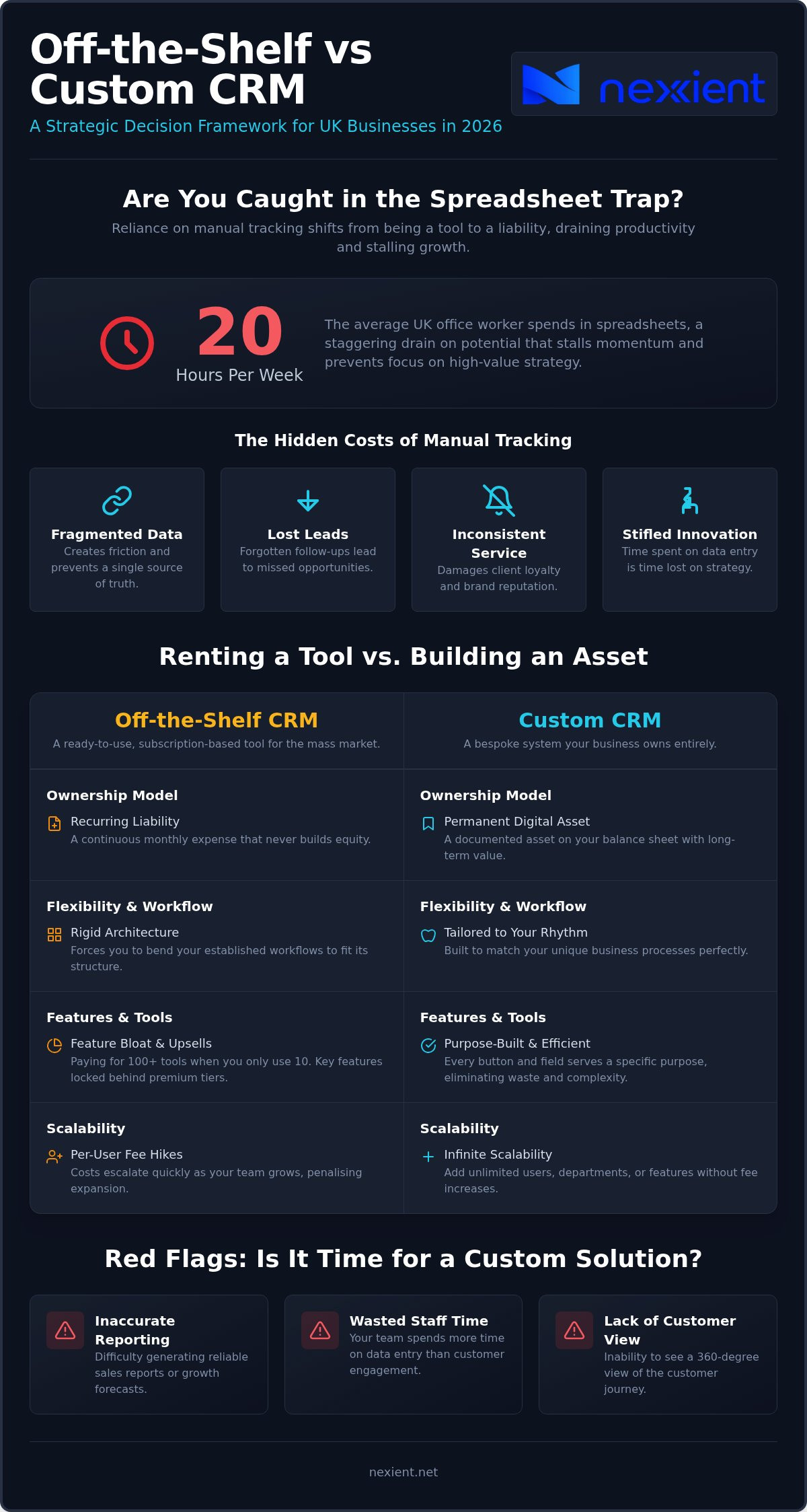
The Spreadsheet Trap occurs when your reliance on Excel or Google Sheets shifts from being a tool to a liability. Research indicates that the average office worker spends roughly 20 hours every week in spreadsheets, a staggering drain on potential that stalls momentum. Fragmented data creates friction. Lost leads, forgotten follow-ups, and inconsistent service are the hidden costs of manual tracking that prevent you from delivering a polished customer experience. A bespoke CRM is a strategic digital asset that organises business intelligence into a high-performance engine for your firm.
Signs You Have Outgrown Your Current System
Identify the friction points before they become failures. Difficulty in generating accurate sales reports or growth forecasts is a primary red flag that your current setup is failing. If your staff spend more time on data entry than on actual customer engagement, your system is broken. The inability to see a 360-degree view of a customer journey across the business prevents you from delivering the personalised service that 2026 buyers expect. When evaluating an off the shelf vs custom crm, these pain points often dictate the urgency of the transition.
The Move Toward Digital Maturity
Transitioning to a dedicated system represents a shift from reactive to proactive business management. Centralising communication ensures every team member stays on the same page, regardless of their role. This move allows you to automate routine tasks, focus on high-value strategy, and build deeper client loyalty. The decision between an off the shelf vs custom crm often marks the moment a business moves from surviving to thriving. For any Worcestershire firm aiming for scalable growth, investing in a custom system is a necessary step toward long-term digital maturity.
Off-the-Shelf vs Custom CRM: A Framework for Strategic Decision-Making
Choosing between an off the shelf vs custom crm is a fundamental choice between renting a generic space and building a permanent home. Off-the-shelf platforms are ready-to-use, subscription-based tools designed for the mass market. They offer speed but often lack deep flexibility. In contrast, custom solutions are bespoke systems that your business owns entirely. It’s a choice between a recurring monthly liability and a long-term digital asset. Whilst generic platforms offer a fast start, they often force you to bend your established workflows to fit their rigid architecture.
Analysing the total cost of ownership over a five-year period reveals the true financial impact of this decision. Subscription fees for a growing team can escalate quickly, especially when essential features are locked behind premium tiers. You also face the burden of “Feature Bloat”, where you pay for a hundred complex tools whilst your team only actually uses ten. A bespoke system eliminates this waste. It’s built to match your unique business rhythm, ensuring every button and field serves a specific purpose. If you want to explore how a tailored hub could transform your operations, you might consider how custom systems provide a more precise fit than generic alternatives.
When Off-the-Shelf Makes Sense (and When It Does Not)
Generic platforms work well for startups with standard needs and limited budgets. However, they often struggle to support niche UK industries or charities with complex reporting requirements. Integration is another common hurdle. Connecting a “one-size-fits-all” CRM to existing eCommerce Websites often requires expensive third-party plugins or custom middleware. Many firms find that “cheap” entry-level tiers are a false economy, as the most vital automation tools are hidden behind expensive upgrades that significantly inflate the monthly bill.
The Bespoke Advantage: Ownership and Agility
Ownership is a powerful strategic benefit. When you build a custom system, it becomes a documented asset on your balance sheet rather than a monthly expense. This path allows for infinite scalability. You can add new users, departments, or features without worrying about per-user fee hikes. Bespoke software is designed using your specific terminology and processes, which significantly reduces the learning curve for your staff. It provides the agility to pivot your strategy instantly, ensuring your software evolves alongside your vision rather than holding it back.
The Design-First Approach: Why UI/UX Matters for CRM Adoption
Software is only as powerful as the people who use it. In the debate of off the shelf vs custom crm, usability is often the deciding factor in long-term success. We define UI (User Interface) as the visual elements your team interacts with, such as buttons, layouts, and menus. UX (User Experience) is the internal logic and journey that dictates how easy it is to complete a specific task. Clean design is not a luxury; it is a vital component of operational efficiency. When a system looks professional and behaves intuitively, it removes the mental fatigue associated with complex data management.
Staff morale relies on tools that empower rather than frustrate. As a Visionary Architect, Nexient balances creative design with methodical building to ensure your software feels like a natural extension of your team. A polished interface signals that you value your employees’ time and effort. When software feels clunky, staff often revert to manual workarounds that compromise your data integrity. By prioritising a design-first approach, you transform your CRM from a chore into a tool that your team actually enjoys using daily.
Reducing Friction in the Daily Workflow
Design drives speed. A well-designed dashboard can save each employee several minutes on every task, which quickly adds up to hours of reclaimed productivity every week. We focus on logical flow, which means placing your most used features exactly where staff expect to find them. This reduces the cognitive load required to navigate the system. Bespoke systems feel more natural to use than generic platforms because they lack the confusing navigation and irrelevant menus that typically clutter “one-size-fits-all” solutions.
Ensuring High Adoption Rates Across Your Team
Adoption is the ultimate metric of software success. We use wireframing and prototyping to create visual blueprints of your system before a single line of code is written. This collaborative process ensures the final product meets the actual needs of your staff. Custom systems allow us to simplify the interface for different user roles. A sales representative sees a different, streamlined view compared to an administrator. Applying the same high standards found in Professional Brochure Websites to internal software ensures your business tools are as elegant and effective as your public-facing brand.
Building Your Asset: The Custom CRM Development Lifecycle
Transforming a broad vision into a functional reality requires a methodical, disciplined approach. Unlike the instant but rigid setup of generic tools, building a bespoke system involves a deep audit of your current business processes and pain points. This ensures the final product isn’t just a piece of software, but a high-performance engine for growth. Our Practical Strategy keeps development aligned with your commercial goals, ensuring that every feature serves a specific purpose. When weighing up off the shelf vs custom crm, the true value lies in this rigorous, tailored foundation that prioritises your long-term stability.
Discovery, Strategy, and Workflow Mapping
The first step is identifying the “golden thread” of data that runs through your organisation. We conduct a collaborative discovery phase to define the key performance indicators (KPIs) your system must track. These KPIs are the specific metrics, such as lead conversion rates or average response times, that measure your success. This strategic foundation is essential for all Data-Driven Web Applications. By mapping your workflows before writing code, we ensure the software fits your business rhythm perfectly. This phase eliminates guesswork and sets a clear trajectory for the entire build.
Development, Integration, and Secure Migration
During the technical phase, we build a robust database architecture and connect essential APIs. An API (Application Programming Interface) is a set of rules that allows different software programmes to communicate and share data with each other. Securely migrating years of spreadsheet data is a priority. We move your records into a structured system without loss or corruption, ensuring total data integrity. Integrating your CRM directly with your Landing Pages allows for automated lead capture, ensuring no enquiry ever slips through the cracks. This level of synergy is rarely possible with generic, restrictive platforms.
Deployment and Ongoing Evolution
The “Go-Live” phase is just the beginning of your journey. Rigorous testing ensures system stability before your team starts using the tool daily. Bespoke software is never truly finished because it evolves as your Worcestershire business expands. Working with a local partner provides the peace of mind that comes with accessible, UK-based technical support. You gain a partner that understands your market and responds quickly to your needs. If you’re ready to build a tool that grows with you, explore our Custom CRM Systems to start your digital transformation today.
Scaling with Confidence: Why a Local UK Development Partner is Essential
Context is the catalyst for successful software. Whilst global providers offer scale, they often lack the nuanced understanding of the UK market, regulatory environment, and business culture. Partnering with a local agency ensures your system is built with full GDPR compliance from the start. GDPR, or the General Data Protection Regulation, is the essential legal framework that governs how personal data is collected and processed in the UK. When you weigh up an off the shelf vs custom crm, a local partner provides the strategic proximity needed for deeper collaboration. This ensures your software isn’t just a generic tool; it’s the engine that powers your internal efficiency and online presence.
Nexient combines modern professionalism with a results-oriented confidence to deliver tangible growth for our collaborators. We believe that your CRM should be a high-performance asset that reflects your specific vision. By working with a UK-based team, you gain a partner that is dedicated, energetic, and deeply invested in your success. This relationship allows us to move quickly from high-level concepts to practical benefits, ensuring your digital landscape is sophisticated and easy to navigate. A local partnership transforms the development process from a distant transaction into a methodical, collaborative journey.
Personal Collaboration vs. Global Templates
Building great software requires a Visionary Architect you can actually meet and talk to. This personal connection leads to better outcomes because we can observe your business rhythm firsthand. We understand the specific needs of Worcestershire charities and firms, allowing us to tailor your system to the local economic landscape. This collaborative approach ensures that your CRM works in perfect harmony with your broader digital strategy. For example, understanding how Bespoke Web Design integrates with your internal systems is vital for creating a seamless flow of data from your public site to your private hub.
The Logical Conclusion: Building for the Future
The time has come to stop renting your business infrastructure and start owning your digital future. Every monthly subscription fee for a generic platform is a missed opportunity to build equity in your own company. By choosing a bespoke path, you invest in a scalable, powerful, and precise tool that belongs entirely to you. We encourage you to view Custom CRM Systems as the foundation for your 2026 growth and beyond. When you decide between an off the shelf vs custom crm, choose the path that offers full ownership and infinite potential. Nexient is here to help you accelerate growth by enhancing your online presence through smart development and practical strategy.
Architecting Your Digital Future
Choosing between an off the shelf vs custom crm is ultimately a decision about long-term ownership and operational efficiency. You now understand that bespoke systems eliminate the friction of generic feature bloat whilst ensuring your data remains a high-performance asset. By prioritising clean design and a methodical development lifecycle, you create a tool that your staff will actually enjoy using daily. This transition marks the moment your business moves from reactive tracking to proactive, strategic management.
Based in Worcestershire, Nexient is a dedicated team of specialists in data-driven web applications. We focus on a practical strategy to help you realise your vision and accelerate growth. Our approach balances creative innovation with grounded reliability, ensuring your software is a permanent asset rather than a monthly liability. Don’t settle for a restrictive subscription that stalls your momentum or clunky interfaces that frustrate your team. Take the next step toward operational excellence and start building your bespoke CRM system with Nexient today. Let’s build a foundation that supports your ambition and drives your business forward with confidence.
Frequently Asked Questions
What exactly is bespoke CRM software development?
Bespoke CRM software development is the methodical process of engineering a tailored digital environment designed to manage your unique customer relationships and data. Unlike rigid platforms, these systems are built from the ground up to mirror your specific business rhythm and terminology. We focus on delivering functional tools that eliminate the friction of generic software. It transforms your customer management from a standard administrative task into a high-performance engine for growth and internal efficiency.
How much does it cost to build a custom CRM in the UK?
The investment for a custom system varies significantly based on the complexity of your workflows and the depth of required integrations. Whilst off-the-shelf platforms charge per-user monthly fees that escalate as you scale, a bespoke build is a project-based investment that creates a permanent company asset. This approach eliminates recurring subscription liabilities. Most Worcestershire firms find that the long-term value of ownership far outweighs the initial development fees when compared to the total cost of generic subscriptions.
How long does the CRM development process typically take?
A typical development lifecycle spans several months, moving through distinct phases of discovery, design, and engineering. We start with a deep audit of your current processes to ensure the strategy remains practical and results-oriented. The timeline depends on the number of custom features and the complexity of your data architecture. By following a structured roadmap, we ensure the final product is stable, secure, and perfectly aligned with your commercial goals for 2026 and beyond.
Can a bespoke CRM integrate with my existing eCommerce website?
Yes, seamless integration is one of the primary advantages of building a bespoke system. We specialise in connecting custom hubs with existing eCommerce websites to ensure data flows naturally between your sales platform and your internal management tools. This synergy allows for automated order tracking, customer profiling, and inventory management. It removes the need for manual data entry and provides a unified view of your customer journey across all digital touchpoints.
Is a custom CRM more secure than an off-the-shelf solution?
Custom systems provide a high level of security because they are built with a privacy-first architecture tailored to your specific needs. Unlike mass-market platforms that are frequent targets for generic attacks, a bespoke system has a smaller footprint and dedicated security layers. We ensure full compliance with UK GDPR requirements, protecting your sensitive business intelligence. This controlled environment gives you total authority over your data access levels and storage protocols without relying on third-party security settings.
Will my team need extensive training to use a bespoke system?
Training requirements are usually minimal because the system is designed to match your team’s existing workflow. When deciding between an off the shelf vs custom crm, adoption is often higher with bespoke builds due to clean design and intuitive user interfaces. We remove the confusing menus and irrelevant features found in generic software. Because the tool uses your own business terminology and logic, it feels natural to use from the first day of deployment.
What happens to my old spreadsheet data during the transition?
We perform a secure migration to move your records from spreadsheets into your new structured database. This process involves cleaning, mapping, and validating your existing information to ensure total data integrity. We identify the “golden thread” of data within your organisation to ensure no lead or contact history is lost during the transition. This methodical approach turns your fragmented spreadsheets into a professional, searchable, and highly functional business asset.
Can a custom CRM be accessed on mobile devices whilst out of the office?
Yes, our custom systems are built as responsive web applications that you can access on any device with an internet connection. Whilst we don’t sell native mobile apps, our browser-based solutions are optimised for smartphones and tablets. This allows your team to view customer records, update lead status, or generate reports whilst working remotely or visiting clients across Worcestershire. You gain the flexibility of mobile access without the complexity of managing multiple platform-specific applications.