
What if the right first step with AI isn’t choosing a tool, but identifying a business task it could improve? For Worcestershire firms considering a custom web app, it can be hard to tell whether a task needs AI or straightforward automation. It’s also important to check whether the results can be reviewed and whether your data and existing systems are suitable.
This article explains what AI may support in a business web app, where its limits matter and how to assess a use case before committing to development. You’ll learn how to define a practical task, consider data and integration needs, and prepare useful questions for a development partner. The aim is to make a sound business decision, not add AI for its own sake.
Key Takeaways
- Define the business task and who needs support before deciding whether AI is the right fit.
- Check whether your data is suitable, then set clear review steps and a way to measure whether the result is useful.
- Compare the potential value with a simpler workflow improvement to avoid unnecessary complexity.
- Plan discovery, workflow mapping and testing with intended users before development. A tailored web application may suit needs that standard tools don’t address.
What AI means for a business web application
In a business web application, AI is software designed to carry out tasks that usually involve human judgement, such as recognising patterns or interpreting written requests. It’s a broad category, not one single tool. Machine learning, for example, identifies patterns in examples, while generative tools can create draft text from a prompt. Each approach suits different tasks, and neither is automatically the right choice.
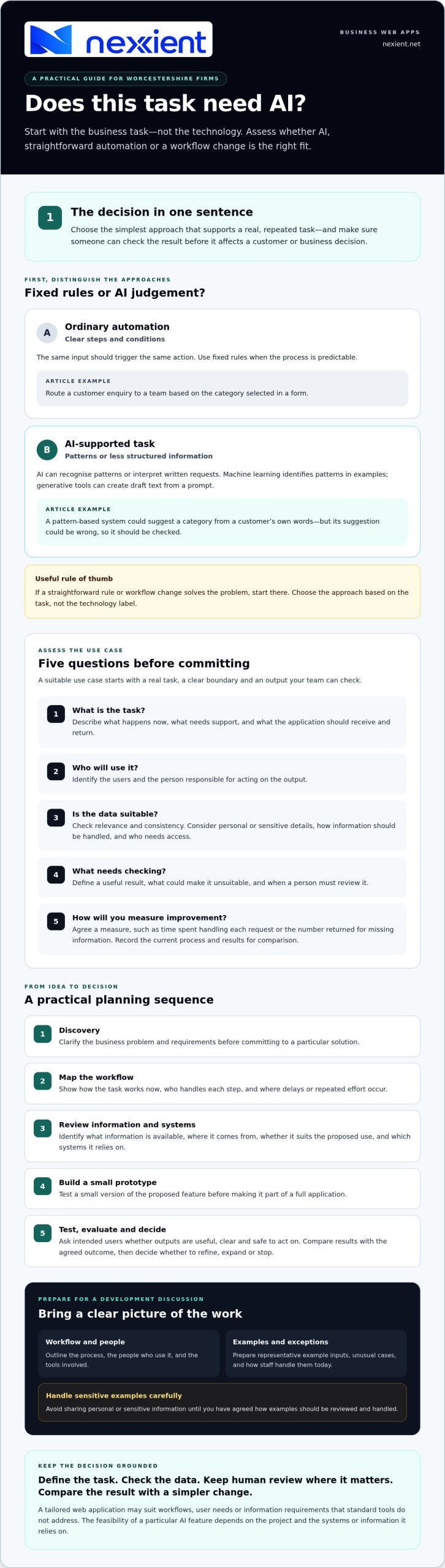
Start with the work itself. If a process follows clear steps and conditions, fixed-rule automation may be simpler and more predictable. For example, an application can route a customer enquiry to a team based on the category selected in a form. That’s ordinary automation. If customers describe their needs in their own words, a pattern-based system might suggest a category from the message, but the suggestion could be wrong and should be checked.
How does it differ from ordinary automation?
With fixed instructions, the same input should trigger the same action. A pattern-based system uses examples to make a judgement about less structured information, rather than following only a set route. A person should check uncertain or important outputs before they affect a customer or business decision. The Intelligent Process Automation overview explains how these approaches can be combined with automation.
Before adding a feature, write down the task, the result you expect and who will review it. If a straightforward rule can solve the problem, start there. Where a workflow needs a tailored interface or connects information in a specific way, a data-driven web application may be worth exploring. Choose the approach based on the task, not the technology label.
Assessing AI use cases for your web app
A suitable AI use case starts with a real, repeated task, not a technology trend. Look for work with a clear boundary and an output your team can check. For example, a system might flag routine maintenance requests that are missing details before a staff member responds. Assess the idea in practical steps:
- Define the task: Describe what happens now and which part needs support. Be precise about what the application should receive and what it should return.
- Identify the users: Establish who will use the feature and who is responsible for acting on its output.
- Review the data: Check whether the information is relevant, consistent and suitable for the intended use. Consider whether it contains personal or sensitive details, and how access and handling should be assessed.
- Set checks: Decide what a useful result looks like, what could make it unsuitable and when a person must review it.
- Choose a measure: Agree how you’ll judge improvement, such as time spent handling each request or the number returned for missing information.
Which business task is suitable for AI?
Choose a task that happens often enough to assess and where a person can verify the result before it affects a customer or business decision. Define success clearly: are you aiming for fewer follow-up messages, faster handling or more complete records? Record the current process and results first, so your team has a meaningful point of comparison.
AI can add complexity, including extra data checks and review steps. Compare its likely value with a simpler workflow change, such as clearer forms or fixed routing rules. If the simpler option addresses the problem, start there. If you’re weighing up a tailored application, discuss your requirements with Nexient before deciding whether AI belongs in the solution.
Planning an AI-enabled web app for your Worcestershire business
A sound plan moves from business need to practical testing, with a decision point at each stage. Discovery clarifies the problem and requirements before you commit to a particular solution. Then:
- Map the workflow: Show how the task works now, who does each step and where delays or repeated effort occur.
- Review the data: Identify what information is available, where it comes from and whether it’s appropriate for the proposed use. Consider how it should be handled and who needs access.
- Build a prototype: Test a small version of the proposed feature before making it part of a full application.
- Test with people: Ask intended users to check whether outputs are useful, clear and safe to act on. Keep a person involved where errors could have consequences.
- Evaluate: Compare results with the outcome agreed during discovery, then decide whether to refine, expand or stop.
A tailored application may be relevant if the workflow, user experience or information needs don’t fit existing tools. Nexient works with businesses in Worcestershire and develops data-driven web applications and custom CRM systems. These services provide a starting point for discussing requirements, but the feasibility of a particular AI feature depends on the project and the systems or information it relies on.
What should you prepare before discussing an AI feature?
Bring a clear outline of the workflow, the people who use it, the tools involved, representative example inputs and the outcome you want. Note unusual cases and how staff handle them today. Avoid sharing personal or sensitive information until you’ve agreed how examples should be reviewed and handled. A development partner can then help assess feasibility and whether a simpler change would meet the need.
Turn a clear use case into a practical plan
A strong web app begins with a defined business need, not a technology choice. Identify the task, the people it affects and the outcome you want to improve. Then review whether your data is suitable, how results will be checked and whether a simpler workflow change could achieve the same goal. These steps help you decide where AI may add value and where it could create unnecessary complexity.
If your requirements call for a tailored workflow or interface, Nexient develops data-driven web applications and custom CRM systems for businesses in Worcestershire. Start by outlining the process, users and desired outcome, then discuss your web application requirements with Nexient. A clear brief and practical evaluation plan give you a useful basis for deciding what to do next.
Frequently Asked Questions
What is AI in a business web application?
AI in a business web application is software that supports tasks involving judgement, such as identifying patterns or interpreting written information. For example, it might suggest a category for a customer enquiry based on its wording. Treat the result as a suggestion to assess, not automatically as a reliable decision. Start by defining the task and who will check the output.
Is AI the same as automation?
No, AI and automation are related but different. Automation follows set instructions, such as sending a form to a team based on a selected option. AI can assess patterns in less structured information, such as the words in a message, to suggest where it should go. Because that suggestion may be unsuitable, decide when a person must review it.
Can AI be added to an existing web application?
It may be possible, but feasibility depends on the application, the task and how information moves through the system. A development partner should review the current app, its tools and the intended feature before recommending an approach. For Worcestershire businesses, Nexient develops data-driven web applications and custom CRM systems, but each project needs its own assessment.
What data does a business need before using AI?
There’s no single data requirement for every use case. Start by identifying the information needed for the task, where it comes from and whether it’s accurate, consistent and relevant. Prepare representative examples, including unusual cases, and consider whether they contain personal or sensitive details. Agree how information will be handled and how staff will check outputs before use.