The most popular choice for your business operations might actually be the one holding you back. Whilst the giants of the Software as a Service (SaaS) world promise a quick fix, many UK companies find themselves trapped in a cycle of paying for complex features they never touch. If you’re wrestling with fragmented data across spreadsheets or workflows that simply don’t match your daily reality, it’s time to reconsider your approach to custom crm software. Choosing a platform shouldn’t mean compromising your internal culture or settling for a rigid, one-size-fits-all framework that ignores your specific goals.
You likely already feel the frustration of a system that forces your team to work around the software, rather than the software working for the team. We agree that technology should be an invisible engine for growth, not a source of friction or rising monthly overheads. This article will help you discover whether you should customise an existing platform or invest in building a bespoke CRM system to achieve true operational efficiency. We’ll preview the shifting landscape of 2026, comparing total ownership costs and showing you how to reclaim visibility over your data for better decision-making.
Key Takeaways
- Identify when your business has hit the “SaaS ceiling” by recognising the frustration of paying for unused features and rigid workflows.
- Learn the functional differences between modifying a standard platform and developing custom crm software designed specifically for your internal processes.
- Compare the five-year total cost of ownership to determine if high subscription fees are more expensive than a one-off bespoke build.
- Use our practical framework to audit your “deal-breaker” requirements and calculate the true cost of your current software limitations.
- Discover how strategic planning and clean design can turn a fragmented data system into a high-performance tool for better decision-making.
The CRM Dilemma: Why “Off-the-Shelf” Often Fails Growing UK Businesses
Many UK businesses reach a point where their standard software stops being a tool and starts being a hurdle. This is the “SaaS Ceiling”. It’s the moment when the rigid architecture of a mass-market platform clashes with the fluid, unique reality of your operations. Whilst Customer Relationship Management (CRM) began as a way to simply track leads, it has evolved into the central nervous system of modern companies. However, when that nervous system is built for everyone, it often fits no one perfectly. The UK CRM market is valued at £2.9 billion in 2026, yet a significant portion of that investment is wasted on software that hinders rather than helps. Rigid systems stifle innovation by forcing you to adapt your successful processes to fit their code, rather than the other way around.
The Hidden Costs of SaaS Subscriptions
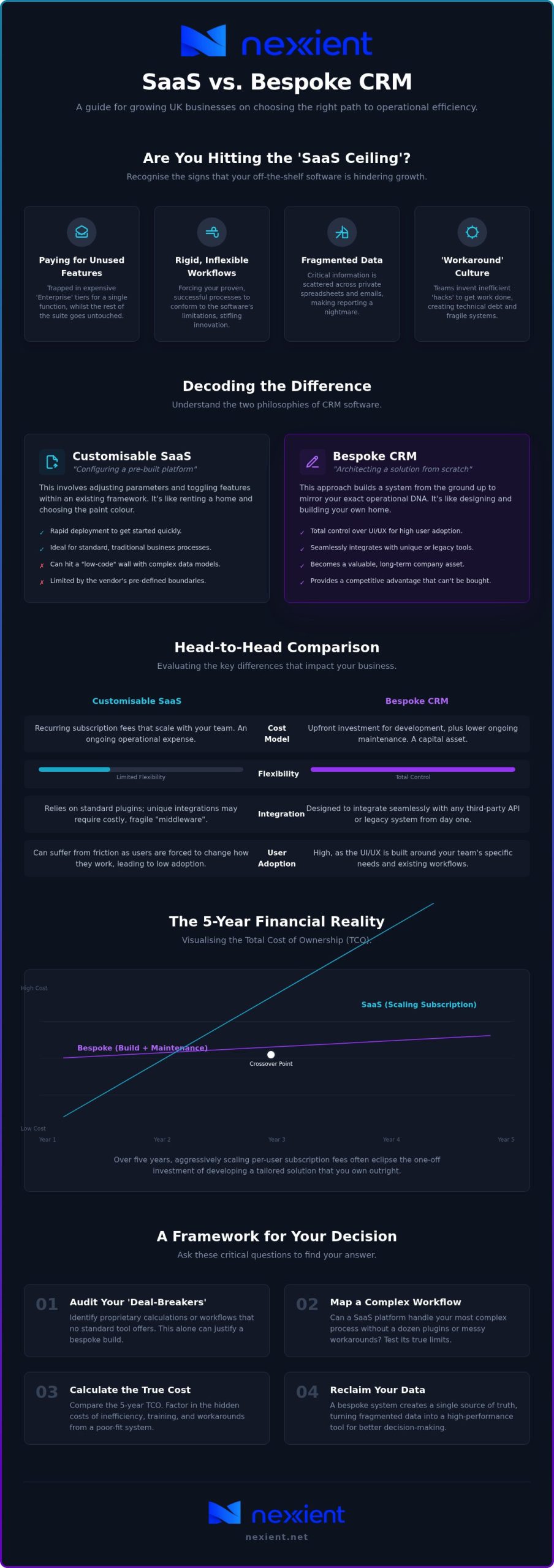
The financial model of SaaS is designed for the vendor’s growth, not necessarily yours. Per-user, per-month pricing seems manageable at first, but as your team expands, the cumulative cost scales aggressively. You often find your business forced into “Enterprise” tiers just to unlock a single essential feature or integration. This “feature-gating” means you’re paying for a massive suite of tools that your team never touches, just to access the one thing you actually need. Subscription fatigue is the growing exhaustion business owners feel when managing a bloated stack of monthly recurring costs that provide diminishing returns. Over five years, these incremental fees often eclipse the cost of developing a tailored solution that you actually own.
Workflow Friction and the “Workaround” Culture
When a system is too rigid, your employees will naturally find the path of least resistance. This usually leads to a “workaround” culture where critical data lives in private spreadsheets, sticky notes, or disparate email threads. This fragmented data makes internal reporting a nightmare and leaves your customer service team flying blind. Bending a SaaS platform to fit your behaviour often involves messy “hacks” that create technical debt, making the system fragile and difficult to update. This is why many organisations are now looking toward custom crm software to regain control. A bespoke solution ensures your digital tools mirror your exact internal processes, rather than forcing you to organise your business around a generic template. It’s about precision, performance, and partnership.
Decoding the Difference: Customisable vs. Bespoke CRM Software
Understanding the terminology is the first step toward clarity. Many businesses use the terms interchangeably, but they represent two fundamentally different philosophies of digital craftsmanship. A customisable CRM refers to a pre-built platform where you adjust parameters, toggle features, and use drag-and-drop interfaces to align the tool with your needs. It is a mindset of “configuring” within existing boundaries. You are essentially renting a room and choosing the paint colour.
In contrast, bespoke custom crm software is a system built from the ground up. This approach is about “architecting” a solution that mirrors your exact operational DNA. Instead of asking what the software can do, you define what the business needs to achieve. Choosing between these paths requires a clear look at your five-year plan. Are you looking for a temporary bridge or a permanent foundation for growth? You should evaluate your unique data requirements before committing to a long-term contract.
Start by identifying your “Deal Breakers”. If your business relies on a proprietary calculation or a specific way of handling client files that no standard tool offers, you’ve already found your answer. Acknowledge that whilst SaaS offers speed, bespoke development offers a competitive advantage that cannot be bought off a shelf. This decision will define how your team interacts with their work for years to come.
When Customisable SaaS Makes Sense
Standard SaaS platforms are often the right choice for early-stage startups or businesses with zero existing infrastructure. If your sales process follows a traditional path, rapid deployment is a significant advantage. These platforms allow you to start tracking leads within hours. However, a “low-code” approach often hits a wall when you deal with complex, proprietary data models. To avoid this, map your most complex workflow and test if the SaaS platform can handle it without a dozen plugins.
The Power of Bespoke CRM Development
Bespoke development offers total control over the user interface and user experience (UI/UX). This ensures the tool feels intuitive to your specific team, reducing training time and boosting adoption. Unlike off-the-shelf products, a custom system integrates seamlessly with your legacy tools or unique third-party APIs without requiring expensive “middleware” hacks. Bespoke software is a high-performance business asset that builds equity in your company rather than a perpetual monthly expense paid to a third-party vendor. By building a custom system, you ensure that every button, field, and report serves a specific purpose.
The Head-to-Head Comparison: Efficiency, Cost, and Control
Direct comparisons between software models often focus solely on the initial invoice. This is a strategic mistake. Whilst a SaaS platform might appear affordable on day one, the five-year total cost of ownership (TCO) tells a different story. If you’re paying for 50 users on a premium tier at $150 per month, your annual spend is already substantial before you’ve added a single custom field. With custom crm software, your capital expenditure is front-loaded, but the tail-end costs drop dramatically once the system is live. This shift from an ongoing liability to a fixed asset changes the financial health of your digital department.
Control extends beyond the balance sheet. When you rely on a third-party provider, you are at the mercy of their update schedule, their price hikes, and their feature deprecations. A bespoke build allows you to pivot your features as your business model evolves, ensuring your tools never become obsolete. If your team discovers a more efficient way to process a lead, you can update the software to match that behaviour immediately. This flexibility ensures that your technology remains an accelerator for growth rather than a rigid cage.
Comparing Long-Term ROI and Ownership
Bespoke systems often pay for themselves by eliminating the “per-user” tax that punishes successful growth. When you invest in your own platform, you are building intellectual property (IP) that adds tangible value to your business valuation. Beyond the financial ROI, there is a human element to consider. Bespoke systems reduce training time by mirroring your established internal processes. Instead of teaching your staff a new language to suit a software vendor, the software speaks your language from the first click. To evaluate your potential ROI, perform these steps:
- Project your headcount for the next five years and calculate the total SaaS subscription cost.
- Audit the time spent by staff manually moving data between “unfriendly” systems.
- Assess the market value of owning a proprietary tool that your competitors cannot buy.
Data Sovereignty and Security for UK Firms
Data sovereignty is a critical pillar for UK firms operating under strict GDPR requirements. By choosing custom crm software, you gain the power to decide exactly where your data is hosted, such as on secure, UK-based servers. This eliminates the legal grey areas often associated with international SaaS providers who may move data across borders without your direct oversight. A unique, non-standard system architecture also offers a security advantage by reducing your “attack surface”. Hackers often target the common vulnerabilities found in mass-market platforms; a bespoke system is a much less predictable target. You can design specific data handling and storage protocols that align perfectly with your compliance needs, ensuring your client information remains both accessible and impenetrable.
Choosing Your Path: A Practical Framework for Selection
Transitioning from a standard platform to custom crm software is a strategic move that requires a structured evaluation. You shouldn’t jump into development without a clear roadmap. To decide whether your business is ready for a bespoke build, follow this five-step framework designed to uncover your true operational needs.
- Step 1: Audit your “Deal Breaker” requirements. Identify the specific functions that your current SaaS platform simply cannot execute without extensive, messy workarounds. If these gaps affect your core service delivery, they are deal breakers.
- Step 2: Calculate your current “SaaS Tax”. Add up every monthly subscription, plugin fee, and the cost of “seat” upgrades over the next three years. Compare this to the long-term value of an asset you own.
- Step 3: Evaluate the complexity of your existing third-party integrations. Assess how much time your team spends manually moving data between tools that don’t talk to each other.
- Step 4: Assess your internal capacity for collaboration. Building a bespoke system is a partnership. Ensure your team has the time to provide feedback on workflows and design during the build process.
- Step 5: Consult with a specialist agency. A professional partner can help you map out a technical roadmap that balances immediate needs with future scalability.
By following these steps, you move from a position of frustration to one of strategic clarity. You stop asking what the software allows you to do and start defining what your business needs to achieve.
Assessing Your Unique Business Processes
Identify the workflows that represent your competitive advantage. If your business has a unique way of scoring leads or managing project lifecycles, that’s your secret sauce. Standardising these processes to fit a rigid SaaS tool is a strategic mistake that dilutes your value proposition. Custom crm software allows you to automate repetitive, industry-specific tasks that off-the-shelf tools ignore. By building around your strengths, you ensure your technology supports your strategy rather than dictating it.
Integration Requirements and Legacy Data
A major hurdle for growing firms is the difficulty of syncing SaaS with existing web applications or legacy databases. Fragmented data leads to errors and missed opportunities. Achieving a unified “Single Source of Truth” is essential for accurate reporting and decision-making. Often, data-driven applications bridge the gap between disparate tools, creating a cohesive ecosystem. If you are ready to stop fighting your software and start scaling your vision, it is time to explore custom systems tailored to your business.
Designing Your Vision: Custom CRM Systems with Nexient
Nexient serves as a dedicated partner for UK businesses ready to transcend the limitations of generic platforms. We don’t just build tools; we architect solutions that empower your team, simplify your workflows, and accelerate your growth. Based in Worcestershire, our team combines local insight with high-level digital craftsmanship to deliver custom crm software that feels like a natural extension of your brand. We focus on clean design, smart development, and practical strategy to ensure your investment translates into tangible business results. Working with a local development team means you gain a partner who understands the UK market and is available for face-to-face collaboration when it matters most.
Our Collaborative Development Process
Building a custom system requires a methodical yet creative approach. Our process moves quickly from high-level concepts to tangible benefits, starting with strategic planning to understand your “why” before moving into UI/UX design. We prioritise clarity, efficiency, and aesthetic quality to ensure the front-end development isn’t just visually striking but functionally superior. Transparency is at the heart of our partnership, which is why we utilise milestone-based fees. This structure provides you with full project control and ensures that every phase delivers immediate operational value. To prepare for this collaboration, you should define your primary operational bottleneck, audit your current software spend, and gather feedback from your core team regarding their daily frustrations.
From Data-Driven Apps to Unified Systems
We specialise in transforming complex business challenges into elegant digital solutions. Whether you need a streamlined interface or a complex data-driven web application, we focus on the synergy between your public website, your customer portal, and your internal CRM. This unified approach eliminates data silos and creates a seamless flow of information across your entire organisation. For a broader look at how tailored technology drives success, you can explore our guide on bespoke web design. Our systems are built to scale alongside your ambitions, ensuring that the software you invest in today remains a powerful asset as your business evolves. We are here to help you navigate the digital landscape with ease, sophistication, and a clear focus on the future.
Architecting Your Digital Future
Choosing the right path for your operations is more than a technical decision; it’s a strategic investment in your long-term growth. Whilst SaaS platforms offer a quick start, they often lead to a ceiling of rigid workflows and rising monthly overheads. By opting for custom crm software, you reclaim control over your data and build a high-performance asset that mirrors your exact internal processes. This transition eliminates the “subscription tax” and replaces it with a system designed for pure operational efficiency. Our Worcestershire-based team provides local UK support and development, ensuring your vision is translated into a scalable reality through transparent, milestone-based fees.
Are you ready to move beyond generic templates and empower your team with tools built for their success? Discuss your custom CRM requirements with our Worcestershire team and discover how a bespoke build can transform your decision-making. We’re here to help you navigate this transition with confidence and precision. Your journey toward true digital craftsmanship starts with a single conversation.
Frequently Asked Questions
Is a custom CRM better than Salesforce or HubSpot for a small business?
Whether custom crm software is better depends entirely on your operational complexity. Whilst standard platforms like Salesforce or HubSpot are excellent for generic sales processes, they often force you into expensive enterprise tiers to unlock specific features. If your Worcestershire business has unique workflows that these tools cannot support without messy workarounds, a bespoke build provides a cleaner, more efficient foundation that you actually own.
How much does it cost to build a bespoke CRM system in the UK?
Investment levels vary significantly based on the complexity of your data models and the number of integrations required. Nexient provides transparency through fixed-price or milestone-based fees, ensuring you maintain full project control without hidden costs. Whilst the initial capital expenditure is higher than a monthly subscription, the five-year total cost of ownership is often lower because you eliminate the perpetual “per-user” tax common with SaaS vendors.
How long does the custom CRM development process typically take?
A typical development cycle moves through strategic planning, UI/UX design, and front-end engineering over several months. Smaller, highly focused systems can be delivered faster, whilst complex data-driven applications require a more methodical approach to ensure every feature delivers operational value. We prioritise a collaborative rhythm that keeps you informed at every milestone, ensuring the final tool aligns perfectly with your growth ambitions and internal culture.
Can a bespoke CRM integrate with my existing website and accounting software?
Seamless integration is one of the primary benefits of choosing a bespoke approach. We design our systems to talk directly to your existing website, customer portals, and UK-specific accounting tools through secure APIs. This creates a unified “Single Source of Truth” for your data, eliminating the need for manual data entry and reducing the errors associated with fragmented spreadsheets across your Worcestershire office.
What happens if we need to add new features to our custom CRM later?
Bespoke systems are built with scalability and future-proofing in mind. Because you own the intellectual property, you have the total freedom to pivot, expand, or refine your features as your business model evolves. You aren’t restricted by a vendor’s roadmap or limited by a rigid plugin ecosystem. We act as your long-term partner, helping you architect new functionality that responds to real-world market changes.
Is bespoke software more secure than off-the-shelf SaaS solutions?
A bespoke build offers a unique security profile by reducing your “attack surface”. Mass-market SaaS platforms are frequent targets for hackers because a single vulnerability can expose thousands of businesses. In contrast, custom crm software uses a non-standard architecture that is far less predictable. You also gain complete data sovereignty, allowing you to choose secure, UK-based hosting that aligns perfectly with your specific GDPR compliance requirements.
Do I need a technical team to manage a custom CRM built by Nexient?
You don’t need an internal IT department to manage your bespoke system. We focus on digital craftsmanship that prioritises clean design and intuitive functionality, making the software easy for any team member to use. Nexient provides the necessary support and practical strategy to ensure your system performs effectively, allowing you to focus on running your business whilst we handle the technical stability of your platform.
Will our staff find it difficult to switch from a standard CRM to a bespoke build?
Staff usually find the transition to a bespoke system much easier than adapting to a standard tool. Because the software is architected to mirror their existing behaviours and workflows, it feels intuitive from the first click. This reduces training time and increases internal adoption rates. Instead of teaching your team a new language to suit a software vendor, the software is designed to speak your language.