Your CRM should be a strategic asset that fuels your momentum, not a monthly tax that penalises your success. As we move into 2026, the debate between a custom crm vs off the shelf solution has shifted from a simple cost comparison to a fundamental question of business sovereignty. You’ve likely felt the friction of rigid software, the drain of rising subscriptions, and the headache of fragmented data. It’s exhausting to pay for features you don’t use whilst lacking the specific tools you actually need to build, own, and scale.
This guide helps you decide whether to build or buy by weighing long-term value against immediate convenience. You’ll discover how a bespoke system can eliminate recurring fees, secure your data ownership, and mirror your exact workflows with precision. We’ll break down the latest 2026 market trends, compare development timelines, and provide a clear roadmap for choosing a platform that fits your vision. By the end, you’ll have a practical strategy to reclaim control of your digital infrastructure and drive measurable growth.
Key Takeaways
- Identify the hidden “per-user tax” in your current subscriptions and learn how to swap recurring overheads for a long-term digital asset.
- Evaluate the strategic trade-offs of a custom crm vs off the shelf platform using our 2026 framework to determine which model best supports your growth.
- Map your unique business processes to ensure your next system eliminates manual data entry and automates your existing workflows with precision.
- Secure your data sovereignty by choosing a system that gives you full ownership of your database and scales effortlessly as your volume increases.
Define, Design, and Deliver: The CRM Choice in 2026
Your CRM is the engine room of your business. It dictates how you connect, how you convert, and how you grow. In 2026, choosing between a custom crm vs off the shelf solution isn’t just a technical purchase; it’s a strategic decision that defines your operational ceiling. One path offers a pre-built template you must adapt to, whilst the other provides a tailored architecture designed to scale with your ambition.
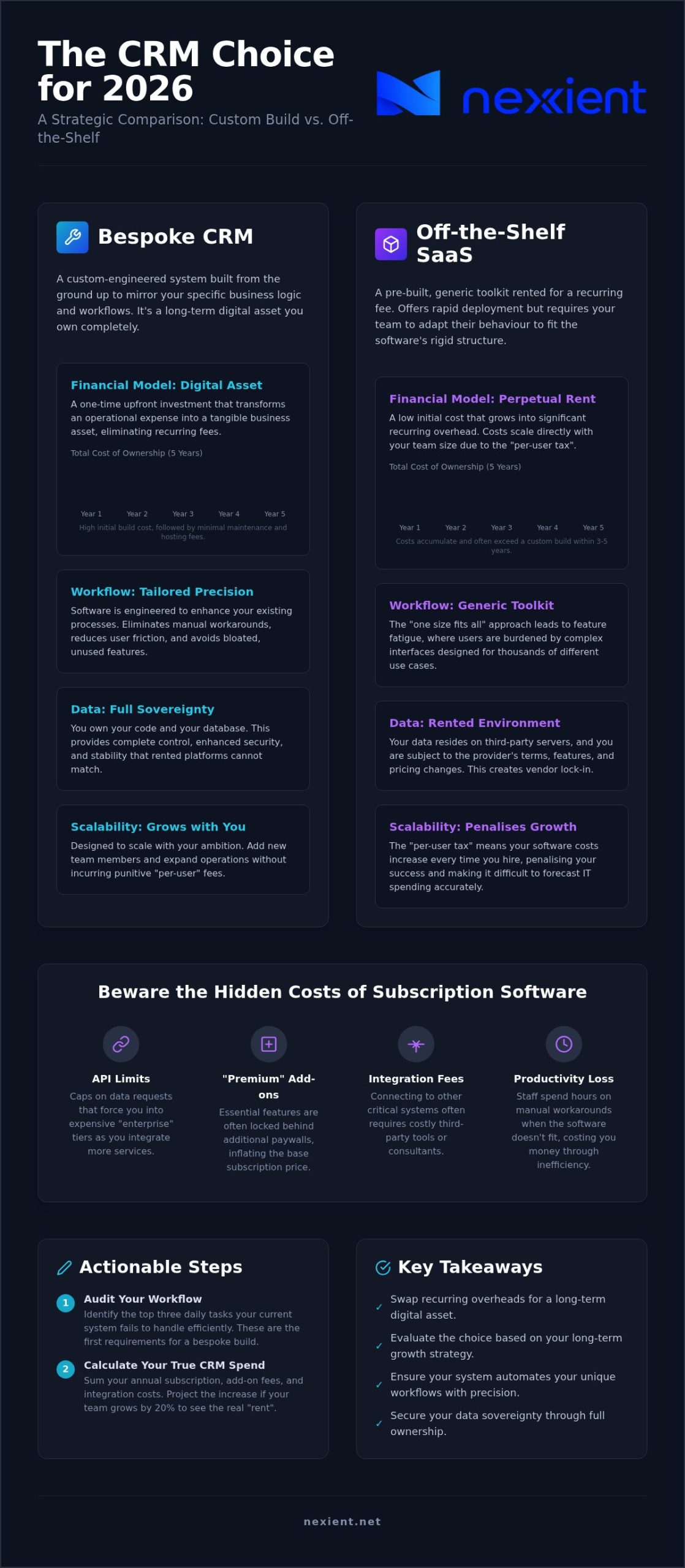
Off-the-shelf software, commonly known as SaaS (Software as a Service), provides a generic toolkit for a recurring monthly fee. It’s essentially a rented workspace where you use the same tools as your competitors. Conversely, a bespoke CRM is a custom system built from the ground up to mirror your specific business logic. Instead of forcing your team to change their behaviour to fit the software, the software is engineered to enhance your existing processes. This choice forms the foundation of your digital strategy, determining whether your technology acts as a catalyst or a constraint.
What is a Bespoke CRM System?
Digital craftsmanship prioritises purpose over presence. In a bespoke system, every button, dashboard, and automation exists because it adds value. We focus on clean, functional design that avoids the bloated interfaces found in generic platforms. This approach reduces user friction and ensures your team spends less time fighting the tool and more time driving results.
Owning your code transforms your software from an ongoing expense into a tangible business asset. You aren’t just paying for access; you’re building equity in your own infrastructure. This eliminates the uncertainty of subscription price hikes and ensures your data remains under your total control, providing a level of security and stability that rented platforms cannot match.
The Off-the-Shelf SaaS Model
SaaS platforms thrive on a “one size fits all” philosophy. Whilst they offer rapid deployment, they often suffer from feature fatigue. This is a state where users are burdened by complex interfaces designed for a thousand different industries. You pay for a vast library of tools, yet your team likely only uses a fraction of them.
Customising these platforms to fit niche workflows often requires expensive consultants or restrictive third-party plugins. You are effectively renting your digital environment. If the provider changes their terms, features, or pricing, your business must react to their roadmap rather than your own. This lack of flexibility can stifle innovation as your organisation grows.
Actionable Step: Audit your current workflow today. Identify the three core tasks your team performs daily that your current system fails to handle efficiently. If these tasks require manual workarounds or external spreadsheets, you’ve identified the first requirements for a bespoke build.
Cost, Capital, and Control: The Financial Comparison
Financial clarity is the cornerstone of any sound technology strategy. When evaluating a custom crm vs off the shelf solution, many leaders fall into the trap of comparing a single invoice against a monthly subscription. This surface-level view ignores the long-term reality of the “per-user tax”. Every time you hire a new team member, a subscription-based model penalises your growth by increasing your overheads. Over a five-year business cycle, these cumulative costs often dwarf the initial investment of a bespoke build.
Total Cost of Ownership (TCO) is the metric that truly matters. A ready-made system might feel accessible today, but it lacks the equity of a custom asset. When you invest in a custom system, you are diverting capital away from endless rent and towards a permanent business tool. You move from a model of perpetual debt to one of digital ownership. This shift allows you to forecast your IT spend with confidence, knowing that your software costs won’t spiral as your headcount increases.
Upfront Investment vs Recurring Fees
Bespoke development requires a larger initial budget because it involves deep discovery and precision engineering. You’re paying for a team to understand your business logic before they write a single line of code. However, consider the math: 30 users on a standard £100 per month SaaS plan costs £36,000 every single year. Within three years, you’ve spent over £100,000 on a platform you’ll never own. After the initial build of a custom CRM, your primary financial commitments are hosting and occasional maintenance, effectively capping your long-term spend.
The Hidden Costs of Subscription Software
SaaS providers often hide additional expenses in the fine print. You might encounter API limits, which are caps on how many times your software can request data from another service, forcing you into expensive “enterprise” tiers. These costs escalate quickly if you are synchronising complex sales data from eCommerce websites or niche databases. There is also the cost of “workarounds”. When your staff spends hours every week manually moving data because the software won’t cooperate, you are losing money through inefficiency. A custom build eliminates these friction points, ensuring your team stays focused on high-value tasks.
Actionable Step: Calculate your current annual CRM spend today. Include the base subscription, “premium” add-on fees, and the cost of third-party integration tools. If you’re planning to grow your team by 20% next year, add that projected “per-user” increase to the total. This figure represents the “rent” you could be converting into a permanent asset.
Flow, Function, and Flexibility: Aligning Your Workflows
Efficiency is born from alignment. When choosing between a custom crm vs off the shelf platform, the most significant impact is felt in your daily operations. Ready-made solutions are ‘feature-led’, meaning they provide a vast library of tools and expect your team to adapt their behaviour to fit the interface. This often results in software-induced friction where simple tasks require multiple clicks or complex workarounds. In contrast, bespoke development is ‘process-led’. It starts with your unique workflow and builds the technology around it, ensuring the system supports your team rather than slowing them down.
A clean user interface is the single most important factor for successful adoption. If a system is difficult to use, your team will revert to spreadsheets and manual notes. By stripping away the bloat of unnecessary features, we create a focused environment where every tool serves a specific purpose. This clarity reduces training time and minimises the risk of human error during data entry.
Adapting Software to Your Business, Not Vice Versa
Niche industries, such as charities or specialised manufacturing, often struggle with standard platforms. These sectors have unique data requirements that generic tools simply aren’t built to handle. By investing in custom systems, you start with your specific goals rather than a rigid template. We focus on organising complex data into intuitive dashboards that reflect your actual business logic. This approach ensures your software grows with you, allowing you to add new functionality as your services evolve without breaking the existing structure.
Integrating Your Entire Digital Ecosystem
Data silos occur when information is trapped in separate, disconnected tools. When comparing a custom crm vs off the shelf solution, consider how each handles external connections. A bespoke build acts as a single source of truth, synchronising data across your entire organisation. You can link your CRM directly to your brochure websites or high-converting landing pages for seamless lead capture. This connectivity ensures that when a prospect interacts with your brand, their details flow instantly into your sales pipeline without manual intervention. Leveraging data-driven web applications provides real-time business intelligence, allowing you to make decisions based on live evidence rather than outdated reports.
Actionable Step: Map your customer journey from the first touchpoint to final delivery. Highlight every ‘manual’ step, such as copy-pasting data between windows or sending internal emails to update a status. These manual gaps are the exact points where a bespoke system will provide the highest return on investment by automating the flow.
Scale, Security, and Stability: Future-Proofing Your Data
Building for the future requires a system that expands alongside your success. When debating a custom crm vs off the shelf solution, scalability is often misunderstood as merely adding more users. True scalability is the ability of your software to process an ever-increasing volume of data without degrading in performance. Rented platforms often struggle here; as your database grows, you might find your searches becoming sluggish or your monthly bill climbing into higher enterprise brackets simply because you’ve crossed a data threshold.
Data sovereignty is the ultimate security advantage. When you own your database, you decide exactly where that data lives and who can access it. There is a common myth that bespoke systems are less secure than global platforms, but the reality is often the opposite. Modern custom builds use the same high-level encryption standards as major banks. By removing the thousands of generic features you don’t use, you actually reduce the “attack surface,” which is the number of potential entry points for a security breach. If you’re concerned about data residency, our team can help you build a custom system that keeps your information secure and compliant.
Scalability without the Price Hike
Bespoke systems are often built on robust, modern frameworks like Laravel or Next.js. These are professional coding foundations that allow developers to create applications that remain fast and stable even with millions of records. Because you aren’t sharing a server with thousands of other companies, your system won’t slow down during peak hours. You can prioritise new features based on your actual business growth, ensuring your technology budget is always spent on high-impact improvements rather than generic updates.
Security and GDPR for UK Businesses
For firms based in Worcestershire and across the UK, data residency is a critical compliance issue. Many off-the-shelf providers host data in various jurisdictions, which can complicate your GDPR (General Data Protection Regulation) obligations. A bespoke build allows you to specify UK-based hosting, ensuring your customer information never leaves the country. This level of control helps you avoid “technical debt.” Technical debt is the future cost of choosing an easy, short-term solution now that will eventually need expensive repairs or a total replacement as your business evolves.
Actionable Step: Review your current CRM’s data export policy today. Check how difficult it is to retrieve your information in a clean, usable format if you decide to leave. If the provider makes it hard to access your own data, you are facing a vendor lock-in that could threaten your operational stability in the years to come.
Strategy, Synergy, and Success: The Nexient Advantage
Navigating the technical crossroads of 2026 requires more than just a software vendor; it demands a partner who understands your long-term vision. Deciding between a custom crm vs off the shelf solution is the first step, but the execution of that choice defines your success. At Nexient, we combine business strategy with digital craftsmanship to ensure your system isn’t just a database, but a growth lever. We don’t just build software; we engineer solutions that reflect your ambition and respect your unique workflows.
We position ourselves as your Visionary Architect, bridging the gap between high-level business goals and precise technical implementation. By focusing on the synergy between design and functionality, we create tools that empower your team and eliminate the friction of generic platforms. Our mission is to provide you with a digital environment that feels dedicated, energetic, and deeply invested in your specific outcomes.
Our Collaborative Development Process
Our approach moves you from a Creative Dreamer to a Methodical Builder. We start by listening to your specific needs, then move through a structured journey of planning, UI/UX design, and front-end development. We strip away the confusing jargon that often plagues the tech industry, ensuring you stay in total control of the project at every stage. Our focus remains on high-level performance and strategic thinking, creating a system that feels intuitive from the very first login. We prioritise clarity and efficiency, ensuring that every button and dashboard serves a tangible purpose in your daily operations.
Why Worcestershire Firms Choose Nexient
Working with a local agency in England offers a level of synergy that remote, faceless vendors cannot match. We understand the UK business landscape and the specific regulatory pressures local firms face in 2026. Our experience extends across various sectors, from local SMEs to charity websites, providing us with a broad perspective on what drives digital growth. We promise digital solutions that look sophisticated, perform effectively, and scale effortlessly as your data volume increases. By choosing a partner in Worcestershire, you benefit from clear communication, face-to-face collaboration, and a shared commitment to building a robust digital future for your organisation.
Actionable Step: Book a discovery call with our team today. We’ll review your current processes and help you determine if your vision aligns with a bespoke build or if a standard solution is the right starting point for your current stage of growth.
Build. Own. Scale: Architect Your Digital Future
Your choice in the custom crm vs off the shelf debate defines whether your technology acts as a rigid cage or a powerful catalyst. Prioritising ownership over high-priced rentals secures a digital asset that grows as you do. You’ve seen how bespoke systems eliminate the per-user tax, protect your data sovereignty, and align perfectly with your unique business logic. This isn’t just about efficiency; it’s about building a foundation that scales without compromise.
Nexient brings local Worcestershire expertise to every project, offering fixed-price milestones and clean, jargon-free communication. We bridge the gap between creative vision and methodical execution, ensuring your software performs as beautifully as it looks. Stop adapting your business to fit someone else’s tools. Orchestrate your business growth with a bespoke CRM from Nexient and take full control of your digital infrastructure today. Your vision deserves a platform that’s built to last.
Frequently Asked Questions
How much does custom CRM development cost compared to a subscription?
Custom CRM development involves a fixed-price investment for discovery and engineering, whereas subscriptions require perpetual monthly payments. Whilst off-the-shelf platforms seem cheaper initially, the cumulative “per-user tax” often makes them more expensive for growing Worcestershire firms over a five-year cycle. By choosing a bespoke build, you convert ongoing overheads into a permanent business asset. This eliminates the risk of sudden price hikes from global SaaS providers and provides better long-term financial stability.
How long does it take to build a bespoke CRM system from scratch?
The development timeline depends on your specific requirements and the complexity of your workflows. A basic system typically takes three to four months to build, whilst more complex enterprise-level platforms can take nine to twelve months. We follow a methodical approach from initial planning to final delivery, ensuring each milestone is met with precision. Starting with core features allows for a faster rollout, with additional functionality added through a planned, phased development strategy.
Can a custom CRM integrate with my existing website or accounting software?
Yes, a bespoke system is designed to act as a single source of truth for your entire digital ecosystem. We can integrate your CRM directly with your existing brochure websites, eCommerce platforms, or accounting software to ensure data flows seamlessly across your organisation. This connectivity eliminates manual data entry and reduces human error. For many businesses in England, linking these disparate tools is the primary driver for choosing a custom crm vs off the shelf solution.
Is a bespoke CRM more secure than a platform like HubSpot or Salesforce?
Bespoke systems provide superior security through data sovereignty, meaning you have total control over where your information is stored. Unlike generic platforms that are high-profile targets for hackers, a custom build has a smaller “attack surface” because it only contains the features you actually need. We use modern encryption standards to protect your database, ensuring your customer information remains secure and fully compliant with UK GDPR regulations for local Worcestershire firms.
What happens if I want to add new features to my custom CRM later?
Adding new features is straightforward because your system is built on scalable frameworks like Laravel or Next.js. You aren’t restricted by a provider’s roadmap; you decide which tools to build and when to launch them. This flexibility allows your software to evolve alongside your business growth. Whether you need deeper data analytics or new automation tools, your bespoke system can be updated without the need for expensive, restrictive third-party plugins or complex workarounds.
Do I own the intellectual property and data of my custom CRM?
You retain full ownership of your data and the software code, making it a tangible asset on your balance sheet. This is a fundamental advantage when comparing a custom crm vs off the shelf platform, where you essentially rent your workspace. Owning your intellectual property means you aren’t tied to a specific vendor’s ecosystem. If your business needs change, you have the freedom to move your hosting or modify the system without seeking permission from a third party.
Will my team need specialised training to use a bespoke system?
Training requirements are usually significantly lower for bespoke systems because the software is designed to mirror your team’s existing processes. Instead of learning a complex, bloated interface with thousands of irrelevant buttons, your staff uses a clean UI tailored to their daily tasks. This intuitive design encourages faster adoption and reduces user frustration. We focus on digital craftsmanship to ensure that every tool feels natural and supportive, helping your Worcestershire team work more effectively.