The most expensive software your business owns isn’t the one with the highest price tag; it’s the one your staff refuse to use because it feels like a chore. By 2026, the gap between firms that struggle with rigid, off-the-shelf platforms and those that command their own digital architecture has become a defining line for UK growth. Implementing a custom crm for small business allows you to replace bloated features with a system that is precise, scalable, and intuitive. It’s time to stop bending your processes to fit a template and start building tools that mirror your unique business DNA.
You likely recognise the frustration of paying for per-user subscriptions whilst your team still spends hours on manual data entry across disconnected tools. This guide promises to show you how to design a bespoke system that eliminates administrative friction and drives sustainable growth. We’ll explore the practical steps to move from messy spreadsheets to a clean, automated interface that gives you total ownership of your data. Discover how to transform your operations from a source of stress into a powerful engine for success.
Key Takeaways
- Identify the hidden costs of per-user licensing and understand why generic software often forces you to compromise your unique business processes.
- Learn how to audit your data architecture and map a customer journey that eliminates administrative friction from lead generation to post-sale support.
- Discover how a custom crm for small business uses intelligent automation to trigger actions based on your specific rules, saving your team hours of manual entry.
- Explore the benefits of a milestone-based development process that prioritises user interface design to ensure your staff actually enjoy using the system.
- Understand why partnering with a local Worcestershire expert provides the strategic proximity needed for complex, data-driven web applications.
Why Off-the-Shelf CRMs Often Fail Growing UK Businesses
Most UK SMEs begin their journey with a generic, subscription-based platform. It’s an accessible entry point into Customer relationship management (CRM), but this convenience often comes at a steep price. As your business scales, you shouldn’t have to distort your proven workflows to fit the rigid architecture of a mass-market tool. When software dictates how you operate, it stops being an asset and starts being a bottleneck. True efficiency happens when your digital tools adapt to your vision, not the other way around.
Growing firms often hit a breaking point where disconnected tools create dangerous data silos. Information gets trapped in spreadsheets, separate email marketing platforms, and accounting software. This lack of synergy forces your team to perform manual data entry across multiple tabs, which increases the risk of human error and drains billable hours. A custom crm for small business eliminates this friction by unifying your data into a single, cohesive ecosystem that reflects your specific operations.
The Problem with Feature Bloat
Standard CRM platforms are built to satisfy every possible industry, which usually means they satisfy no one perfectly. Most small teams find that a vast majority of the features they pay for go entirely unused. This clutter isn’t just a waste of money; it’s a cognitive drain. When staff are forced to navigate through dozens of irrelevant buttons and tabs, productivity drops and frustration rises. A clean, focused workspace allows your team to concentrate on what actually moves the needle. By removing the noise, you create an environment where staff enjoy the process of managing data rather than fearing it.
Calculating the Real Cost of Ownership
Whilst the low monthly entry fee of a generic CRM looks attractive, the long-term arithmetic often tells a different story. Per-user licensing fees act as a tax on your success. The more you grow and hire, the more your overheads climb. In contrast, investing in custom systems represents a shift from an endless operational expense to a valuable capital asset. You aren’t just renting a service; you’re building equity in your own infrastructure.
Consider the hidden costs of rigid systems that a custom crm for small business can resolve:
- Time lost to manual workarounds for tasks the software can’t handle natively.
- Subscription fatigue as you add expensive “bolt-on” apps to fix missing functionality.
- The risk of data fragmentation when staff use personal spreadsheets to bypass clunky interfaces.
- The cost of retraining teams every time a generic platform pushes an unwanted update.
A bespoke solution becomes significantly more cost-effective as your headcount grows. Because you own the logic and the system, you can scale your team without paying a premium for every new hire. It’s a methodical approach to building a platform that supports your long-term roadmap whilst keeping your data secure and under your total control.
Planning Your Bespoke CRM: A Strategic Roadmap
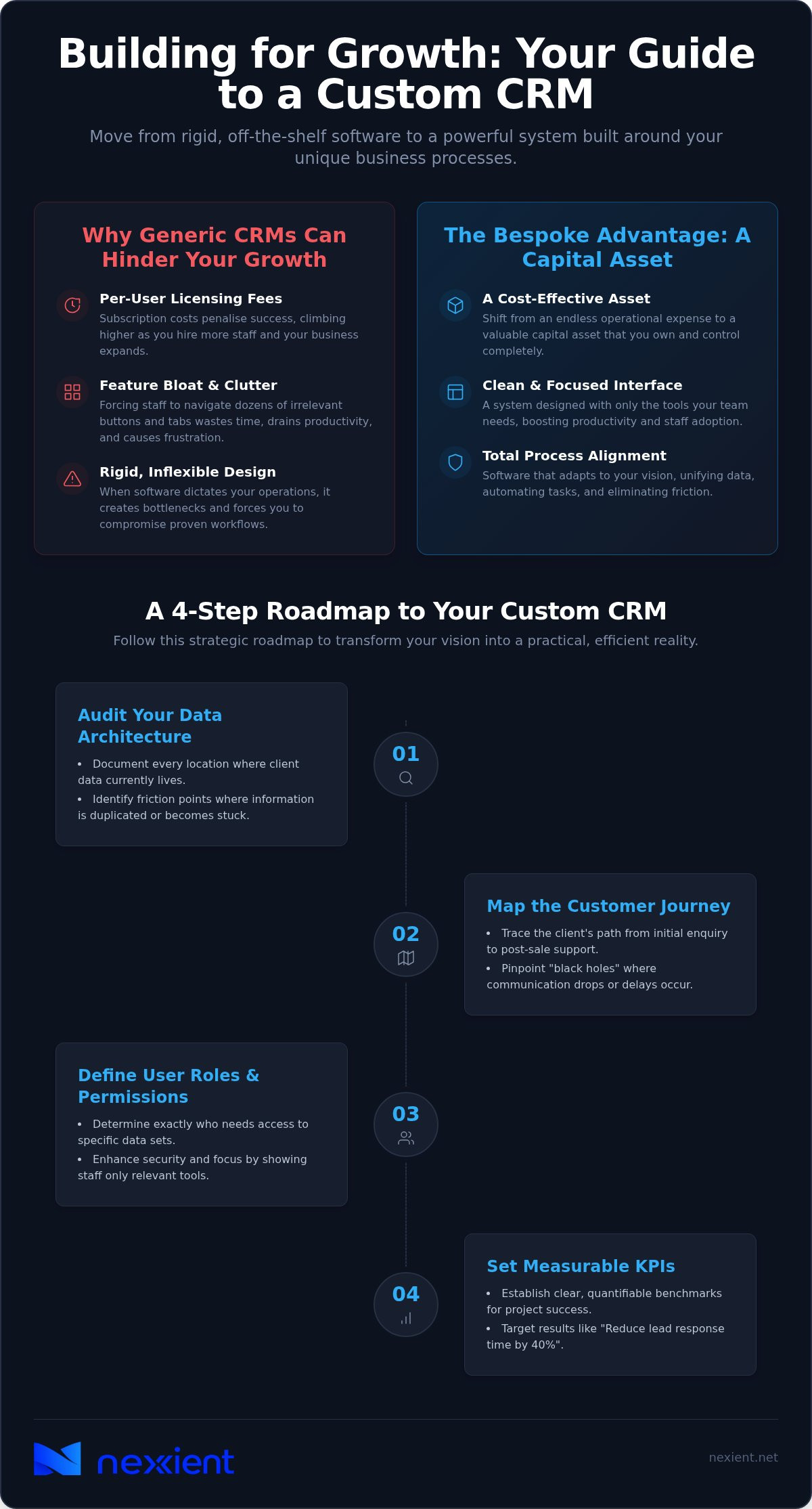
Constructing a custom crm for small business is a methodical exercise in architectural design. You wouldn’t build a house without a blueprint; similarly, you shouldn’t develop software without a deep understanding of your operational landscape. A strategic roadmap transforms your vision into a practical, buildable reality. It ensures every feature serves a purpose and every workflow drives efficiency. Follow these four essential steps to lay a solid foundation for your digital transformation.
- Audit your data architecture: Document every location where client data currently lives, from fragmented spreadsheets to personal inboxes. Identify the friction points where information is duplicated or becomes stuck.
- Map the customer journey: Trace the path of a client from the initial enquiry through to final delivery and post-sale support. Look for “black holes” where communication drops or delays occur.
- Define user roles and permissions: Decide who needs access to specific data sets. This clarity enhances security and ensures that staff only see the tools relevant to their specific tasks.
- Set measurable KPIs: Establish clear benchmarks for success. Whether it’s reducing lead response times by 40% or saving 10 hours of admin per week, having targets keeps the project focused on results.
Mapping Your Internal Workflows
Success requires looking beyond the surface. Take the time to interview your team and uncover the “hidden” manual tasks that consume their day. You might discover that your sales manager spends hours manually syncing lead data between tools. Visualise the flow of information between your departments to spot redundancies. By refining these processes before they are baked into your custom systems, you ensure the software accelerates your business rather than simply digitising existing inefficiencies.
Technical Requirements and Data Security
Your data is your most valuable asset, so protecting it is paramount. Determine exactly where your servers will be located and how data will be encrypted at rest and in transit. For UK-based firms, compliance with UK GDPR is a legal necessity. This means building in custom privacy features, such as automated data retention policies and detailed access logs. Additionally, identify the essential third-party tools that must be integrated via API. Whether it’s your accounting platform or a specialised marketing tool, ensuring these systems talk to each other is vital for maintaining a single source of truth. If you’re ready to move beyond generic templates, exploring data-driven web applications can provide the bespoke edge your business needs.
Core Features of a High-Performance Custom System
Building a high-performance system requires a shift in mindset. You’re no longer settling for what’s available; you’re defining what’s necessary. A custom crm for small business acts as the central nervous system of your organisation, ensuring that information flows exactly where it’s needed without manual intervention. By 2026, the competitive advantage for UK firms lies in speed, precision, and the ability to act on data in real time. Your system should be precise, powerful, and personal.
- Intelligent automation: Set specific business rules that trigger actions, such as sending a follow-up email the moment a quote is viewed.
- Custom reporting: Build dashboards that display the specific metrics your board needs to see, stripping away the noise of irrelevant data.
- API connectivity: Utilise digital bridges (APIs) to link your CRM seamlessly with your website, accounting software, and communication tools.
- User-centric design: Create an interface that mirrors your team’s natural habits, reducing the time spent on training and data entry.
Workflow Automation and Logic
Modern business moves too fast for manual lead assignment. Your system can automatically route enquiries to the right team member based on their expertise or current workload. Beyond simple sorting, you can generate complex documents, such as bespoke contracts or VAT-compliant invoices, with a single click. This doesn’t just save time; it eliminates the risk of human error. By implementing validation rules at the point of entry, you ensure that every piece of data in your system is clean, consistent, and useful for your long-term strategy.
Data Visualisation and Intelligence
It’s time to move beyond the static rows and columns of a traditional spreadsheet. High-performance systems transform raw numbers into interactive, real-time charts that highlight trends as they happen. You can identify shifts in customer behaviour or regional sales patterns that generic tools often miss. For firms requiring deeper insights, Nexient data-driven applications provide the advanced infrastructure needed to turn complex datasets into clear, actionable intelligence. This level of clarity allows you to make confident decisions based on facts rather than intuition, ensuring your business remains agile amongst changing market conditions.
The Development Process: From Concept to Deployment
Creating a custom crm for small business requires a methodical transition from abstract vision to functional reality. You don’t just write code; you architect an environment where your team can thrive. This journey is defined by precision, transparency, and a commitment to quality. By following a structured development lifecycle, you ensure the final product isn’t just a piece of software, but a strategic asset that grows alongside your firm. The process is designed to be collaborative, moving through logical stages that keep you in control of the outcome.
- Prototyping and UI/UX: We design the interface and user journey before writing a single line of code. This allows you to visualise the final product and refine the experience early.
- Agile development: Utilising a milestone-based approach provides regular feedback loops. You see progress in real-time, allowing for adjustments that keep the project aligned with your goals.
- Rigorous testing: Every feature undergoes intense scrutiny to ensure it’s robust, secure, and bug-free. We test for performance under load and cross-device compatibility.
- Data migration: Moving legacy data from spreadsheets or old platforms is a delicate operation. We use custom scripts to map and clean your data, ensuring a safe transition to the new environment.
The Importance of Digital Craftsmanship
Clean design is the foundation of high user adoption rates. If a tool feels heavy or confusing, staff will eventually find ways to bypass it. Digital craftsmanship is about the synergy between aesthetic quality and functional power. By focusing on front-end development that is fast, responsive, and intuitive, we create workspaces that feel light and capable. Nexient’s approach prioritises this balance, ensuring that your system is as beautiful as it is technically sound. When your team enjoys the interface, they engage more deeply with the data.
Deployment and Staff Training
A successful launch is never a single event; it’s a phased roll-out designed to minimise business disruption. We begin by deploying the system to a small group of power users who can provide final feedback before the full company-wide release. To support this transition, we create custom documentation and training materials tailored specifically to your workflows. This isn’t generic “how-to” advice; it’s a guide to your unique business logic. Beyond the initial deployment, your bespoke system is built to evolve. As your needs change, the software can be updated and expanded to meet new challenges. If you’re ready to start your journey with a partner who values precision, contact Nexient to discuss your custom system today.
Partnering with a Worcestershire Bespoke CRM Expert
Selecting a custom crm for small business is a decision that extends far beyond technical specifications; it’s a choice of partnership. Whilst global platforms provide a generic framework, they frequently miss the subtle nuances of your specific industry and local culture. Partnering with a specialist in Worcestershire offers a level of strategic proximity that remote, offshore teams simply cannot match. It allows for a synergy where visionary architecture meets methodical building, ensuring your digital tools are as ambitious as your business goals.
The Value of a Local Digital Agency
Proximity is a catalyst for deeper understanding. Face-to-face workshops enable us to immerse ourselves in your business culture, observing exactly how information moves between your departments. This isn’t just about gathering requirements; it’s about identifying the human elements of your workflow that software needs to support. We are dedicated to strengthening the Worcestershire business community by providing the high-level performance usually reserved for enterprise-level firms. You can view how we’ve transformed local operations by visiting our Nexient custom systems page for project examples and case studies.
Starting Your Custom Journey with Nexient
Your journey begins with a comprehensive discovery session designed to map your vision to a tangible roadmap. We listen to your pains, evaluate your goals, and architect a solution that eliminates administrative friction. Transparency is the cornerstone of our process, which is why we offer fixed-price clarity through milestone-based fees. This means you aren’t hit with unexpected costs or drifting timelines; you stay in control of your investment from the first wireframe to the final deployment.
We focus on the “how” and “why” of your digital products, ensuring that every feature adds measurable value to your bottom line. By combining professional design with smart development, we create systems that aren’t just functional but aspirational. This approach helps you bridge the productivity divide, allowing your team to focus on high-value tasks whilst the software handles the routine. It’s about creating a tool that your staff enjoy using every day.
Realise the potential of a system built specifically for you. Schedule your strategic consultation today to discuss how we can build a tailored CRM that drives scalable growth for your UK business.
Command Your Growth with a Bespoke Digital Engine
Investing in a custom crm for small business represents a transition from renting generic templates to owning a strategic digital asset. You’ve explored how a tailored roadmap, intelligent automation, and user-centric design can eliminate the administrative friction that stalls growth. By choosing a system that mirrors your unique business DNA, you empower your team to work faster, smarter, and more effectively. It’s time to stop bending your processes to fit a template and start building a platform that accelerates your vision.
Our Worcestershire-based expertise provides the local proximity needed for complex software projects. We combine visionary architecture with methodical building to deliver tools that are precise, powerful, and polished. Through our transparent, milestone-based project fees, you maintain total control over your investment whilst we focus on creating a clean interface your staff will love. This methodical approach ensures your software is a grounded, reliable partner in your long-term success.
The future of your organisation depends on the strength of its infrastructure. Book a consultation for your bespoke CRM project today to discuss how we can realise your operational potential. Let’s build a foundation that drives your success for years to come.
Frequently Asked Questions
What is the difference between a bespoke CRM and an off-the-shelf system?
A bespoke system is designed specifically for your unique business logic, whereas an off-the-shelf platform is a generic template built for the mass market. Off-the-shelf tools often force you to change your workflows to fit their rigid structure. In contrast, a custom crm for small business mirrors your existing processes perfectly. This eliminates the clutter of unused features and removes the burden of expensive per-user monthly subscription fees that tax your growth.
How much does it cost to build a custom CRM in the UK?
Investment levels for a bespoke system depend entirely on the complexity of your data architecture and the level of automation required. Industry averages in the UK vary widely based on whether you need a basic tool or an advanced enterprise application. At Nexient, we provide transparency through milestone-based fees. This ensures you only pay for tangible progress. You should view this as a capital asset that builds equity in your company.
How long does the bespoke CRM development process typically take?
The timeline for developing a custom crm for small business typically ranges from 8 to 20 weeks, depending on the scope of the project. A basic system with core contact management might be ready in two to three months. More complex applications featuring deep API integrations and advanced automation logic naturally require a longer development cycle. We use a milestone-based approach to ensure you see functional progress and provide feedback at every stage.
Can a bespoke CRM integrate with my existing website and accounting tools?
Yes, seamless connectivity is one of the primary benefits of a custom-built solution. We utilise digital bridges, known as APIs, to link your CRM directly to your website, accounting software, and communication tools. This creates a unified ecosystem where data flows automatically between departments. By integrating these systems, you eliminate the need for manual data entry and ensure that your team always has access to a single, accurate source of truth.
Will our data be secure in a custom-built system?
Security is integrated into every layer of our custom development process. Unlike generic platforms that are common targets for automated attacks, a bespoke system allows for security measures tailored to your specific needs. We focus on UK GDPR compliance by building in custom privacy features, automated data retention policies, and robust encryption. Being based in Worcestershire, we can also ensure your data is hosted on secure servers that meet strict UK regulatory standards.
Do we need technical knowledge to manage a bespoke CRM?
You do not need any specialised technical knowledge to manage or use a bespoke system. We prioritise a clean, user-centric design that feels intuitive to your team from day one. Because the interface is built around your natural habits and language, the learning curve is significantly shorter than with complex off-the-shelf platforms. We also provide custom documentation and training materials specifically written for your unique business logic to ensure a smooth transition for everyone.
Is bespoke software suitable for small businesses or just large corporations?
Bespoke software is highly suitable for UK small businesses that have outgrown the limitations of spreadsheets or rigid templates. Whilst large corporations often use custom tools, SMEs often see the greatest return on investment by automating niche processes that generic software cannot handle. If your business has unique workflows or you are frustrated by high per-user licensing costs, a custom solution provides the scalable foundation you need to compete effectively.
What happens if our business processes change after the CRM is built?
Your CRM is built to be a living asset that evolves alongside your organisation. Unlike rigid off-the-shelf software, a bespoke system is modular, meaning we can update or expand functionality as your business processes change. Whether you add new departments, launch different services, or require new integrations, the software can be adjusted to maintain its efficiency. This flexibility ensures that your initial investment remains valuable even as your strategic goals shift over time.