
What if the expensive software subscriptions you pay for every month are actually the primary obstacle to your company’s growth? Many UK business leaders find themselves trapped between disconnected systems that don’t talk to each other and staff who spend hours on manual data entry. You likely recognise the frustration of paying for complex features your team never uses, whilst searching for custom business process automation software that actually fits your workflow. It’s a common struggle that limits your ability to make informed decisions in real time.
This guide explains how bespoke applications can eliminate these bottlenecks and create a streamlined, single source of truth for your data. You’ll discover how tailored systems can automate repetitive tasks to free up your staff for high-value work and provide a scalable foundation for your organisation. We’ll walk through the practical steps to evaluate your requirements, understand the 2026 UK market landscape, and build a digital strategy that turns your vision into a high-performance reality.
Key Takeaways
- Understand why custom business process automation software outperforms generic applications by aligning perfectly with your specific UK business workflows and growth goals.
- Identify and eliminate “time-thieves” by conducting a thorough audit of your manual processes to reveal where bespoke automation will deliver the highest return on investment.
- Establish a single source of truth for your organisation by centralising data from siloed systems into one high-performance, data-driven web application.
- Secure your company’s long-term competitive advantage by maintaining full data sovereignty and owning the business intelligence required for informed, real-time decision-making.
- Follow a practical implementation roadmap that transitions your team from repetitive administrative drudgery to high-value strategic work through a scalable digital foundation.
What is Custom Business Process Automation Software?
Think of Business process automation (BPA) not as a generic tool, but as a digital architect for your organisation. At its core, custom business process automation software is a bespoke digital solution built to handle the specific, repetitive tasks that currently drain your team’s energy. It transforms fragmented spreadsheets and manual data entry into a unified, intelligent system that works exactly how you do. It’s about moving from talking about efficiency to actually doing it through high-performance technology.
Standard applications often demand that you change your successful business habits to fit their rigid structures. In contrast, a bespoke application adapts to your unique workflows. This transition from manual, paper-based processes to integrated digital workflows ensures that your data remains accurate, accessible, and actionable. For a modern UK organisation, this isn’t just about saving time; it’s about building a scalable foundation that supports rapid growth without increasing administrative overhead.
The Core Components: Design, Develop, Deliver
Every high-performance data-driven web application relies on three fundamental pillars to drive results:
- Front-end interface: This is the clean, intuitive layer where your staff interact with information. It’s designed for clarity and speed, ensuring that complex data stays easy to manage.
- Back-end logic: The engine of your software. It contains the specific rules and calculations that automate tasks behind the scenes, ensuring consistency and eliminating human error.
- Data integration: An effective system connects your new software to your existing tools, such as accounting platforms or email services, to create a seamless flow of information across the business.
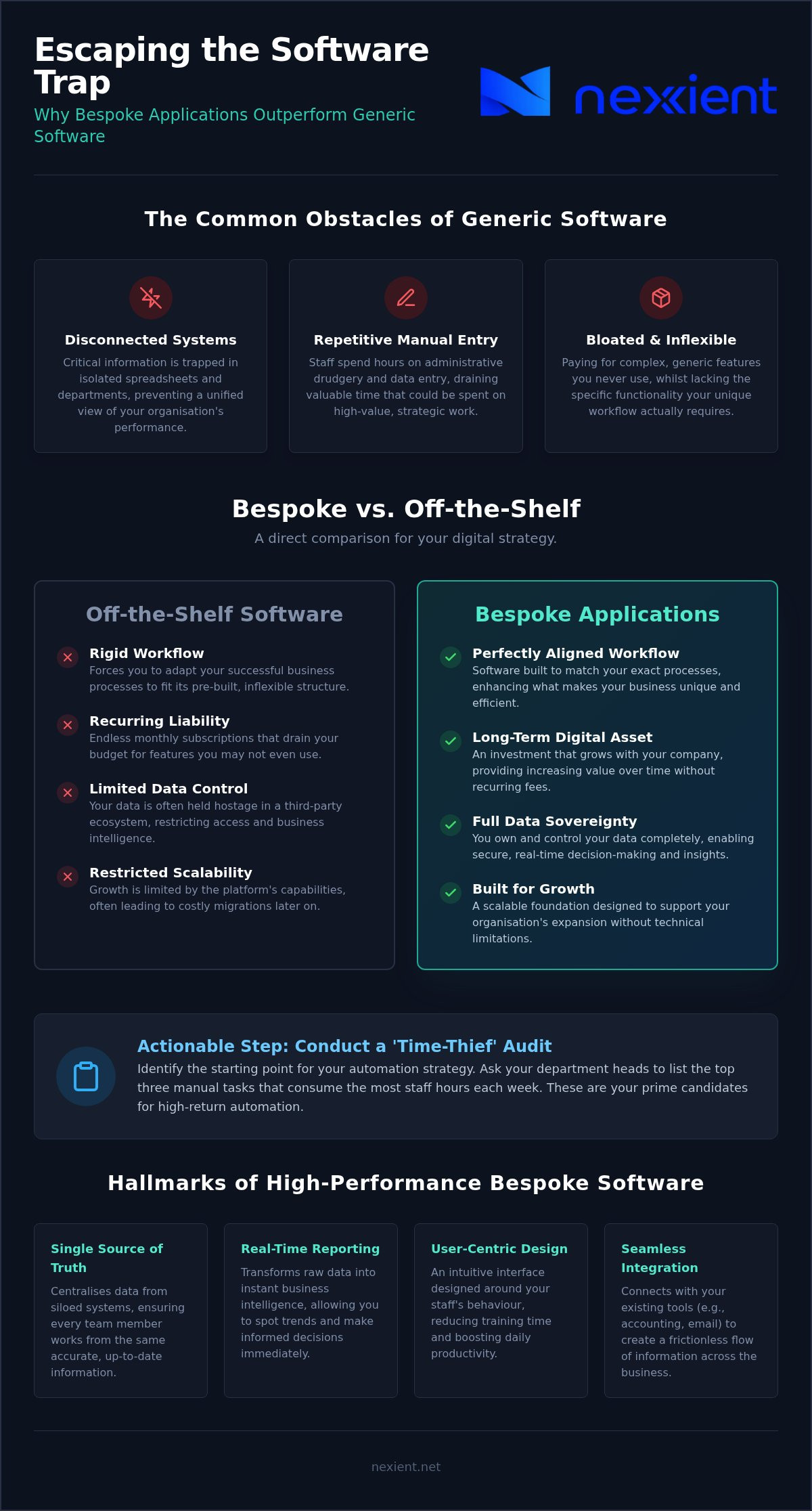
Actionable Step: Conduct a ‘time-thief’ audit. Ask your department heads to list three manual tasks that consume the most staff hours each week. This list forms the starting point for your automation strategy.
Bespoke vs. Off-the-Shelf: A Quick Overview
Off-the-shelf software often feels like a bargain initially, but the hidden costs can be substantial. You’re often paying for expensive monthly subscriptions for features you’ll never use, whilst lacking the specific functionality you actually need. These generic platforms can become a monthly liability that restricts your flexibility. They often force you to compromise on the very processes that make your business unique.
Choosing custom business process automation software turns your digital infrastructure into a long-term asset. Instead of working around the limitations of a standard app, you own a system that grows with you. This bespoke approach ensures data sovereignty and gives you total control over your business intelligence, allowing you to make strategic decisions based on a single source of truth.
Key Features of High-Performance Bespoke Business Applications
High-performance software acts as the nervous system of your business. It isn’t just a tool; it’s a strategic asset tailored specifically to the needs of an organization. By investing in custom business process automation software, you eliminate the fragmented ‘silo’ effect where critical information is trapped in isolated spreadsheets or departments. Instead, you create a centralised hub where every team member accesses the same accurate data, ensuring everyone works from a single source of truth.
Real-time reporting turns this raw data into business intelligence. You don’t have to wait for end-of-month reviews to see how your Worcestershire firm is performing. Effective custom business process automation software allows you to spot trends, identify bottlenecks, and make informed decisions instantly. This level of clarity is only possible when the software is designed around your staff’s specific behaviours. User-centric design ensures the interface is intuitive, which reduces the time spent on training and increases daily productivity as your company scales.
Custom CRM Systems: Beyond Contact Management
A bespoke CRM does more than just store names and phone numbers. It automates lead nurturing and sales pipelines, ensuring no enquiry falls through the cracks. By integrating customer data directly with your operational workflows, you gain a 360-degree view of every client interaction. If you’re deciding between a generic platform and a tailored one, our custom CRM vs off-the-shelf guide provides a detailed framework for your 2026 strategy.
Data-Driven Web Applications for Operations
Operational efficiency relies on precision. Whether you need inventory tracking, project management, or automated invoicing, data-driven web applications provide the structure required to grow without chaos. Clean UI/UX design is vital here. When the interface is simple and logical, employees spend less time fighting the software and more time on high-value work. This practical focus on functionality is what distinguishes a professional build from a cluttered enterprise module.
Actionable Step: Map out your ‘data journey’. Identify which software or spreadsheet currently holds your most critical business data, then list every other system that needs to access it. If these systems don’t talk to each other, you’ve identified your first automation priority.
Ready to streamline your workflows? Explore how custom systems can transform your daily operations.
Evaluating the Investment: ROI and Strategic Value
Investing in custom business process automation software represents a shift from paying for access to owning an asset. Many UK organisations find that whilst initial costs are higher than standard subscriptions, the long-term return on investment is significantly greater. This value stems from direct savings in staff hours and the elimination of the “subscription tax” that plagues growing firms. By removing manual bottlenecks, you don’t just save money; you create the capacity for your team to focus on high-value strategy rather than administrative drudgery.
Error reduction provides another significant financial gain. Manual data entry is prone to human mistakes, which can lead to expensive shipping errors, billing discrepancies, or compliance failures. An automated system ensures data integrity by following strict, pre-defined rules. Beyond these savings, owning the intellectual property (IP) of your business tools adds tangible value to your company’s balance sheet. You are no longer reliant on a third-party vendor’s roadmap; you control your own digital destiny.
Bespoke Software ROI Framework
To understand the true value of a project, you must calculate “time-back” for your key staff members. If a bespoke system saves five senior employees four hours each week, that equates to over 1,000 hours of high-level productivity reclaimed per year. When evaluating the cost of bespoke software development UK, it’s essential to factor in the total cost of ownership. Unlike off-the-shelf tools, custom solutions eliminate per-user monthly licensing fees, which often spiral as your team grows. Instead of a monthly liability, your software becomes a one-off capital investment with predictable, low-cost maintenance.
Intangible Benefits: Morale and Agility
The impact on staff morale is often overlooked but deeply felt. Removing repetitive, “boring” tasks reduces burnout and allows your employees to engage in more creative and fulfilling work. This modern approach positions your brand as a tech-forward organisation, making it easier to attract and retain top talent in a competitive UK market. Furthermore, a custom system provides unmatched agility. When market conditions change, you can pivot your internal processes and update your software immediately, rather than waiting months for a third-party provider to release a relevant update.
Actionable Step: Perform a “Licensing Audit”. Add up every monthly software subscription your team currently uses for operations. Compare this total annual spend against the potential cost of a unified, custom system that replaces three or more of those tools. You might find the “break-even” point is much sooner than you expected.
A Manager’s Roadmap to Implementing Custom Automation
Successful implementation of custom business process automation software isn’t an accident; it’s the result of a deliberate, five-step journey. Many managers feel overwhelmed by technical complexity, but the process actually starts with business strategy rather than code. By following a structured roadmap, you can transform your organisation from a collection of siloed departments into a high-performance, integrated entity. This path moves you from identifying manual bottlenecks to launching a scalable digital asset that grows alongside your firm.
The journey follows five essential stages:
- Step 1: Audit your current workflows to identify the biggest “time-thieves”.
- Step 2: Define your core requirements, distinguishing between “must-haves” and “nice-to-haves”.
- Step 3: Select a development partner who understands both technical craftsmanship and business logic.
- Step 4: Engage in agile development, which involves building the software in small, testable chunks.
- Step 5: Launch, monitor, and refine the system based on real-world feedback from your team.
Auditing Your Workflows: Where to Start?
Begin by looking for tasks that involve “copy and paste” between two different systems. These are the primary indicators of a manual bottleneck. You should also identify processes that require multiple manual approvals or rely on a single person’s memory to function. These friction points are where automation delivers the fastest impact. For a deeper look at managing this transition, our manager’s guide to custom database apps provides a practical framework for identifying these opportunities.
Choosing the Right UK Development Partner
Local proximity matters because deep-dive discovery sessions are most effective when your partner can sit in the same room as your team. You’re looking for an agency that focuses on clean code and digital craftsmanship rather than mass-produced templates. It’s also vital to ensure they offer a dedicated discovery phase. In 2026, a discovery phase typically accounts for 10-15% of your total project budget and is crucial for reducing the risk of costly changes later in the programme. Your partner must be a methodical builder who listens to your needs whilst guiding you toward the most efficient solution.
Actionable Step: Create a “Process Map” for your most time-consuming task. Draw every step from start to finish, noting where data is manually entered or moved. If you find more than three manual touchpoints, that process is a prime candidate for automation.
Ready to start your journey? Consult with our specialists about building your custom systems today.
Why Bespoke Automation is the Future for UK Business
Bespoke automation provides the essential foundation for sustainable growth in an increasingly volatile market. By 2026, the divide between organisations using generic, rigid tools and those powered by custom business process automation software has become a defining factor in commercial success. Custom solutions allow you to maintain absolute data sovereignty, ensuring you own the business intelligence that drives your strategy rather than renting it from a global vendor. This ownership transforms your digital infrastructure from a monthly expense into a high-value corporate asset.
Local firms across Worcestershire are already leveraging this approach to outpace larger national competitors. Whilst enterprise giants struggle with bloated, “one-size-fits-all” platforms, agile local businesses are using tailored systems to respond to market changes in days rather than months. These organisations move faster, serve customers better, and operate with leaner overheads because their software is built specifically for their unique workflows. It’s time to move from a broad vision of efficiency to the practical reality of a high-performance digital ecosystem.
Digital Craftsmanship: The Nexient Approach
At Nexient, we believe in digital craftsmanship. This means focusing on clean design, smart development, and a practical strategy that delivers tangible results. We don’t just build code; we act as visionary architects for your digital future. Our approach to custom systems and web applications ensures that every feature serves a specific business purpose. We invite you to discuss your unique challenges with a local expert who understands the Worcestershire business landscape and can help you navigate the transition from manual processes to automated excellence.
Taking the First Step Toward Automation
The journey toward a fully automated organisation doesn’t have to happen overnight. In fact, the most successful projects often start small by targeting one high-impact process. A professional discovery session is the most effective way to map out this digital future. During this phase, we sit down with your team to uncover the “hidden” bottlenecks that standard software ignores. This collaborative process ensures that the final build is both modern and highly practical for your daily operations.
Actionable Step: Identify your priorities for 2026. List three tasks you would love to never do manually again. Whether it’s synchronising data between siloed systems or generating complex monthly reports, these three items represent the starting point for your automation strategy. Once you have your list, you’re ready to begin the transition from “talking” to “doing”.
Ready to build a scalable digital foundation? Contact our team to book your discovery session and start your journey today.
Building Your Scalable Digital Foundation
The transition from fragmented spreadsheets to high-performance systems is no longer a luxury for UK organisations; it’s a strategic necessity. By investing in custom business process automation software, you reclaim thousands of staff hours and secure absolute control over your business intelligence. You’ve seen how a methodical roadmap, from auditing “time-thieves” to iterative testing, ensures your software fits your unique workflow perfectly.
As professional web application developers based in Worcestershire, we focus on results-oriented digital craftsmanship that turns your vision into a practical, scalable asset. We specialise in delivering tailored solutions for UK businesses of all sizes, ensuring your digital tools act as long-term assets rather than monthly liabilities. The path to a more efficient, error-free future starts with identifying a single high-impact process and committing to its digital transformation.
Ready to automate? Explore our bespoke business applications today
Take that first step today and watch your organisation grow with clarity, speed, and confidence.
Frequently Asked Questions
What is the difference between custom automation and off-the-shelf software?
Custom automation is built to match your specific workflows, whilst off-the-shelf software requires you to adapt your successful habits to fit a rigid template. With custom business process automation software, you own the intellectual property and avoid paying for features your team never uses. Generic apps often create data silos, but bespoke solutions integrate your operations into a single source of truth, providing the flexibility needed for your organisation to scale without restriction.
How much does custom business process automation software cost in the UK?
In the 2026 UK market, small automation projects typically range from £15,000 to £50,000, whilst mid-range applications involving multiple workflows usually fall between £50,000 and £150,000. Complex enterprise-grade systems can exceed £150,000. It’s also important to budget 15-20% of the initial build cost for annual maintenance. Actionable Step: When requesting quotes, always ask for a breakdown of the discovery phase costs to ensure the project logic is fully mapped before coding begins.
How long does it take to develop a bespoke business application?
Development timelines vary based on the project’s complexity and the number of custom business rules required. A simple application automating a single workflow generally takes 2-4 months to launch. Mid-range projects with third-party integrations usually require 4-8 months, whilst complex systems can take 8-18 months. Every project should begin with a dedicated discovery phase, which typically accounts for 10-15% of the total budget, to ensure the final product meets your strategic goals.
Will custom software be difficult for my team to learn?
Bespoke software is often easier for staff to learn because it is designed specifically around their existing daily tasks. Unlike generic platforms that feel cluttered with unnecessary buttons, a custom interface only includes the tools your team actually needs. By focusing on clean UI and UX design, we ensure the software is intuitive. This user-centric approach significantly reduces training time and minimises the human error often associated with complex, off-the-shelf enterprise systems.
Can bespoke software integrate with my existing tools like Xero or Outlook?
Yes, tailored business applications are built to connect with your existing tools like Xero, Outlook, or industry-specific platforms. This is achieved through data integration, which allows different systems to “talk” to each other automatically. By bridging these gaps, you eliminate the need for staff to manually copy and paste information between siloed databases. Actionable Step: List every software subscription your team currently uses; this list will be vital for your development partner during discovery sessions.
Do I own the code once the custom software is built?
You typically own the full intellectual property rights to your custom software once the development is complete. This means your business tools are a capital asset on your balance sheet rather than a monthly subscription liability. Owning the code gives you total data sovereignty and the freedom to modify the system whenever your strategy evolves. You aren’t tied to a vendor’s roadmap, allowing you to control the future of your own digital infrastructure.
Is bespoke software more secure than standard cloud applications?
Bespoke software can be more secure because it isn’t a high-profile target for mass automated attacks that often hit popular generic platforms. Your system is built with specific security protocols tailored to your data protection needs and current UK GDPR standards. Since the ICO increased PECR fines to match GDPR levels in 2026, building robust security from the ground up is essential. We focus on digital craftsmanship to ensure your data remains protected and compliant.
What happens if my business processes change after the software is built?
Custom software is designed to be scalable and adaptable, allowing it to grow alongside your firm. Unlike rigid off-the-shelf tools, a bespoke system can be refined or expanded as your internal processes change. This flexibility is a core benefit of working with a local Worcestershire development partner who provides ongoing support. Actionable Step: Review your core business processes every six months to identify new bottlenecks that could be solved by adding a new module.