
What if your company data wasn’t a source of daily stress, but your most reliable competitive advantage? Most leaders feel buried under endless spreadsheets and fragmented reports that simply refuse to talk to each other. You likely recognise the frustration of using rigid, off-the-shelf tools that feel too complex or fail to match your specific workflows. It’s difficult to lead with confidence whilst you lack the real-time insights needed to make fast, accurate decisions.
This is where bespoke business intelligence software development changes the narrative for your organisation. We’ll show you how a tailored approach transforms chaotic data points into a powerful, streamlined engine for strategic growth. By the end of this guide, you’ll understand how to replace manual work with automated reporting, build a scalable system that grows alongside your vision, and finally access a dashboard that shows clear, undeniable ROI. We’re moving beyond static charts into a new era of interactive, intelligent analytics that puts you back in control. It’s time to stop guessing and start growing with precision, clarity, and purpose.
Key Takeaways
- Understand how modern business intelligence software development turns fragmented data into a live engine for strategic decision-making.
- Evaluate the total cost of ownership between bespoke systems and off-the-shelf tools to ensure your technology scales with your business.
- Transition from static monthly reports to real-time data pulses that allow for immediate, proactive adjustments to your strategy.
- Use a structured roadmap to identify your “North Star” metrics and audit your existing data sources for a seamless implementation.
- Discover how data-driven web applications can automate hours of manual reporting, freeing your team to focus on high-value growth tasks.
Beyond Data Collection: Defining Business Intelligence Software Development in 2026
In the current market, possessing data is not enough; you must possess the ability to command it. True business intelligence is the strategic architecture that organises raw, chaotic information into insights that are visual, actionable, and reliable. Whilst most organisations collect vast amounts of data, few understand how to use it to drive growth. This gap is precisely why business intelligence software development has become the cornerstone of modern strategy. It’s the bridge between having a database and having a direction.
By 2026, the digital landscape has shifted. What was once a luxury reserved for global enterprises is now a core requirement for SMEs across Worcestershire. The democratisation of technology means smaller firms can now leverage high-performance tools to outpace larger competitors. We see this manifest through Data-Driven Web Applications, which serve as the modern, accessible interface for complex business logic. These applications allow your team to interact with data in real-time, turning abstract numbers into tangible results.
The Core Components of a BI Ecosystem
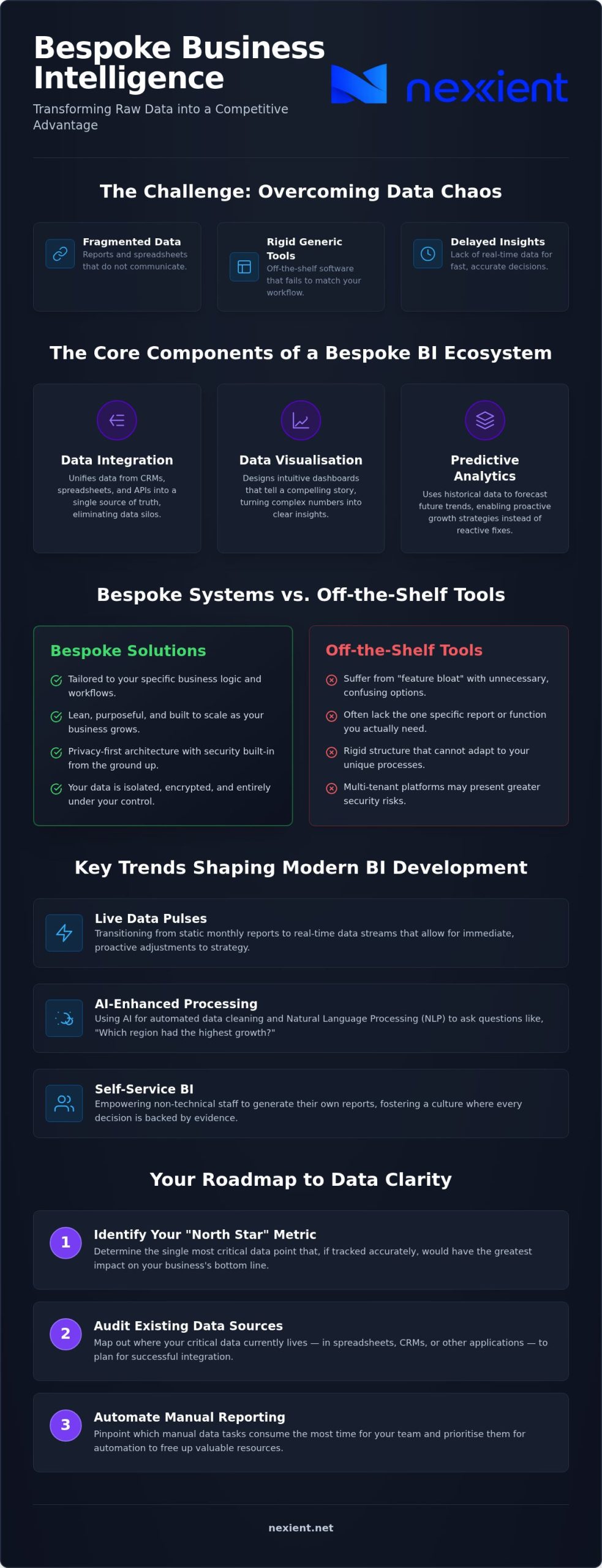
Building a robust system requires three fundamental pillars to ensure your data remains clean, precise, and powerful. First, Data Integration ensures information from your custom CRMs, spreadsheets, and external APIs flows into a single source of truth. This eliminates “data silos”, which are isolated pockets of information that slow down decision-making. Second, Data Visualisation focuses on designing dashboards that tell a compelling story at a single glance. Finally, Predictive Analytics uses historical patterns to forecast future trends, allowing you to move from reactive fixes to proactive growth.
Why “Off-the-Shelf” Often Falls Short
Generic tools often struggle with the unique logic of your specific business. They frequently suffer from “feature bloat”, which happens when standard software is packed with unnecessary buttons that overwhelm your team whilst missing the one specific report you actually need. Investing in professional business intelligence software development allows you to bypass these limitations. It ensures your system is lean, purposeful, and built to scale. To begin your transition, your first step should be to identify your “North Star” metric; the one data point that, if tracked accurately, would most significantly impact your bottom line. Once identified, you can audit your existing information sources to see where that data currently lives and how it can be integrated into a new, bespoke dashboard.
Key Trends Shaping Custom Business Intelligence Development
The landscape of business intelligence software development is shifting from static archives to dynamic, living ecosystems. It’s no longer enough to look back at what happened last quarter; you need to know what is happening right now. This evolution is driven by four primary trends that prioritise speed, accessibility, and automation. Modern organisations are moving away from traditional “monthly reports” and embracing “live pulses” that provide a real-time view of their operations. This immediacy allows you to spot a supply chain issue or a sudden sales spike the moment it occurs, rather than weeks after the fact.
Accessibility is also undergoing a radical transformation. With a mobile-first approach, you can now access critical business metrics whilst on a train or between meetings. Perhaps most importantly, the rise of “Self-Service BI” is empowering non-technical staff to generate their own reports. This democratisation of data means your team no longer has to wait for a specialist to translate raw numbers into useful information. It fosters a culture where every decision, at every level, is backed by evidence.
AI-Enhanced Data Processing
Automated anomaly detection and Natural Language Processing (NLP) are the standout features in modern business intelligence software development. AI agents now handle the heavy lifting of cleaning and categorising data, which removes the human error that often plagues manual entry. NLP allows you to talk to your database in plain English. You can ask simple questions like, “Which region had the highest growth this month?” and receive a visual answer instantly. Nexient focuses on building Data-Driven Web Applications that integrate these intelligent automations to save your team hours of mundane work. If you want to see how these tools can streamline your specific workflow, you should explore our data-driven web applications to see the potential for your own business.
Privacy-First Architecture and Security
As data becomes your most valuable asset, it also becomes your greatest risk. Privacy-first architecture is now a baseline requirement for any bespoke project. Building “Security by Design” into your tool ensures that UK GDPR compliance is handled at the source code level, rather than as an afterthought. Bespoke systems offer a level of protection that generic, multi-tenant SaaS platforms simply cannot match. Your information is isolated, encrypted, and entirely under your control. To stay ahead of these trends, begin by identifying which manual data tasks currently consume most of your team’s time. Mapping out these bottlenecks is the first step towards building a secure, high-performance environment that actually drives growth.
Bespoke BI vs. Off-the-Shelf Tools: Navigating the Choice
Choosing the right foundation for your data is a defining moment for any ambitious organisation. You are essentially deciding between renting a generic platform or building a proprietary asset. Standard, off-the-shelf tools often appear attractive due to their lower initial entry point, but they frequently carry hidden costs that surface as you scale. Subscription fees, per-user licences, and expensive “add-on” charges can quickly drain your budget. In contrast, business intelligence software development offers a different path; it prioritises a one-off investment in a system you own entirely.
Integration is another critical factor for your success. A generic tool might struggle to communicate with your existing custom CRM system, leading to data gaps and manual entry errors. Bespoke solutions are designed to bridge these gaps, ensuring your software talks to your database whilst you organise your operations with perfect clarity. Beyond the technical specs, consider the human element. A bespoke user interface is crafted around your team’s specific behaviour, which significantly boosts engagement and adoption. When a tool is easy to use, it moves from being a chore to being a favourite part of the daily workflow.
When to Choose Custom Development
Bespoke development is the right choice when your business logic is unique. If your workflows don’t fit the rigid templates of mass-market software, you shouldn’t force your team to change how they work. Custom builds are also essential if you want to retain the intellectual property of your software. Owning your code means you aren’t at the mercy of a third-party provider’s updates or price hikes. It gives you the freedom to innovate, the power to adapt, and the security of knowing your data is truly yours.
The Long-Term Value of Bespoke Solutions
The financial benefits of custom software become clearer over time. By eliminating recurring monthly costs, you free up capital that can be reinvested into other areas of growth. You also gain the ability to pivot. If the market shifts, your bespoke tool can be updated with new features that keep you ahead of the competition. This approach to digital craftsmanship is a cornerstone of professional growth. For a broader look at how custom digital assets drive success, you can read our Bespoke Web Design guide to see the wider context of this strategy. To begin your evaluation, calculate your total projected subscription costs over the next three years; often, this figure alone justifies the move to a bespoke build.
Delivering Insights: A Strategic Roadmap for BI Implementation
Building a high-performance BI environment requires a disciplined, architectural approach. It’s the difference between a collection of pretty charts and a functional engine for growth. To ensure your business intelligence software development project succeeds, you must follow a roadmap that prioritises clarity and practical outcomes. This journey moves from high-level discovery into the methodical building of functional modules.
Step 1: Define Your Strategic Goals
Before touching a single line of code, you must identify your “North Star” metrics. These are the key indicators that directly influence your bottom line, such as customer lifetime value or operational lead times. Avoid “vanity metrics”, like raw page views or social media likes, that look impressive but don’t drive revenue. Your BI goals should align with the broader digital strategy established by your website design agency. Ask yourself: “What specific business question must this data answer?” If you can’t answer that, you aren’t ready to build.
Step 2: Architecture and Integration
Once your goals are set, you must map out where your information currently lives. This data auditing process identifies silos in your spreadsheets, APIs, and your eCommerce platform. The objective is to create a “Single Source of Truth” where every department accesses the same verified data. You will also need to decide on your hosting environment. Cloud-native solutions offer immense scalability, whilst hybrid models provide additional control for sensitive internal data.
From Prototype to Agile Delivery
The next stage involves visualising the dashboard through UI/UX design. Prototyping allows your team to test the user experience before the heavy development begins. This ensures the final interface is intuitive and behaviour-driven. Finally, we move into agile development. By building the system in functional modules, you can begin using parts of your BI tool whilst the rest is still being refined. This iterative process ensures the software remains flexible enough to adapt to real-world feedback. If you’re ready to start mapping your data journey, you can consult our team for custom systems to begin your strategic audit.
Nexient: Crafting Data-Driven Web Applications in Worcestershire
Nexient acts as a Visionary Architect for your business data. We understand that for Worcestershire firms, data is more than just numbers; it is the raw material of your future success. Our team combines digital craftsmanship with practical strategy to build systems that are powerful, precise, and polished. By choosing a partner dedicated to high-performance development, you ensure your business intelligence software development project results in a tool that actually works for your people. We prioritise clean design and methodical building to turn fragmented information into a live asset that drives your daily decisions. It’s about moving beyond simple spreadsheets and into a space where your data works as hard as you do.
A Local Partner for Global Ambitions
Working with an England-based agency offers a distinct advantage that remote, global platforms cannot replicate. We value face-to-face strategy sessions where we can sit down and truly listen to your unique challenges. This collaborative approach allows us to build trust and momentum from the very first meeting. You benefit from a partner who understands the local market whilst possessing the technical skill to compete on a global scale. Whether you require simple brochure websites to establish your presence or complex, data-driven web applications to run your entire operation, we bring the same results-oriented confidence to every task. We focus on the how and why of your digital products, ensuring the synergy between design and functionality is perfect. Our goal is to move you away from the cold, detached nature of corporate software and toward a voice that feels dedicated, energetic, and deeply invested in your results.
Start Your Data Transformation Today
The path to clarity begins with a single, purposeful step. We invite you to schedule a strategy session to map out your digital vision and identify the bottlenecks holding you back. Our “doing over talking” philosophy means we move quickly from high-level concepts to tangible prototypes you can actually test. We don’t just provide advice; we build the methodical structures that allow your business to scale with ease. It’s time to stop drowning in fragmented data and start leading with a system that grows with you. Professional business intelligence software development is an investment in your company’s long-term intelligence and agility. You can Contact Nexient to discuss your custom software requirements and take the first step toward a more intelligent, automated, and profitable future. By choosing a local partner, you gain a guide that helps you navigate the digital landscape with sophistication and ease.
Command Your Future with Data-Driven Clarity
The journey from fragmented data to strategic momentum requires a shift in perspective. You’ve discovered that modern business intelligence software development is no longer a luxury; it’s a core requirement for growth and operational efficiency. By choosing bespoke architecture over rigid, off-the-shelf tools, you secure total ownership of your intellectual property and eliminate the recurring costs that drain your budget as you scale.
Success lies in identifying your “North Star” metrics and building a single source of truth that every department can trust. As Worcestershire-based experts specialising in bespoke CRMs and data-driven applications, Nexient is ready to guide you through an agile, results-oriented process. We don’t just talk about potential; we build the methodical structures that turn your vision into a high-performance reality.
Bring your data to life with Nexient’s custom software development services and take control of your strategic growth today. The digital landscape is yours to command.
Frequently Asked Questions
What is the difference between business intelligence and data analytics?
Business intelligence focuses on the architecture and tools that turn raw data into visual, actionable insights for strategic planning. Data analytics is the specific process of examining datasets to draw conclusions about the information they contain. Whilst analytics looks for patterns, business intelligence software development creates the environment where those patterns become visible and useful for your daily operations. It’s the difference between finding a trend and building a dashboard to track it.
How long does custom business intelligence software development take?
The timeline for a bespoke project varies based on the complexity of your data sources and the specific features you require. Typically, a functional prototype is ready within weeks, whilst a full enterprise-grade system may take several months. We use an agile development process, which means we build in functional modules. This allows you to start using key parts of your software whilst we continue to refine and scale the remaining features.
Can custom BI software integrate with my existing Excel spreadsheets?
Yes, custom BI tools are designed to talk to your existing spreadsheets whilst moving you toward a more automated future. We can build integrations that pull data directly from Excel files or legacy databases into your new, centralised dashboard. This ensures you don’t lose historical information whilst you organise your operations. It’s a practical way to bridge the gap between fragmented spreadsheets and a high-performance, data-driven web application.
Is bespoke software development more expensive than a monthly SaaS subscription?
Bespoke development requires a higher upfront investment, but it eliminates the recurring per-user monthly fees that drain your budget over time. When you invest in your own software, you are building a proprietary asset rather than renting a generic platform. This approach often results in a lower total cost of ownership over a three-to-five-year period. You also gain the freedom to innovate without being restricted by a third-party provider’s pricing or updates.
Do I need to be a large corporation to benefit from custom BI development?
No, business intelligence software development is now a core requirement for SMEs and mid-market firms across Worcestershire. Smaller organisations often benefit the most because they need to be more agile and efficient than their larger competitors. A tailored BI tool helps you automate manual reporting tasks and make faster decisions with limited resources. It levels the playing field by giving you the same high-performance insights used by global enterprises.
What security measures are included in custom software development services?
We build Security by Design into every layer of your custom software to protect your most valuable information. This includes end-to-end encryption, multi-factor authentication, and strict adherence to UK GDPR requirements. Unlike multi-tenant SaaS platforms, where your data sits alongside other companies, a bespoke system provides an isolated environment. This significantly reduces your risk profile and ensures your business intelligence software development project remains secure and compliant from day one.
How does UI/UX design impact the success of a BI dashboard?
UI/UX design is critical because a dashboard is only successful if your team actually uses it. Clean design ensures that complex data is presented in a way that is intuitive and behaviour-driven. If a tool feels too complex or cluttered, adoption rates will drop, and your investment will be wasted. By focusing on high-performance digital solutions, we create interfaces that tell a story at a glance and make decision-making a favourite part of the day.
Will I own the source code for my custom BI software?
Yes, when you partner with Nexient for custom software, you own the source code and the intellectual property entirely. This is a fundamental advantage over off-the-shelf tools where you are merely a subscriber. Owning your code means you have the power to adapt, the freedom to scale, and the security of a permanent asset. It ensures your organisation is never at the mercy of a developer’s roadmap or a platform’s sudden closure.