
How can you tell whether a new website is generating enough value to justify its investment? Measuring ROI of a new website can feel unclear when build and running costs sit alongside enquiries, sales and benefits that may take time to appear. Visits alone won’t show whether the site is doing its job.
Start with what the website is meant to achieve. This guide explains how to set a useful goal before launch, connect website activity to business outcomes and include relevant costs in your calculation. You’ll also learn which measures suit a brochure site, online shop or landing page, how to interpret early results and how to choose practical improvements. The aim is a realistic view of value, not a score detached from your business model.
Key Takeaways
- Understand what website ROI reveals and how to calculate it using measured return and total investment.
- Make measuring ROI of a new website more useful by setting one primary business outcome and recording your starting point.
- Choose a lead, sales or campaign measure that reflects what your website is designed to achieve.
- Separate directly tracked sales from the website’s wider influence, then use the evidence to choose a sensible next improvement.
What does measuring the ROI of a new website really tell you?
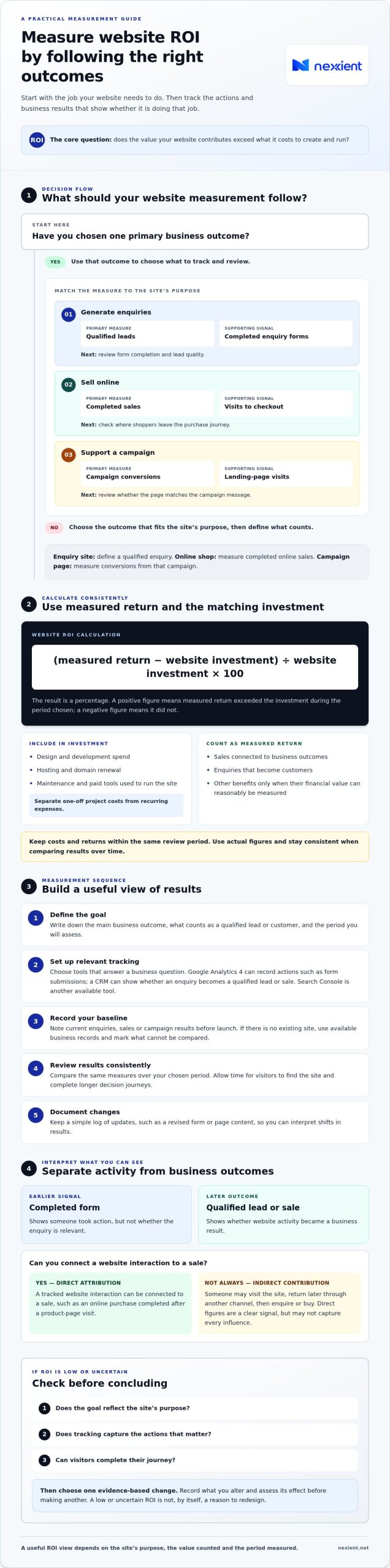
Measuring ROI of a new website compares the value it contributes with what it costs to create and run. The standard calculation is: (measured return − website investment) ÷ website investment × 100. The result is a percentage. A positive figure means the measured return exceeded the investment during the period you chose; a negative one means it did not.
The calculation is only as useful as its inputs. A new brochure website might be designed to generate qualified enquiries, while an online shop might be assessed on completed sales. Your goals, review period and assumptions about which sales the website influenced all affect the result. There’s no single ROI benchmark that suits every website.
For background on the underlying financial measure, see Return on Investment (ROI). Before calculating your own figure, decide what counts as a return and which costs belong in the same period. Be consistent when you compare the figures over time.
Which website investment and return belong in the calculation?
Separate one-off project costs from recurring expenses so you can see what you’re assessing. Include relevant design and development spend, then add ongoing costs such as hosting, domain renewal, maintenance and paid tools used to run the site. Use your actual figures and apply the same time period to both costs and returns.
Count returns you can connect to business outcomes, such as sales or enquiries that become customers. Benefits like clearer information or an easier customer journey are useful supporting evidence, but include them as financial value only if you can reasonably measure that value. A customer journey is the path someone takes through your site to complete a task.
A website’s ROI depends on its purpose, the value you count and the period you measure.
How to measure new website ROI when results are not immediate
A new site needs a clear starting point, not an instant verdict. Before launch, choose one primary business outcome and decide when you’ll review it. For a lead-generation site, that might be qualified enquiries; for an e-commerce website, completed online sales; for a campaign page, conversions from that campaign. A brochure website design project may focus on helping prospective customers find the information they need and make an enquiry.
A practical measurement sequence for a new site
- Define the goal. Write down the main business outcome the site should support, what counts as a qualified lead or customer, and the period you’ll assess.
- Set up relevant tracking. Use tools such as Google Analytics 4 (GA4), Search Console or a customer relationship management system (CRM), depending on your goal. GA4 can record actions such as form submissions; a CRM can show whether an enquiry becomes a qualified lead or sale. Choose tracking that answers a business question, rather than collecting data for its own sake.
- Record your baseline. Note current enquiries, sales or campaign results before launch. If there’s no existing site, use available business records as a starting point and mark clearly what can’t be compared.
- Review results consistently. Compare the same measures over your chosen period. Allow time for visitors to find the site and complete longer decision journeys.
- Document changes. Keep a simple log of updates, such as a revised form or page content, so you can interpret any shifts in results.
Separate early signals from business outcomes. A completed form is a leading indicator: it shows someone took action, but not whether the enquiry is relevant. Qualified leads and sales are later outcomes. Track both, then review where potential customers drop out. For example, if forms are being completed but few enquiries become customers, look at lead quality as well as the website. This makes measuring ROI of a new website more useful than relying on traffic alone, and helps identify a practical next step while results build.
How to interpret website ROI and decide what to improve next
A return figure is useful evidence, but it isn’t the whole story. Direct attribution means a tracked website interaction can be connected to a sale, such as an online purchase completed after a product-page visit. Indirect contribution is harder to capture: someone might visit your site, return later through another channel and then enquire or buy. Treat direct figures as a clear signal, but don’t assume they capture every way the site influenced a decision.
Use your website’s goal to interpret results and choose a relevant next step. For example:
| Site goal | Primary measure | Supporting signal | Sensible next action |
|---|---|---|---|
| Generate enquiries | Qualified leads | Completed enquiry forms | Review form completion and lead quality |
| Sell online | Completed sales | Visits to checkout | Check where shoppers leave the purchase journey |
| Support a campaign | Campaign conversions | Visits to the landing page | Review whether the page matches the campaign message |
Turn the measurement into a focused improvement plan
A low or uncertain ROI isn’t an automatic reason to redesign. First check whether the goal reflects the site’s purpose, whether tracking captures the actions that matter, and whether visitors can complete their journey. Measuring ROI of a new website is most useful when the figures lead to a focused question, not a rushed conclusion.
Choose one evidence-based change, record what you alter and assess its effect before making another. For a campaign page, compare its goal, content and visitor journey with a landing page design guide as you plan the next improvement.
When you’re planning a project, Nexient can help shape a website around measurable outcomes.
Build your next website around measurable progress
Make measurement part of the project from the start, rather than a report you scramble to assemble after launch. When goals guide the planning and design, you can decide what the site needs to do and how you’ll recognise progress. For a business in Worcestershire, that means setting measures that reflect your own enquiries, customers and sales, rather than relying on a generic benchmark.
Nexient brings strategic planning, design and development together across brochure websites, e-commerce websites and landing pages, with each project shaped around its purpose. To turn your business goals into a website project you can evaluate, discuss your website project with Nexient.
Frequently Asked Questions
How long should you wait before measuring the ROI of a new website?
For measuring ROI of a new website, choose a review point that gives you enough activity to assess the outcome and reflects how long customers usually take to decide. A short campaign may show form activity quickly, whilst a considered business purchase can take longer to become a sale. Note early signals separately, then revisit the commercial result at a consistent checkpoint.
Can a website have a positive ROI without generating online sales?
Yes. A brochure site may deliver value by producing suitable enquiries, helping customers find key information or reducing repetitive questions, even if payment happens offline. To assess financial return, track which enquiries progress to paid work and estimate value using your own records. Treat convenience or clearer journeys as supporting benefits unless you can link them to a measurable business outcome.
What should you do if you cannot attribute a sale directly to your website?
Use more than one source of evidence rather than assigning a sale to the last interaction. Ask new customers how they first heard about you, record website interactions and enquiry dates in your CRM, and look for patterns across sales. Mark uncertain cases as influenced rather than directly generated. This keeps your estimate useful without claiming more certainty than the evidence supports.
Should you compare your website ROI with an industry benchmark?
Use benchmarks as context, not as a pass-or-fail target. ROI varies with website purpose, margins, sales cycles and which costs are counted, so a figure from another sector may not be comparable. For an SME in Worcestershire, your own previous performance and progress towards your chosen goal are usually more useful reference points. Compare like with like, and note differences before drawing conclusions.