
What if the answer to a tangled business process isn’t another tool, but one that fits the way your team works? When spreadsheets, inboxes and disconnected systems pile up, routine tasks can become harder to track and manage. Bespoke business applications can help, but only when they address a clearly defined operational need.
This guide will help you decide when a tailored application is worth exploring and when existing tools may be enough. You’ll learn how to map a workflow, identify where work gets stuck and clarify what your team needs before a project begins. We’ll also cover a practical route from business challenge to digital solution, connecting strategy, user experience and development to keep the work focused.
Key Takeaways
- Spot when repeated manual tasks, disconnected information or limitations in standard tools could point to a need for bespoke business applications.
- Map who uses the process and note its information inputs, outputs and hand-offs before shaping a solution.
- Set a clear desired outcome, then prioritise the needs the application must meet.
- See how strategic planning, user experience design and development can turn a defined business challenge into a practical application.
When does a bespoke business application make sense?
A bespoke business application is software shaped around an organisation’s workflows, users and information needs. Unlike a standard tool designed for broad use, it can reflect the way your team needs a process to work. Custom software is another term for this tailored approach, but tailoring alone isn’t a reason to build: the application should solve a clear operational problem.
Put simply, bespoke business applications are digital tools built to support the specific work a business needs to get done. They may be worth exploring when repeated manual tasks, disconnected information or gaps in standard tools make a real process harder to manage.
Which business problems are worth solving with an application?
Start with the workflow, not a feature wish list. If staff repeatedly copy information between spreadsheets or pass files around for updates, for example, a shared process could make it easier to see what’s current and who needs to act next. The opportunity is to improve the hand-off, not simply to add a dashboard.
Use these questions to identify the problem and its impact:
- Which team or user group deals with it?
- Where does the process slow down, require repeated input or lose useful information?
- What should be easier to complete, find or track?
If a standard tool can support the workflow with a straightforward adjustment, custom development may add needless complexity. If the same limitation keeps disrupting a defined process or business information need, explore whether a tailored solution could address it. For teams that need to organise and use business data in a process-specific way, data-driven web applications may be relevant. The next step is to map how the work happens today.
How to scope a bespoke business application before development
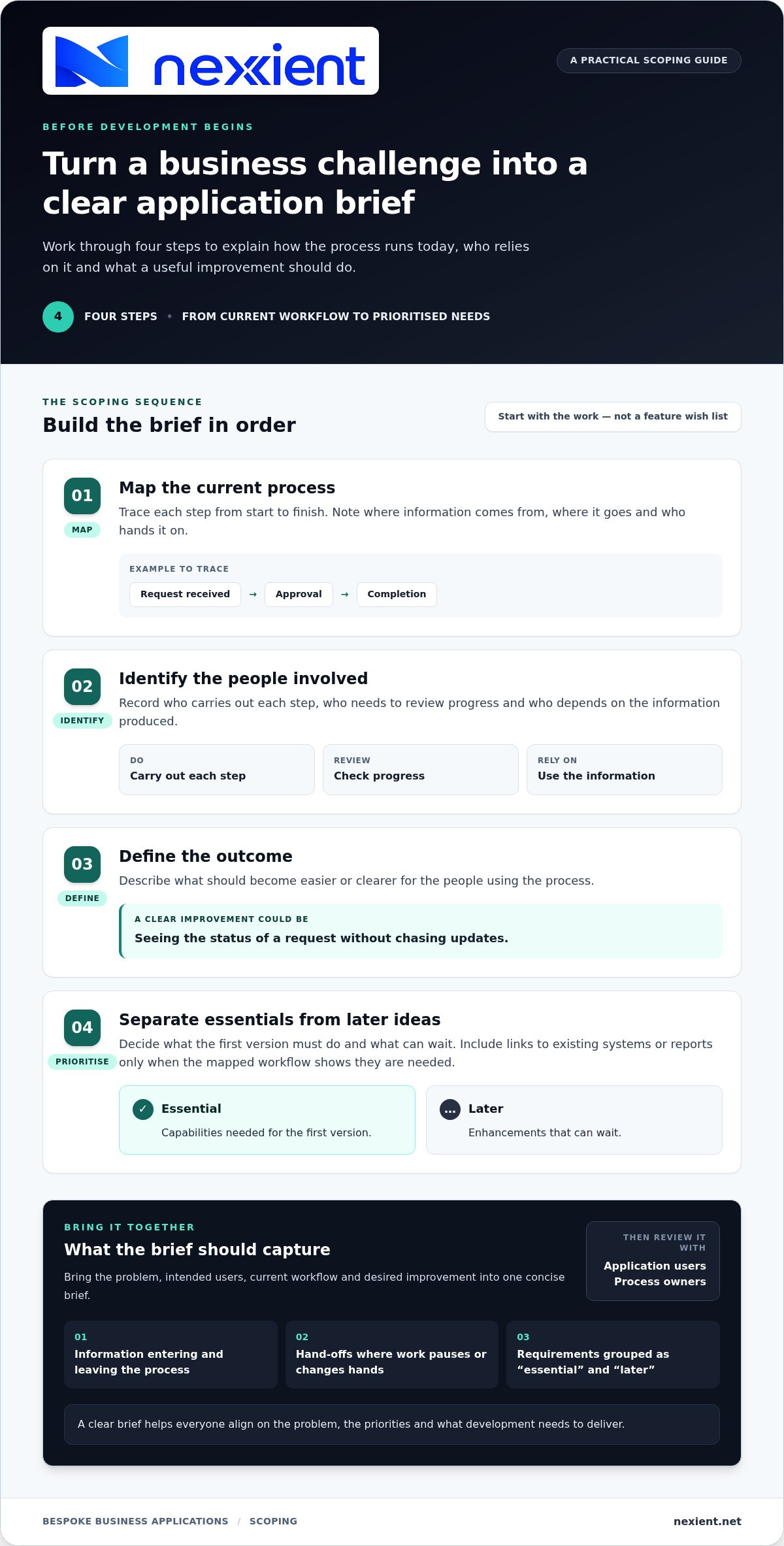
A clear scope turns a business challenge into something a team can discuss, test and prioritise. Before considering features or technical choices, capture how the work happens now and what a useful improvement would look like. This gives managers and developers a shared starting point for shaping bespoke business applications around real needs.
- Map the current process. Note each step from start to finish, including where information comes from, where it goes and who hands it on. For example, trace how a customer request moves from receipt to approval and completion.
- Identify the users. Record who carries out each step, who needs to review progress and who relies on the information produced.
- Define the outcome. Describe what should become easier or clearer, such as seeing the status of a request without chasing updates.
- Prioritise the needs. Separate essential capabilities for the first version from enhancements that can wait. Include connections to existing systems and reports only where the mapped workflow shows they’re needed.
What should a useful application brief include?
Bring the problem, intended users, current workflow and desired improvement into one concise brief. Add examples of information entering and leaving the process, plus the hand-offs where work pauses or changes hands. Then group requirements into “essential” and “later”. Clear requirements help everyone align on the problem, the priorities and what development needs to deliver.
Before development begins, review the brief with the people who’ll use the application and those responsible for the process. Their feedback can clarify priorities and reveal gaps while the scope is still taking shape. If you’re ready to explore your plans, you can discuss your application project with Nexient.
From business challenge to bespoke application with Nexient
A well-scoped brief gives a project a practical starting point. Nexient designs and develops web applications, combining strategic planning, user-focused design and development to address your organisation’s needs. The focus stays on the work the application needs to support, not technology for its own sake. For businesses in Worcestershire, starting with a clear account of the process helps keep the project grounded in the needs of the people who will use it.
If the challenge involves bringing business information together or making it more useful in day-to-day work, a data-driven web application may be a relevant direction. Where the core issue is managing customer interactions or other relationship processes, custom CRM systems may be a better fit. The right starting point depends on the workflow you’ve defined.
What happens after you define the business need?
Use the first project conversation to explain the challenge, who encounters it and what outcome you want. Bring your process notes or brief, including the steps that cause difficulty and the information people need to act. You don’t need a finished technical plan; clear examples of the work give the discussion something concrete to build on.
From there, a focused brief can guide design and development. Strategic planning helps frame the problem and priorities, whilst design considers how the application looks and works for its users. Development turns the agreed direction into a working digital solution. Keeping the scope tied to the original need helps the project stay purposeful as ideas take shape.
Have a business challenge you’re ready to explore? You can discuss your application project with Nexient and share what your team needs the solution to do.
Give your next idea a clear starting point
Choose one process you’d like to make easier and write down what a better working day would look like for the people involved. Note what changes, who benefits and what information they need. That gives your idea a practical measure of success and helps keep future decisions anchored to the change your team actually needs.
Bespoke business applications can support processes in ways standard tools may not. Nexient designs and develops data-driven web applications, combining strategic planning, UI/UX design and practical development to shape a solution around your business needs.
Ready to explore what your idea could become? Start a conversation about your application project and take the first step towards a digital tool built around your team’s work.
Frequently Asked Questions
What is a bespoke business application?
A bespoke business application is software designed around an organisation’s tasks rather than a broad, off-the-shelf workflow. For example, a distributor might need one place to coordinate order exceptions and approvals that its existing tools handle separately. The defining feature is how closely the application supports the organisation’s work, not whether its appearance is unique.
When should a business consider a bespoke application?
Consider one when existing tools repeatedly force staff into workarounds that affect service, decision-making or the handling of important information. A Worcestershire organisation might, for instance, find that a process for managing unusual customer requests falls between several systems. Before exploring a build, gather examples of where the current approach breaks down and identify who feels the impact.
How do you scope a bespoke business application?
Turn the business need into a brief that describes what the application should and should not cover. Include a typical user scenario, an unusual case the team must handle, and how you’ll recognise that the new approach works. Ask the people who own the process to review these examples together, resolve conflicting needs and agree which decisions need approval.
Can a bespoke business application integrate with existing business systems?
Integration depends on the systems involved and how they can share information. Start by naming the records that need to move, such as customer details or order status, and identify which system should remain the main source for each. This helps clarify the connection needed and avoid creating duplicate or inconsistent information.