
What if the right software choice starts with your workflow, not the technology? Disconnected tools, repeated data entry and workarounds can make everyday processes harder to manage. Yet a bespoke build isn’t automatically the answer. Custom software development services make sense when a clear business need can’t be met effectively by adapting existing tools.
This guide will help you assess the options, turn an unclear idea into a practical project brief and understand how a development partner can help. Start by noting which tasks are repeated, where information gets stuck and who needs to use it. You’ll also learn how strategy, UI/UX design and development can support a tailored web application or custom CRM. The focus is simple: understand the workflow first, then shape the right digital tool around it.
Key Takeaways
- Consider custom software development services when adapting existing tools leaves a clear business need unmet.
- Record who uses the process, where it slows down and what a better outcome would look like before writing a project brief.
- Separate essential features from future improvements to keep the project focused.
- For businesses in Worcestershire, a tailored web application or CRM can be planned around real workflows and user needs.
When do custom software development services make sense for a business?
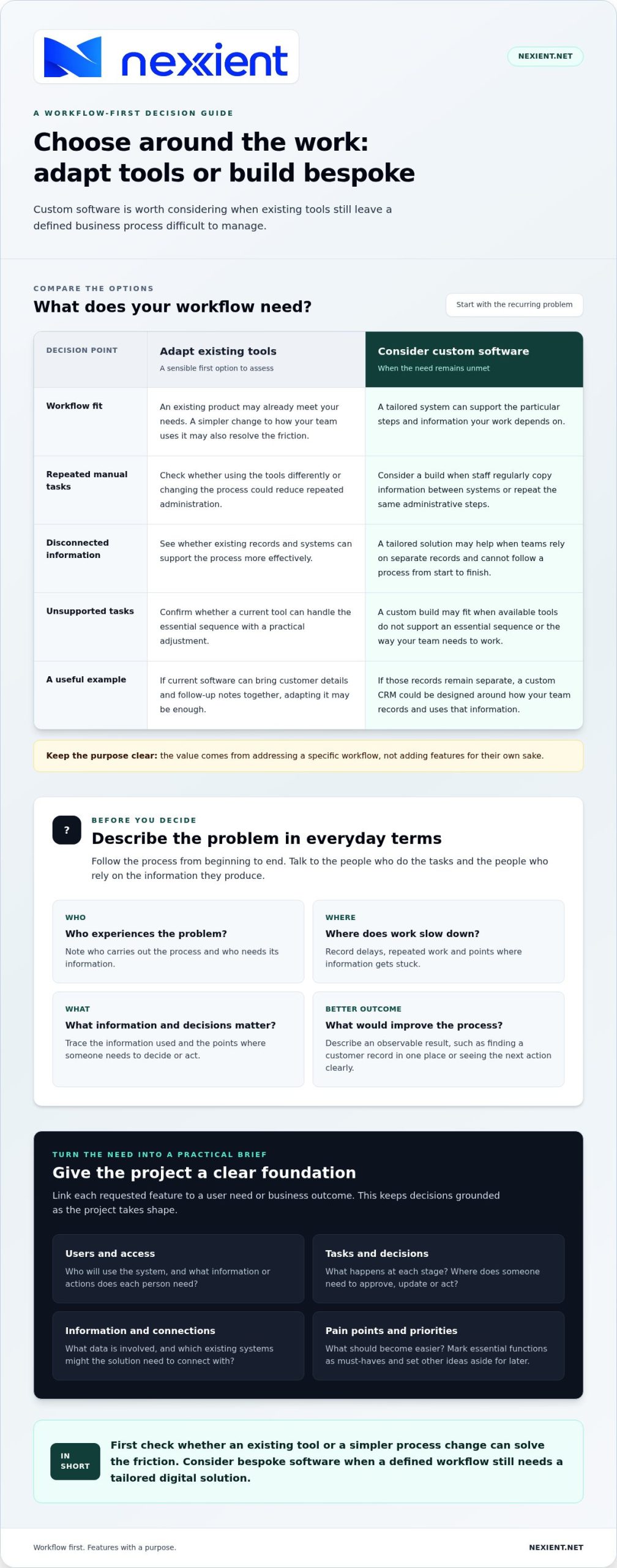
Custom software is a digital tool designed around a business’s particular workflows, users and requirements. Instead of asking your team to fit a standard product’s process, a tailored system can support the steps and information your work depends on. For a concise overview of the concept, see What is Custom Software?
A bespoke build isn’t automatically the right choice. Existing software may already meet your needs, or a change to how your team uses it may resolve the friction. Consider custom software development services when available tools still leave a defined process difficult to manage.
- Repeated manual tasks: Staff regularly copy information between systems or repeat the same administrative steps.
- Disconnected information: Teams rely on separate records, making it difficult to follow a process from start to finish.
- Unsupported workflows: Your tools don’t handle an essential sequence of tasks or the way your team needs to work.
For example, if customer details and follow-up notes are stored separately, a custom CRM system could be designed around how your team records and uses that information. The value comes from addressing the specific workflow, not adding features for their own sake.
Is bespoke software right for your current business challenge?
Start with the recurring problem. Note who experiences it, what happens now, where delays or repeated work occur, and what a better process would look like. Inconvenience alone doesn’t prove custom development is necessary. First consider whether an existing tool or a simpler process change could solve it.
Custom software is most relevant when a defined workflow needs a tailored digital solution. Describing the problem this way gives you a practical starting point for deciding whether to adapt what you have or develop something new.
How to turn a business need into a clear custom software brief
A clear brief starts with the work, not a wish list of features. Follow one process from beginning to end and record who carries it out, what information they use, where decisions happen and what causes friction. Talk to the people doing the tasks as well as those who rely on the information they produce.
Then describe the outcome you want in observable terms. For example, you might want staff to find a customer record in one place or see the next action clearly. Use the current process as a baseline so you can later assess whether the solution addresses the original difficulty. Define success in language that makes sense for your business.
What should a practical software development brief include?
Give your development partner enough context to understand the need and shape a realistic scope. Include:
- Users and access: Who will use the system, and what information or actions does each person need?
- Tasks and decision points: What happens at each stage, and where does someone need to approve, update or act?
- Information and connections: What data is involved, and which existing systems might the solution need to connect with?
- Pain points and priorities: What should the finished system reduce or make easier? Mark essential functions as must-haves and set other ideas aside for later.
A useful brief links each requested feature to a user need or business outcome. This keeps decisions grounded as the project takes shape. For another perspective on a tailored approach, read Benefits of Custom Software Development.
These details give custom software development services a practical starting point, so strategy and design can respond to real tasks rather than assumptions. If you have a defined business need, discuss your software project with Nexient.
What to expect from custom software development services in Worcestershire
A well-planned project turns a defined business need into a tool people can use in their everyday work. For businesses in Worcestershire, Nexient provides custom software development services that start with understanding the workflow, users and information involved. This gives the project a practical foundation before design or development begins.
Strategy and UI/UX design then shape how the solution should work and feel. UI/UX describes how people interact with a digital tool, from the information they see to the actions they take. Once the experience is defined, development brings the requirements to life. Reviewing the solution against the original business need helps keep decisions focused on the problem it is intended to address.
Nexient develops data-driven web applications for needs involving structured information and business processes. If the challenge is managing customer details and related activity, a custom CRM system can be shaped around how your team needs to organise and use its records. The right direction depends on the workflow, not on adding technology for its own sake.
How can a development partner keep the project focused?
Keep decisions tied to the agreed business need. Clarify priorities, connect design choices to real user tasks and revisit the brief when questions arise. For example, when a new feature is suggested, ask which user need it addresses and whether it is essential to the core process or can wait. This helps the team maintain a shared view of the project’s purpose.
With a defined challenge and a clearer sense of the process, you can discuss a custom software project with Nexient.
Shape software around the work ahead
Custom software development services are worth exploring when a clear business workflow needs a better-fit digital solution. Start by documenting who does what, where the process gets stuck and what a useful improvement would look like. A focused brief, with essential features linked to user needs, gives the project a practical foundation.
From clarifying the challenge to shaping the experience and developing the solution, each decision should stay connected to your business priorities. Nexient develops data-driven web applications and custom CRM systems for businesses in Worcestershire and across England.
Ready to turn a recurring challenge into a considered project? Discuss your custom software project with Nexient and take the next step with a clearer direction.
Frequently Asked Questions
What are custom software development services?
Custom software development services create digital tools around a business’s specific processes, users and information needs. Examples include data-driven web applications for handling business information and custom CRM systems for organising customer records. Nexient develops these tailored solutions for businesses in Worcestershire and across England, combining strategy, design and development around a defined business need.
When should a business choose custom software instead of off-the-shelf tools?
Choose custom software when existing tools can’t support an important workflow effectively, even after you’ve explored practical adjustments. Repeated manual entry, separated information or processes that don’t fit the software may point to a need for a tailored approach. First describe the problem, who experiences it and what should improve. If an existing tool already meets the need, a bespoke build may not be necessary.
What should I include in a custom software development brief?
Include the users, tasks, information involved and any existing systems the new solution may need to connect with. Explain where decisions happen, what access different users need and which parts of the current process cause difficulty. Then rank features as essential or possible future improvements. Link each requested feature to a user need or business outcome to keep the scope focused.
Can custom software be tailored to existing business workflows?
Yes. A tailored solution can reflect how your team currently handles tasks and information while addressing specific gaps in the process. Map the steps from start to finish, involve the people who use the workflow and identify what the software should make easier. Nexient develops web applications and custom CRM systems for businesses in Worcestershire, shaped around practical business requirements.