
What if the answer to scattered customer records and workarounds isn’t another off-the-shelf tool, but a system shaped around the way your team already works? A bespoke CRM can bring customer and operational information into clearer view, but it creates value when it fits your workflows and solves specific problems.
If your team is adapting its processes to software or relying on manual steps to fill the gaps, it’s reasonable to ask whether a tailored system would help. This guide will help you assess whether a bespoke CRM fits your needs, turn everyday workflows into clear requirements and understand the practical steps involved in planning a focused project. You’ll also see how Nexient’s strategic planning, design and development can help shape a CRM around the way your business operates, including if your business is based in Worcestershire.
Key Takeaways
- A bespoke CRM can organise customer records, interactions and business tasks around the way your team works.
- Map a key workflow first, then identify its users, information needs and desired outcomes.
- Separate essential launch requirements from later enhancements to keep your bespoke CRM focused and practical.
- Prepare for a project discussion by noting recurring friction and the changes you want a CRM to support.
Bespoke CRM: What It Is and When a Business Needs One
A bespoke CRM is customer relationship software shaped around your business’s processes, rather than a standard system your team has to work around. It can bring customer records, conversations and relevant tasks into one place, giving people a clearer view of what has happened and what needs attention. For a wider introduction to the fundamentals, see Customer relationship management (CRM).
The key question isn’t whether a newer interface or a longer feature list sounds appealing. Look for a recurring workflow problem. For example, staff may enter the same customer details in separate tools, or rely on messages and spreadsheets to pass an enquiry between teams. Trace how information moves through the business and note where it gets lost, repeated or delayed. A tailored system can then be scoped around that specific handover, rather than adding features that don’t address the underlying friction.
What problems can a bespoke CRM address?
Start by tracing one customer journey from beginning to end. Note where records become disconnected, information gets re-entered or a task depends on someone remembering to pass it on. For each point, write down who needs the information, what they need to do next and what a useful prompt or view would show. This turns a general wish for “better CRM” into a practical workflow to explore.
A bespoke CRM may be worth considering when these friction points happen regularly, affect several users or are difficult to resolve with your current tools. Custom software is not automatically the right answer, though. Suitability depends on your processes, the people who use them and the problem you’re trying to solve. If the main goal is simply a fresh look or more features, first clarify what should improve as a result. A clear outcome, such as reducing repeated data entry or making enquiry handovers easier to follow, gives the project a more useful starting point.
How to Scope a Bespoke CRM Around Your Workflows
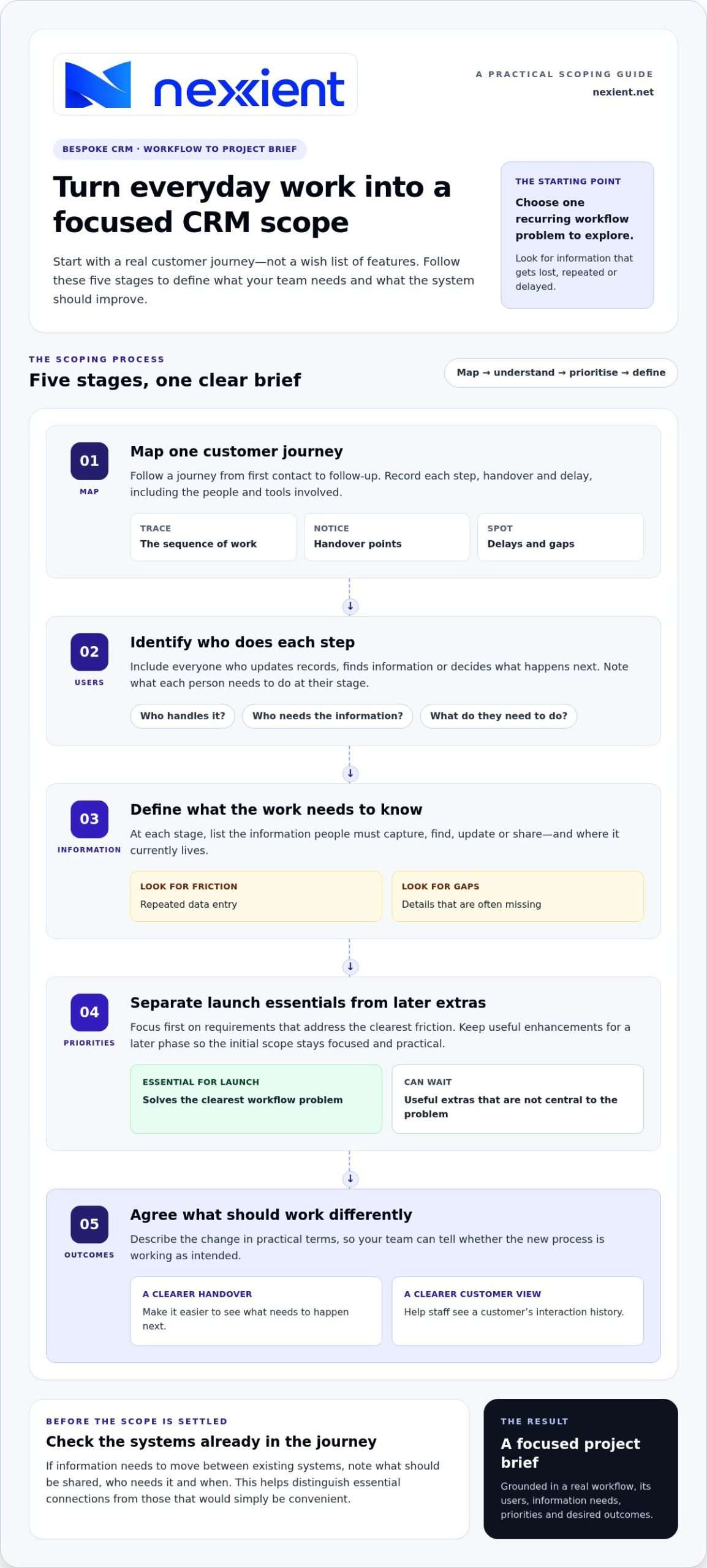
Start with the work, not a wish list of features. A custom-built business software approach makes most sense when requirements come from real tasks and user needs. Use this process to turn a day-to-day workflow into a focused project brief:
- Map a workflow. Choose one customer journey and note each step, handover and delay from first contact to follow-up. Include the people or tools involved at each stage.
- Identify users. List who handles each step and what they need to do. Include people who update records as well as those who need to find information or decide what happens next.
- Define the information. For each stage, record what users must capture, find, update or share, and where that information currently lives. Note any repeated data entry or details that are often missing.
- Set priorities. Mark what is essential for launch and what can wait. Focus first on requirements that address the clearest friction; leave useful extras for a later phase.
- Agree outcomes. Describe what should work differently, such as making a handover clearer or helping staff see a customer’s interaction history. Keep the outcomes specific enough that your team can tell whether the new process is working as intended.
Which CRM requirements should you define first?
Consider the systems already involved in the customer journey. If information needs to move between them, document what should be shared, who needs it and at what point in the workflow. This helps distinguish essential requirements from connections that would be convenient but are not central to solving the problem. Nexient’s custom systems development brings strategic planning, design and development together to shape a focused scope.
Not sure whether tailoring is the right route? Read Custom CRM vs Off-the-Shelf: The Definitive 2026 Decision Guide for a separate comparison. To discuss your workflow and priorities with Nexient, get in touch about your CRM project.
Plan Your Bespoke CRM Project with Nexient
A strong project starts with a clear picture of how your business works. Nexient designs and develops custom CRM systems shaped around practical workflows, bringing strategic planning, design and development together. That keeps the focus on the people who will use the system and the outcomes it needs to support, rather than features for their own sake. For businesses in Worcestershire, starting with a real workflow helps make the project discussion specific to how your team operates.
What should you bring to an initial CRM project discussion?
You don’t need a polished specification. A few practical notes can make the conversation more focused:
- One example workflow: Show how a customer or enquiry moves through your business, from the first step to the outcome.
- The people involved: Note who handles each stage and what information they need to record, find or pass on.
- Your current tools: List where customer details are stored and how staff use those tools during the workflow.
- Recurring friction: Point out repeated manual tasks, delays, duplicated information or unclear handovers.
- Desired outcomes: Describe what you want to become easier or clearer, such as seeing the status of an enquiry or knowing who needs to act next.
These details help turn the idea of a bespoke CRM into a project scope that reflects real work. Where your needs extend into wider digital services, Nexient also develops data-driven web applications.
Bring your notes, questions and priorities to a conversation with Nexient. Discuss a bespoke CRM project with Nexient and take the next step towards a system designed around your business.
Turn Your CRM Requirements into a Clear Plan
A bespoke CRM is most valuable when it addresses a real workflow need, not simply adds another feature. Start by documenting how work moves through your business, who needs to use the system and what outcomes matter. Then prioritise the essentials, leaving later enhancements for a future stage.
With that groundwork in place, you can approach the project with a clearer scope and shared priorities. Nexient brings practical strategy, design and development together for custom CRM systems and data-driven web applications, helping shape digital tools around the work they need to support.
Ready to explore what a tailored system could look like for your business? Discuss your bespoke CRM project with Nexient and take a confident first step towards a better-fitting workflow.
Frequently Asked Questions
What is a bespoke CRM?
A bespoke CRM is customer relationship management software designed around a business’s particular processes and information needs. Instead of asking users to follow fixed workflows, the project defines what they need to manage and how they work. A focused scope keeps the system centred on genuine operational requirements, rather than adding features simply because they’re available.
Is a bespoke CRM right for a small business?
It can be worth exploring if recurring tasks or customer information don’t fit your current tools. Business size alone doesn’t decide suitability. Identify the specific friction, who experiences it and what a better process would achieve. For a small business in Worcestershire, these notes can help clarify whether a tailored CRM is a practical next step.
Can a bespoke CRM work with existing business systems?
A bespoke CRM can be planned to work alongside existing business systems, depending on the tools and information involved. List the systems your team relies on, what information needs to move between them and why. Treat each connection as a requirement to scope, rather than assuming every system can connect automatically.
How much does a bespoke CRM cost?
There’s no single cost that applies to every bespoke CRM project. The workflows, features, information and system connections involved all affect the work required. Start by describing the operational problem you want to solve, then separate essential launch requirements from later enhancements. A focused scope gives you a more useful basis for discussing project costs.