
What if your CRM followed the way your business works, instead of asking your team to change its habits? When customer and operational information sits across spreadsheets, inboxes and disconnected processes, a generic system can add friction rather than clarity. The right crm development company starts by understanding the work behind each customer interaction, then turns those needs into a practical system.
You may know your current processes could work better, but still be unsure what a tailored CRM project involves. This article explains how to turn workflow needs into clear requirements, what planning and development can involve, and what to bring to an initial project conversation. For Worcestershire businesses, Nexient combines strategic planning, UI/UX design and development to create custom CRM systems around operational and data management needs.
Key Takeaways
- Spot workflow friction by noting repetitive tasks, scattered records and handovers where responsibilities are unclear.
- A crm development company can turn those observations into practical requirements when you describe real tasks, users and information needs.
- A focused process moves from discovery and workflow mapping through design, development, testing and handover.
- Bring your business goals, current processes and priority challenges to an initial conversation with Nexient to help shape the project scope.
Why CRM development should start with your business workflows
A crm development company plans and builds customer-management software around a business’s requirements. That means starting with the work people need to do, not a checklist of features. A CRM can organise customer information and interactions; Customer Relationship Management (CRM) also describes the broader approach to managing those relationships.
Look for workflow friction in everyday activities. Staff might enter the same details in more than one place, search separate records before a customer conversation, or be unsure who should follow up after a handover. These signs don’t automatically mean you need bespoke software. They do give you useful questions to investigate before deciding what a system should do.
A CRM is useful when its workflows fit the way your team serves customers. A tailored custom CRM system can be planned around the information and tasks that matter to your operation. Bespoke development is worth exploring when your important processes or data needs don’t fit a standard setup. If the main issue is a preference about how a screen looks, first decide whether it affects the work the system needs to support.
What should a CRM improve before software is designed?
Map the customer journey in practical terms, from the first enquiry to ongoing support. Speak with the people who handle each step, then record what they do, what information they need and where responsibility passes to someone else. This gives your CRM development company a stronger foundation for requirements than a feature wish list alone.
- Write down recurring tasks and where the details are recorded.
- Identify which customer information each person needs at each stage.
- Mark handovers and note what the next person needs to know.
Defining the workflow first helps keep design decisions tied to real business needs. It also makes it easier to separate essential requirements from features that can wait.
How a CRM development company turns requirements into a working system
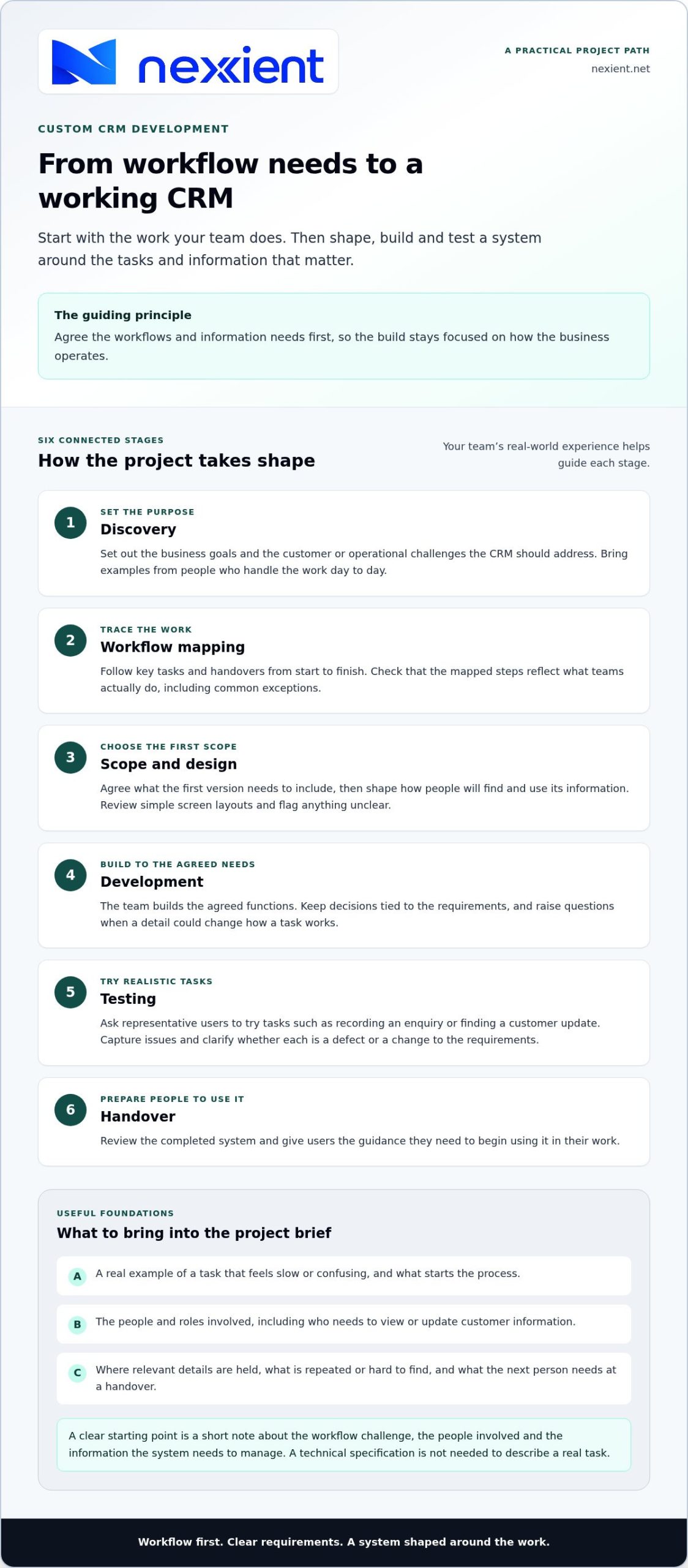
A crm development company turns business needs into a clear project through a series of connected stages. Your team’s input matters throughout: the people who use the system can explain what happens in practice, where decisions are made and what information is needed next.
- Discovery: Set out the business goals and the customer or operational challenges the CRM should address. Bring examples from staff who handle the work day to day.
- Workflow mapping: Trace key tasks and handovers from start to finish. Check that the proposed steps reflect what teams actually do, including any common exceptions.
- Scope and design: Agree what the first version needs to include, then shape how people will find and use its information. Review simple screen layouts and flag anything that feels unclear.
- Development: The team builds the agreed functions. Keep decisions tied to the requirements, and raise questions when a detail could change how a task works.
- Testing: Ask representative users to try realistic tasks, such as recording an enquiry or finding a customer update. Capture issues and clarify whether each one is a defect or a change to the requirements.
- Handover: Review the completed system and give users the guidance they need to begin using it in their work.
Good CRM scope follows agreed workflows and information needs, keeping the build focused on how the business operates.
What information helps shape a bespoke CRM brief?
Bring examples of customer journeys, recurring admin tasks and the places where relevant information currently lives. Note who uses each record, what they need to do with it and where details are repeated or hard to find. Nexient combines strategic planning and UI/UX design, which focuses on how people interact with a system, with development to create practical digital tools. Its custom CRM systems are shaped around business operations and data needs.
Have a project idea to explore? Share your CRM requirements with Nexient to start shaping the conversation.
Working with a CRM development company in Worcestershire: Nexient’s approach
For a Worcestershire business, a CRM project can bring customer information and everyday operations into a clearer structure. Nexient develops custom CRM systems and data-driven web applications to support business operations and data management. The focus is on connecting what the business needs with software people can use in their work.
A first conversation can bring business goals, workflow needs and project scope into the same discussion. For example, explain that staff need a clearer view of customer activity, then describe how information is currently recorded and passed between colleagues. That context helps define the problem and identify what a practical first scope could cover, rather than choosing features before the requirements are understood.
Nexient brings planning, design and development together to shape digital tools around business needs.
How can a Worcestershire business take the first step?
Start with a short project note. Describe the workflow challenge in everyday language, name the people involved and list the information the system needs to manage. You don’t need a technical specification; a real example of a task that feels slow or confusing is a useful place to begin.
- Outline what starts the process and what a successful handover looks like.
- Note which roles need to view or update customer information.
- List where relevant details are held and what needs to be brought together.
Where teams need connected information across business processes, data-driven web applications can provide a practical foundation for managing it. Bring your notes to a conversation to discuss priorities and shape a project scope around the work your business needs to do.
Ready to explore the fit for your business? Discuss a CRM project with Nexient.
Turn your next step into a clear project brief
A useful starting point doesn’t need to be a technical specification. Capture the customer or team challenge you want to address, the people involved and what a more workable process would look like. That gives a crm development company a practical foundation for discussing priorities and shaping a project around your business.
Bring the outline to a conversation with Nexient. Together, you can explore how business goals and day-to-day needs might translate into a considered project scope. You don’t need to have every detail decided in advance.
Map out your CRM project with Nexient and take the first step towards a system shaped around the way your business works.
Frequently Asked Questions
Is a custom CRM suitable for a small business?
Yes, a custom CRM can suit a small business if its specific processes or information needs aren’t served well by a standard setup. A Worcestershire firm might start by identifying one important task, such as tracking repeat enquiries or coordinating customer updates. A crm development company can help explore whether a focused system makes sense for that need and the people who’ll use it.
How long does CRM development take?
There’s no single timeframe, as the schedule depends on the agreed scope and how much design, development and testing the system needs. The number of workflows, data sources and decisions involved can all affect the plan. Discuss timing alongside the project stages, and clarify what your team needs to review or provide at each point.
What information should I prepare before discussing a CRM project?
Alongside your project goals, bring examples that show how your team currently records and uses customer details, such as an anonymised record or a blank form. Note which information is essential, which would be helpful later, and who should be able to view or change it. This helps turn general ideas into decisions about priorities and access.
Can a bespoke CRM be designed around existing business processes?
Yes, a bespoke CRM can be designed to reflect existing processes, including the variations teams handle in practice. Make a note of exceptions, such as a customer journey that needs approval before moving forward. This helps distinguish essential steps from habits worth reviewing, so the system can support the way your business works without simply reproducing every manual workaround.