
Could a cheaper off-the-shelf tool end up costing your Worcestershire business more in workarounds, wasted time and technical debt? When older systems struggle to keep pace, Laravel can provide a flexible foundation for a bespoke web application designed around how your business works.
It’s understandable to weigh a ready-made option against a custom build, particularly when security, future growth and investment are at stake. This article explains what to consider when assessing Laravel for a business application, from replacing outdated processes to planning for change. You’ll also find practical steps for defining requirements and evaluating a development project. Based in Worcestershire, Nexient designs and develops custom CRM systems and data-driven web applications, bringing functionality and user experience together to address practical business needs.
Key Takeaways
- Laravel can provide a foundation for a bespoke application that is easier to adapt as business needs change.
- Its development and security features can support a practical application, but careful design, testing and maintenance remain essential.
- Before development begins, map the business processes your application should improve and the outcomes you need.
- List the existing tools the application may need to connect with, then assess those requirements during planning.
What Is Laravel and Why Does It Power Modern Business Applications?
Laravel is a framework for building bespoke web applications and digital systems. A framework is a pre-built foundation that gives developers structured ways to handle common tasks, leaving them to focus on features that suit your business. For Nexient, Laravel can be considered as a foundation for bespoke CRM systems and data-driven tools.
Laravel is open-source, which means its underlying code is available for developers to use and adapt. Its use by businesses in the UK means it may be possible to find developers familiar with the framework. That can help avoid relying on a single supplier, although clear documentation and maintainable code still matter when planning for future development. Read the Laravel framework overview for background on its history and structure.
Understanding the Framework Concept for Non-Technical Managers
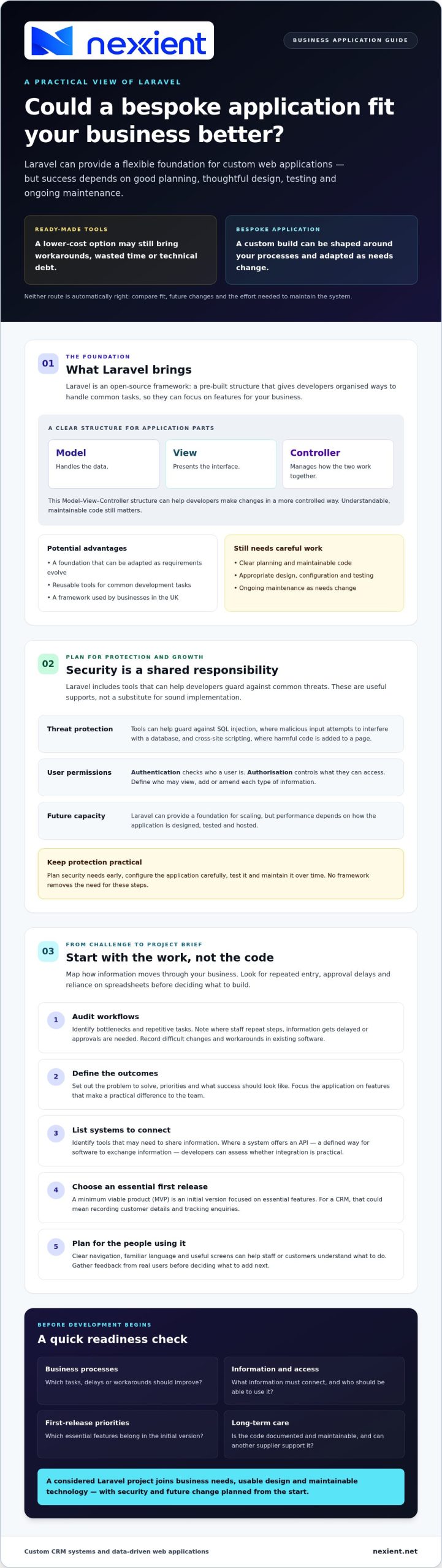
A framework gives a project an organised way to separate its moving parts. Laravel follows the Model-View-Controller (MVC) pattern: the model handles data, the view presents the interface, and the controller manages how the two work together. This separation can help developers make changes in a more controlled way.
That structure supports a clean-code approach: software is organised so people can understand, maintain and update it as requirements evolve. It doesn’t remove the need for careful planning, but it can make future changes easier to manage than software whose code is difficult to understand or change.
Practical step: Review your current software. List the changes that are difficult to make, the workarounds staff rely on and the information you need to connect. Ask a developer how the system is structured and whether another supplier could maintain its code. This gives you a clearer basis for deciding whether to improve, replace or extend it.
Strategic Advantages of Laravel for Worcestershire Business Growth
Custom software should solve a business problem without creating new delays. Laravel includes reusable tools for common development tasks, which can reduce repetitive work and support the development of bespoke web applications. The time involved depends on the project’s scope and requirements. A well-planned build can focus effort on features that make a practical difference to your team.
Security needs the same considered approach. Laravel provides tools that help developers guard against threats such as SQL injection, where malicious input attempts to interfere with a database, and cross-site scripting, where harmful code is added to a page. These protections can support safer handling of customer information, but no framework removes the need for careful configuration, testing and ongoing maintenance. For further background, consult the official Laravel technical documentation.
Security and Scalability: Protecting Your Digital Investment
Authentication checks who a user is; authorisation controls what they can access. Both matter in custom CRM systems, where different team members may need different permissions. Laravel can support these controls, but the project’s design must define them appropriately. For example, decide which roles can view, add or amend different types of information.
As a business grows, an application may need to handle more users and activity. Laravel can provide a foundation for scaling, but performance depends on how the application is designed, tested and hosted. Before development, assess expected growth, essential tasks and security needs. To understand the investment considerations, read this guide to the cost of bespoke software development in the UK. Nexient is based in Worcestershire and develops bespoke applications. The contact page is available if you want to discuss your application requirements.
Implementing Laravel: A Practical Roadmap for Scalable Success
A successful application starts with the work it needs to improve, not with code. Map how information moves through your business today: where staff re-enter data, wait for approvals or rely on spreadsheets. This discovery stage helps define the problem, priorities and measures of success before development begins. It can also reveal which existing tools, such as Xero or Salesforce, need to share information with your application. Where a system offers an API, a defined way for software to exchange information, developers can assess whether an integration is practical.
Plan for people as well as processes. Clear navigation, familiar language and useful screens help staff or customers understand what to do, supporting adoption. For further context, Built In discusses Laravel’s role in building scalable web applications, but the right design and features still depend on your specific needs.
Transitioning to a Bespoke Laravel Solution
Use these steps to turn an operational challenge into a considered project brief:
- Audit workflows: Identify bottlenecks and repetitive tasks. Note how often staff repeat steps, where information gets delayed and which tasks need approval. Then explore whether business process automation software in the UK could address them.
- Define a first release: Choose the essential features for an initial version, often called a minimum viable product (MVP). For example, a CRM might initially focus on recording customer details and tracking enquiries. Gather feedback from real users before deciding what to add next.
- Agree how the project will run: Work with a Worcestershire-based partner such as Nexient to clarify design, development, integration, maintenance responsibilities and decision-making.
Before committing, ask prospective partners how they’ll document requirements, test the application and plan for future changes. Also ask how they will check integrations and handle data transferred from existing systems. Clear answers help you compare proposals and understand what your investment is intended to deliver.
Build a Stronger Digital Foundation for Growth
A bespoke application should do more than replace an outdated system. It should fit your business processes, help your team work efficiently and remain adaptable as your needs change. Laravel can provide the foundation, but clear priorities, thoughtful planning and a design people can use are just as important.
For Worcestershire businesses, working with a local partner can help keep a project grounded in your goals. Nexient designs and develops websites, custom CRM systems and data-driven web applications. Start by noting the processes you want to improve, the information your teams need and the systems your application may need to connect with. These details will help shape a useful first conversation and a clearer project brief.
Ready to explore what a bespoke application could look like for your organisation? Talk to Nexient about your Laravel project.
Frequently Asked Questions
Is Laravel better than WordPress for a custom business application?
Laravel may be a better fit for a bespoke application with tailored workflows, user permissions or complex data handling. WordPress is commonly used for content-focused websites and may suit businesses that mainly need to publish and manage pages. The right choice depends on your requirements: list the tasks your software must support, then compare each platform against them.
How much does it cost to develop a bespoke Laravel application in the UK?
There’s no reliable single price for a bespoke Laravel application because the investment depends on its features, design, integrations and data requirements. For a useful proposal, document the main business problem, essential functions and systems involved. A Worcestershire-based provider such as Nexient can use this brief to scope the work and explain the proposed fees, stages and deliverables.
Can Laravel integrate with my existing business software and databases?
Laravel applications can often exchange information with existing software and databases, provided the systems support a suitable connection. For example, Xero or Salesforce may offer ways for software to connect, while other tools may require a custom API, a defined method for exchanging data. Ask your developer to check access, data formats and security needs before confirming feasibility.
How long does a typical Laravel web application project take to complete?
Project timescales depend on the application’s scope, integrations, design requirements and the availability of decisions and feedback. A focused first release may involve less work than a system with multiple workflows or complex data migration, meaning the transfer of information from an existing system into the new application. Ask your developer for a staged plan covering discovery, design, development, testing and launch, with assumptions clearly stated.