
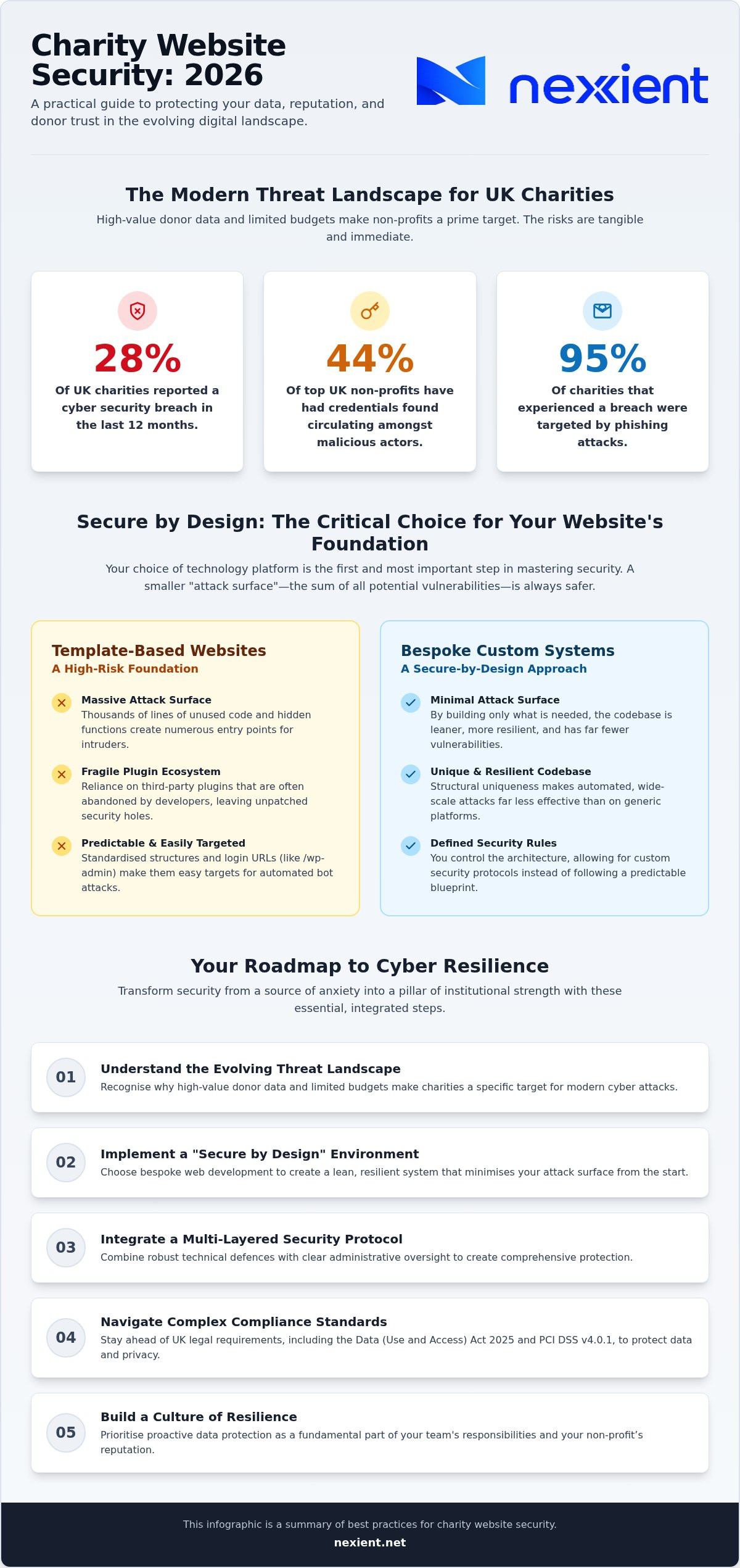
Did you know that 28% of UK charities reported a cyber security breach in the last 12 months? With credentials for 44% of the UK’s most recognisable non-profits already circulating amongst malicious actors, the risks to your mission are tangible and immediate. Strengthening your charity website security is no longer just a technical checkbox; it’s a fundamental act of stewardship. You likely understand that donor trust is your most valuable currency, yet staying ahead of the Data (Use and Access) Act 2025 whilst managing tight budgets can feel like an exhausting hurdle.
We promise to demystify these complex regulations and provide a clear, actionable roadmap to protect your digital assets. This definitive checklist explores the essential protocols for 2026, including the latest Cyber Essentials updates and PCI DSS v4.0.1 standards. You’ll discover how to build, verify, and maintain a resilient digital presence that empowers your growth. Let’s transform your security from a source of anxiety into a pillar of institutional strength that safeguards your reputation, your data, and your future.
Key Takeaways
- Understand the evolving 2026 threat landscape and why the combination of high-value donor data and limited budgets makes charities a specific target for modern cyber attacks.
- Discover how bespoke web development creates a “secure by design” environment by minimising your attack surface—the total sum of vulnerabilities available to a malicious actor.
- Implement a multi-layered roadmap for charity website security that integrates technical protocols with administrative oversight and the latest UK legal requirements.
- Navigate complex compliance standards, including the Data (Use and Access) Act 2025 and PCI DSS v4.0.1, to protect your financial integrity and donor privacy.
- Build a culture of resilience within your team that prioritises proactive data protection as a fundamental part of your non-profit’s digital reputation.
Understanding the Modern Cyber Threat Landscape for UK Charities
Effective charity website security is the proactive protection of donor data, financial integrity, and brand reputation. It isn’t just a technical requirement; it’s a fundamental act of stewardship that ensures your mission remains uninterrupted. By aligning your digital strategy with core information security principles, you protect the confidentiality of your supporters and the availability of your services. In 2026, the National Cyber Security Centre (NCSC) emphasises that security must be a board-level priority for every UK non-profit, regardless of size or income.
Non-profits are prime targets because they often sit on a goldmine of personal and financial data whilst operating with lower security investment than commercial entities. Recent data shows that 28% of UK charities reported experiencing a cyber security breach or attack in the last 12 months. Attackers recognise this vulnerability, viewing the sector as an entry point to sensitive donor records and payment systems. This creates a dangerous imbalance that requires a strategic, modern response.
Why Charities are Vulnerable Targets in 2026
Automated attacks now scan the web for common vulnerabilities in generic plugins every second. Many organisations rely on off-the-shelf platforms where a single unpatched flaw can open the door to thousands of sites simultaneously. Beyond technical gaps, attackers use social engineering to exploit the inherent helpfulness of charity staff. They leverage your mission-driven nature to bypass protocols through deceptive emails or phone calls. Limited IT resources often lead to delayed updates, leaving known doors wide open to threats that could be mitigated through more robust custom systems. Common vulnerabilities include:
- Outdated Plugins: Using generic software that hasn’t been updated to patch known security flaws.
- Social Engineering: Deceptive tactics designed to trick staff into revealing passwords or sensitive data.
- Phishing Attacks: Malicious emails that appear to be from trusted sources, affecting 95% of charities that experienced a breach.
The True Cost of a Digital Security Breach
The legal ramifications under UK GDPR for failing to protect personal data are severe, but the financial penalties are often eclipsed by the ‘Trust Tax’. This is the long-term erosion of your reputation that follows a breach. When donor data is leaked, the emotional connection to your cause is severed, often leading to a sharp drop in recurring donations. It’s a heavy price for any organisation to pay, as trust is far harder to rebuild than a database.
Cyber Resilience is the ability to anticipate, withstand, and recover from attacks whilst maintaining core operations. This mindset shifts the focus from merely preventing attacks to ensuring your charity can perform under pressure. By following the latest NCSC guidelines, you can transform your digital presence from a potential liability into a verified asset that inspires donor confidence.
Secure by Design: Custom Software Development vs Off-the-Shelf
Choosing the right foundation for your digital presence is the first step in mastering charity website security. In the world of cyber defence, we often talk about the “attack surface”. This is the total sum of entry points and vulnerabilities available to a hacker. Popular off-the-shelf templates often come with a massive attack surface because they’re designed to be everything to everyone. They include thousands of lines of code and hidden functions that your charity will likely never use, each representing a potential door for an intruder to kick down.
Bespoke custom software development offers a powerful alternative. By building only what you need, you create a leaner, more resilient codebase. This approach avoids the “target on back” nature of generic platforms. When a vulnerability is found in a major template used by millions, every site on that platform becomes a target overnight. Bespoke systems benefit from a degree of structural uniqueness that makes automated, wide-scale attacks far less effective. They allow you to define your own rules rather than following a predictable blueprint.
The Risks of Template-Based Charity Sites
Generic sites often rely on a fragile ecosystem of third-party plugins. Many of these tools are eventually abandoned by their developers, leaving your site exposed to unpatched threats. This leads to the “bloatware” problem, where unnecessary code creates hidden security holes that are difficult to monitor. Standardised login URLs, such as /wp-admin, also make it incredibly easy for bots to launch brute-force attacks. As noted in the UK government cyber crime guidance, charities must be vigilant about these common entry points. You can significantly reduce risk by moving away from predictable architectures that hackers have already mapped out.
Benefits of a Bespoke Security Architecture
A custom-built system acts as a visionary architect for your data. It ensures that your database structures are specifically designed to protect sensitive donor history rather than fitting into a one-size-fits-all model. As non-profits grow, they often require sophisticated data-driven web applications that generic platforms simply cannot secure effectively. These bespoke solutions allow for granular control over who accesses what data and how it is stored. Learn how custom systems provide better security for non-profits by exploring our architectural approach. If you’re ready to move beyond the limitations of generic templates, we can help you build a platform that is secure by design from the very first line of code.
The 2026 Charity Website Security Checklist
Security is never a static destination; it’s a continuous journey of vigilance. To build a resilient digital presence, you must adopt a “Defence in Depth” strategy. This approach ensures that multiple layers of security work in harmony, so if one barrier is breached, others remain to protect your assets. In 2026, robust charity website security is built upon four essential pillars. Technical controls provide the digital barriers, whilst administrative policies define the rules of engagement. Legal compliance ensures you meet UK standards, and a strong security culture ensures your team remains an active line of defence.
Establish a rigorous routine for regular, automated backups. These must be stored in a separate, off-site location to ensure they aren’t affected by an incident on your primary server. If your site is compromised, a clean, recent backup is your fastest route to recovery and minimises potential downtime. Treat security as a living process that evolves alongside new threats rather than a project you complete once.
Technical Security Essentials
Start with the technical foundations. Every interaction on your site must be encrypted using the latest SSL/TLS certificates. These certificates establish a secure link between a web server and a browser, ensuring that sensitive data remains private during transit. Next, implement a Web Application Firewall (WAF). A WAF acts as a digital filter, inspecting incoming traffic and blocking malicious requests before they ever reach your server. Finally, make Multi-Factor Authentication (MFA) mandatory for every user with administrative access. By requiring a second form of verification, such as a code sent to a mobile device, you render stolen passwords practically useless and significantly harden your perimeter.
Administrative and Access Controls
Managing who can touch your data is just as vital as your technical barriers. Implement the Principle of Least Privilege, which ensures that staff and volunteers only have access to the specific information and tools they need for their roles. This limits the potential damage if an individual account is compromised. You should also conduct monthly user audits to identify and remove access for former team members immediately. “Ghost accounts” are a common entry point for attackers because they are often unmonitored.
Your choice of hosting provider is a cornerstone of this strategy. Choose a partner that offers proactive monitoring and robust protection against Distributed Denial of Service (DDoS) attacks. These attacks attempt to overwhelm your site with artificial traffic to take it offline. Following the UK government guidance on cyber crime provides a solid framework for these administrative tasks. For organisations handling complex requirements, a custom CRM system can offer superior granular access controls compared to generic alternatives, ensuring your donor data stays exactly where it belongs.
Protecting Donor Data: Compliance and Payment Security
Protecting donor data is the heartbeat of your organisation’s reputation. When you manage an ecommerce-enabled charity site, you take on a significant responsibility for financial safety. Effective charity website security in 2026 requires more than just a locked door; it demands a sophisticated approach to how data flows and where it rests. One of the most effective ways to lower your risk is to ensure your charity never actually touches or stores raw credit card data on your own servers.
By outsourcing payment handling to specialist providers, you transfer the heaviest security burdens to experts whose entire business model relies on impenetrable encryption. This shift doesn’t just protect your supporters; it simplifies your legal obligations and allows you to focus on your core mission without the constant fear of a financial data leak.
Safe and Secure Payment Gateways
Using off-site payment processing through platforms like Stripe or GoCardless creates a vital buffer between a hacker and your donor’s bank account. These systems use tokenisation, which is a process that replaces sensitive financial details with a unique, non-sensitive code or “token” during the transaction. Even if your site were compromised, the attacker would find no usable credit card numbers amongst your records. PCI-DSS compliance is a mandatory standard for anyone accepting card payments.
Data Management and GDPR Compliance
Beyond payments, you must respect the personal data your supporters share. UK GDPR mandates strict rules on data retention and the “Right to be Forgotten,” which allows individuals to request the complete deletion of their records. To manage this effectively, you need to organise your database so that personal data is easily identifiable and deletable. A messy spreadsheet or a bloated, generic database makes compliance nearly impossible and increases the risk of accidental exposure.
Many non-profits find that custom CRM systems are the best way to centralise and secure this information. These bespoke tools allow you to build “compliance by design” into your workflow, making it simple to track consent and update your Privacy Policy. Your Privacy Policy should be clear, accessible, and updated to reflect the Data (Use and Access) Act 2025. If you’re looking for a simpler starting point, explore our brochure website solutions with built-in compliance.
We can help you build a platform that protects your donors whilst empowering your mission through strategic digital craftsmanship. Contact our Worcestershire team today to secure your charity’s digital future.
Nexient: Securing Charity Growth in Worcestershire
Nexient isn’t just a development agency; we’re your local Worcestershire partners. We understand that for non-profits, your digital presence is the front door to your mission. Our “Security First” philosophy ensures that charity website security is integrated into the very first wireframe of every bespoke web design project. We don’t believe in bolting on protection at the end. Instead, we architect systems where safety and performance are inseparable foundations for your growth.
Our process is methodical, purposeful, and transparent. It begins with strategic planning to map out your data flows and user journeys, followed by clean, efficient development that avoids the inherent vulnerabilities of generic templates. We focus on digital craftsmanship that prioritises the “how” and “why” of your website’s functionality. Once your site is live, we provide long-term support to ensure your defences evolve alongside new threats. We invite local organisations to join us for a comprehensive security audit to identify hidden vulnerabilities in their current platforms before they become critical issues. This proactive approach turns your website into a stable pillar of your organisation’s reputation.
Bespoke Solutions for Mission-Driven Organisations
We build high-performance sites that prove you don’t have to sacrifice aesthetic quality for robust protection. Working with a local agency means you have a partner who truly understands the specific UK regulatory landscape, including the latest NCSC standards and the Data (Use and Access) Act 2025. We specialise in creating digital tools that empower your team whilst keeping donor data locked tight. Our designs are modern, energetic, and deeply invested in your success. View our specialised web design for Worcestershire charities to see how we blend sophisticated form with resilient function.
Start Your Security Journey with Nexient
Taking the first step toward a more secure digital presence doesn’t have to be overwhelming. We offer transparent, fixed-price project fees for professional charity websites, ensuring you can plan your budget with total confidence. Whether you need a simple brochure site or a complex data-driven web application, our team is ready to help you build a resilient future. Contact Nexient today to discuss your charity’s security needs and let’s secure your growth together.
Future-Proofing Your Charity’s Digital Stewardship
Building a resilient digital presence requires a shift from reactive fixes to proactive architectural design. By prioritising bespoke development and lean codebases, you move away from the vulnerabilities of generic platforms and create a “secure by design” environment. This strategic approach ensures your charity website security remains robust whilst fostering deep donor trust and operational stability. It’s about creating a platform that protects your mission as effectively as it promotes it.
Managing data protection and payment compliance doesn’t need to be a technical burden. As specialists in bespoke UK charity web development and secure custom CRM systems, we help you navigate the 2026 regulatory landscape with confidence. Based in Worcestershire, our team provides the local support and strategic planning needed to safeguard your reputation and donor data. It’s time to transform your security from a source of anxiety into a pillar of institutional strength that supports your long-term growth.
Secure your mission with a bespoke charity website from Nexient and begin your journey toward a more resilient digital future today. Your vision deserves a foundation that is as secure as it is ambitious.
Frequently Asked Questions
Is a WordPress site secure enough for a UK charity?
WordPress can be secure if managed perfectly, but its popularity makes it a constant target for automated attacks. For many organisations in Worcestershire, the maintenance burden of patching generic plugins becomes a risk in itself. Bespoke charity website security offers a leaner alternative by removing the unnecessary code that hackers often exploit. By choosing custom development, you eliminate common vulnerabilities and ensure your platform is built specifically for your non-profit’s needs.
What is the most common cyber attack facing small charities in 2026?
Phishing remains the most prevalent threat, accounting for 95% of reported breaches according to 2026 data. Attackers often target the helpful nature of charity staff to gain access to sensitive systems through deceptive emails. Additionally, automated bots constantly scan for outdated plugins in generic software. Small charities should focus on staff training and multi-factor authentication to neutralise these common entry points. Building a culture of resilience is vital for your digital defence.
How often should our charity perform a website security audit?
You should perform a comprehensive security audit at least once a year. However, if your organisation handles significant donor data or has recently updated its core software, quarterly reviews are much safer. These audits identify hidden vulnerabilities before they can be exploited by malicious actors. Our team in Worcestershire recommends regular checks to ensure your site remains compliant with the latest UK government standards and NCSC Cyber Essentials requirements.
Does my charity need to be PCI-DSS compliant if we use a third-party payment processor?
Yes, every organisation that accepts card payments must comply with PCI DSS v4.0.1. Whilst using a third-party processor like Stripe simplifies the process, you are still responsible for ensuring your website correctly integrates these tools. This usually involves completing a Self-Assessment Questionnaire to verify that you aren’t accidentally storing sensitive data. Maintaining this compliance is a non-negotiable part of protecting your charity’s financial integrity and donor trust in 2026.
What is the difference between an SSL certificate and a Web Application Firewall?
These tools serve two distinct but equally important roles in your digital defence. An SSL certificate encrypts the connection between your visitor and the server, ensuring data stays private during transit. A Web Application Firewall (WAF) acts as a digital filter that blocks malicious traffic and automated bots before they can even reach your website. You need both to create the “Defence in Depth” strategy required for modern non-profit data protection.
Can bespoke software development really be more secure than a standard platform?
Bespoke development is inherently more secure because it follows a “secure by design” philosophy. Standard platforms often include unnecessary features and predictable login paths that hackers have already mapped out. By building a custom system, you remove this “bloatware” and create a unique architecture that is far harder for automated tools to penetrate. This tailored approach allows you to focus resources on protecting the specific data that matters most to your mission.
How do I explain the need for a security budget to our board of trustees?
Frame the security budget as an investment in your “Trust Currency” rather than a technical expense. Explain that the “Trust Tax” following a breach is far more expensive than proactive protection. Highlight that trustees have a legal responsibility to safeguard donor data under the Data (Use and Access) Act 2025. Demonstrating that charity website security is a pillar of your digital reputation helps the board see it as a strategic necessity for growth.
What should we do immediately if we suspect our charity website has been breached?
You must act quickly to isolate the affected systems and prevent further data loss. Follow the NCSC guidance by changing all administrative passwords and checking your logs for unauthorised activity. If personal data is compromised, you must inform the Information Commissioner’s Office (ICO) within 72 hours. Once the threat is neutralised, restore your site from a clean, off-site backup. Taking these structured steps helps you recover whilst maintaining transparency with your supporters.