
A bespoke e-commerce platform is only as strong as the decisions behind its build. For secure e-commerce platform development in the UK, costs depend on features, integrations, platform complexity and business requirements, so no single figure suits every project. Security shapes those decisions too: customer data, payment journeys and ongoing maintenance all need careful planning.
It makes sense to look beyond the launch cost: a platform must support how your business sells while protecting customer trust. This guide explains what shapes bespoke development costs, which security risks merit attention and how a custom build moves from requirements through testing to launch.
You’ll also see how an experienced digital partner can shape the brief, build the right functionality and keep security in view throughout development. Start with the factors that matter most, then use them to define a platform built for your business and its customers.
Key Takeaways
- Scope the platform around your required features, integrations and business needs to understand what will drive development costs.
- Plan secure payment gateway integration carefully, including how payment information is handled and where extra verification may be useful.
- Build trust with clear privacy information, customer contact details and signals that help shoppers feel confident at checkout.
- Shape a bespoke build around your workflows, then allow time for development, integration and testing before launch.
Are there any security risks involved with eCommerce sites?
Security risks can arise in payment processes and connected business systems. Secure development includes checking payment services, testing connections and planning reviews after launch.
Secure payment gateway integration
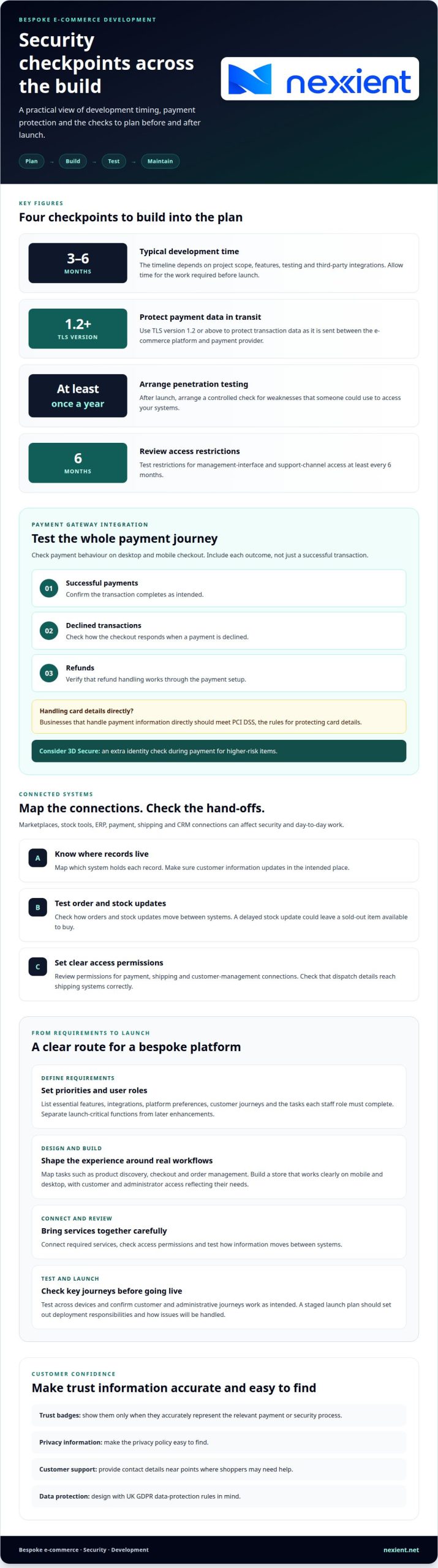
A payment gateway passes transaction details between the ecommerce platform and payment provider. Protect data as it is sent using TLS version 1.2 or above. Businesses that handle payment information directly should meet PCI DSS, the rules for protecting card details. Consider 3D Secure, an extra identity check during payment, for higher-risk items. During integration, test successful payments, declined transactions and refunds on desktop and mobile checkout.
Connections to marketplaces, stock tools and ERP (enterprise resource planning) systems, which help manage business operations, can affect security and daily work. Map which system holds each record, then test how orders and stock updates move between them. For example, a delayed stock update could leave a sold-out item available to buy. Payment, shipping and CRM (customer relationship management) connections, which help manage customer information, also need clear access permissions. WooCommerce works with payment systems such as PayPal and Stripe, so test the chosen setup across the complete order journey. Check that dispatch details reach shipping systems correctly and customer records update in the intended place.
Post-launch security checks
After launch, arrange penetration testing at least once a year. This is a controlled check for weaknesses that someone could use to access your systems. Test management-interface and support-channel access restrictions at least every 6 months. According to the UK legislation register, developers should design with UK GDPR data-protection rules in mind. Ongoing reviews can assess access, payment processes and connected systems. To make those checks practical, provide the professional with system roles, connection details and a route for reporting operational changes.
How much is custom e-commerce development in the UK?
The project price depends on its scope and is given after a quote request. Key cost factors include tailored functionality, Magento customisation, integrations, design and testing. A simple online shop has different needs from a B2B ecommerce platform with customer-specific pricing, account approvals and repeat-order tools. Define these requirements early to shape a realistic project scope.
Custom e-commerce software can adapt the shopping journey to your customers. A business-to-business buyer, for example, may need to reorder previous purchases, while a retail customer may need clear product choices and a straightforward checkout. Each additional journey affects design, development and testing. Decide which functions are essential at launch and which can come later.
Plan customer and administrator authentication as part of the project scope. Customer accounts may need order histories, while admin access should reflect staff responsibilities. List user roles and the tasks each role must complete. This helps define permissions without adding unnecessary complexity.
Trust elements need careful placement too. Show trust badges only when they accurately represent the relevant payment or security process. Make the privacy policy easy to find, and provide customer contact details near points where shoppers may need help. These details support confidence, but must reflect how the online shop actually operates.
For a tailored estimate, bring together your platform preference, required features, integrations and customer journey. Discuss your e-commerce project with Nexient to turn those requirements into a defined scope.
Bespoke e-commerce website development
A professional develops a bespoke platform by defining requirements, designing the experience, building functionality, then testing and launching it. Development typically takes 3-6 months, depending on scope, features, testing and third-party integrations.
Bespoke platform development
A custom e-commerce website is shaped around your products, workflows and growth plans. The team first maps key tasks, such as product discovery, checkout and order management. That brief guides technical choices, design and integrations. Shopify may suit different requirements, while bespoke development lets the project focus on your specific operations. Look for a responsive online store that works clearly on mobile and desktop, with room to refine functionality as your business develops.
Secure development and launch steps
Once the scope is agreed, the team designs the platform structure and builds its core features. It then connects the required services, reviews access permissions and tests the e-commerce website across devices. Before launch, the team checks that key customer and administrative journeys work as intended. A staged launch plan sets out deployment responsibilities and how issues will be handled, giving your team a clear route from development to live operations.
To keep the build focused, provide product information, brand assets, operational requirements and details of essential integrations. A store serving several customer types, for example, may need distinct account journeys and permissions. Clear priorities help the development team separate launch-critical functions from later enhancements, keeping the initial scope aligned with business needs.
Discuss your bespoke e-commerce project and define a practical route from requirements to launch.
Nexient
Nexient can turn your e-commerce requirements into a clear project scope and a professionally developed platform. If your current online shop needs bespoke functionality, or you’re planning a new store, Nexient’s eCommerce Websites service takes your business goals towards a customer-focused website. Nexient can also help plan how design, integrations and future maintenance fit into the wider project, so priorities are clear before development moves forward.
Bring your platform aims, essential features and operational needs into the conversation. Together, these details can guide a practical next step, whether you’re refining an existing ecommerce website or planning a new one. Contact Nexient to discuss your project.
Shape your next step with confidence
Use your project brief to set a clear direction: describe the customer experience you want, the business processes the platform must support and how you’ll measure progress. This gives secure e-commerce platform development in the UK a practical starting point, helping the team turn ambitions into focused decisions. Nexient’s Business Websites, eCommerce Websites and Landing Pages serve different business needs, with the right direction shaped by your goals.
You don’t need every detail resolved before starting a conversation. Bring your priorities and questions, then work towards a scope that reflects your plans and gives the project room to evolve. Discuss your e-commerce project with Nexient and take the next step towards a platform built around your business.
Frequently Asked Questions
How does a professional choose the best e-commerce platform and content management system for a business?
Choose a platform and content management system suited to your catalogue, sales model, integrations and internal skills. A retailer with standard products and straightforward fulfilment may need different tools from a wholesaler with account-specific pricing and repeat orders. A professional maps essential workflows, then assesses how each option supports the required functions, updates and planned growth.
What makes a professional eCommerce website design company stand out?
A strong e-commerce design company connects visual design with business operations. A professional working on secure e-commerce platform development in the UK should clarify the project scope, turn customer and staff needs into practical journeys, and plan testing before launch. Look for clear communication and decisions explained in plain language. For a Worcestershire business, the design should reflect its customers and fulfilment needs.
Why does the UK need serious e-commerce development in 2026?
UK businesses need platforms that support secure transactions, dependable operations and changing customer journeys, not simply an online catalogue. UK e-commerce revenue is expected to grow by around 7 percent per year through 2029. Development that connects checkout, stock control and customer service can help businesses prepare their operations to support this market direction.
Will my eCommerce website be responsive and adapt to all mobile devices?
A responsive layout adjusts to different screen widths, helping shoppers browse and buy on mobile devices. During development, define important mobile tasks, such as filtering products, changing basket quantities and completing checkout. Testing these journeys on phones and tablets helps identify layout or usability problems before launch.
What are the key security requirements for e-commerce platforms in the UK?
Secure e-commerce platform development in the UK should protect information sent between shoppers and websites using TLS, which encrypts data in transit. Businesses that handle payment information directly should meet PCI DSS, a security standard for payment card data. UK GDPR is the UK’s data-protection framework; developers should design with its rules in mind, including ways to handle requests to delete or anonymise personal data.