
In 2026, your online presence is no longer a digital business card; it is the high-performance engine of your entire commercial strategy. Many business owners across the UK feel overwhelmed by technical jargon and the persistent fear of investing in a platform that fails to convert. You likely recognise that a stunning interface is hollow without the strategic engineering required to drive growth, yet the distinction between web design and website development often remains frustratingly blurred.
We will help you master the essentials of modern digital architecture to transform your site into a high-performing business asset. By reading this guide, you will gain a clear understanding of the development lifecycle, find the confidence to choose between bespoke and off-the-shelf solutions, and learn how to trigger local growth. We focus on vision, craft, and results, ensuring your next project delivers the clarity, efficiency, and precision your brand demands. It is time to move beyond simple templates and start building for performance, scalability, and long-term success.
Key Takeaways
- Understand the critical distinction between aesthetic web design and the structural engineering of your site to ensure your digital presence is built for performance.
- Discover how strategic website development balances intuitive front-end experiences with robust back-end logic to drive measurable business growth.
- Identify the hidden costs and technical limitations of off-the-shelf templates whilst exploring the long-term scalability of bespoke, data-driven solutions.
- Master the non-negotiable technical standards for the 2026 UK market, including lightning-fast load speeds and a mandatory mobile-first architecture.
- Learn how a methodical strategy and prototyping phase can eliminate technical jargon and align your digital investment with your specific commercial goals.
What is Website Development? Beyond the Code
To many, a website is simply a collection of pages and pictures. In reality, website development is the structural engineering of your digital presence. It is the invisible framework that ensures your site remains stable, secure, and swift. Think of it as constructing a digital landmark. For Worcestershire businesses, this landmark serves as a permanent, high-performance anchor in a shifting marketplace. While marketing campaigns come and go, your development foundation remains the engine room that powers every interaction.
Build with purpose. Scale with confidence. Lead with authority. These are the hallmarks of a site that treats development as a strategic asset rather than a technical chore. When you invest in the structural integrity of your platform, you create a resilient tool that supports your long-term vision. It moves your business beyond being a mere participant in the digital space to becoming a dominant force.
The Difference Between Web Design and Web Development
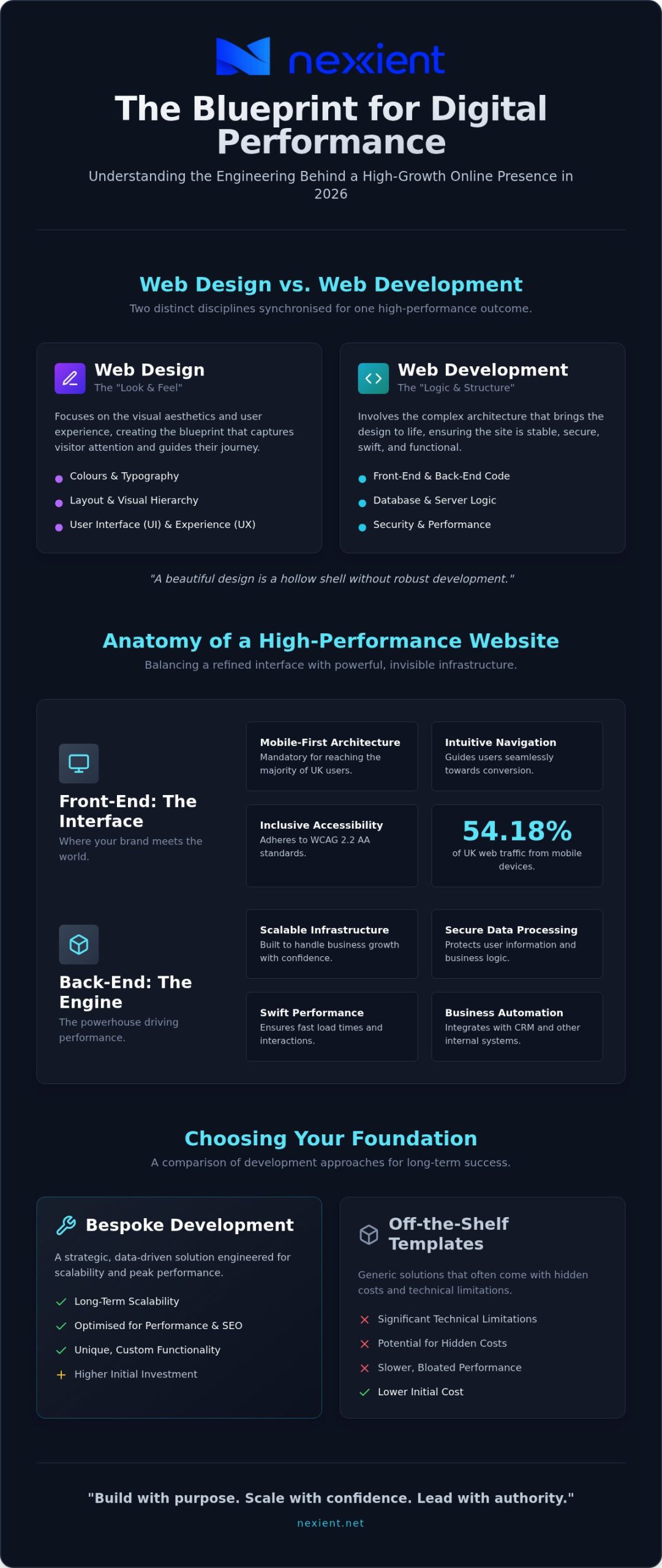
Design and development are two halves of a whole, yet they serve distinct purposes. Web design focuses on the visual aesthetics: the colours, the typography, and the layout. It is the “look” that captures attention. Development, however, is the “logic” that retains it. It involves the complex architecture that makes buttons work, forms submit, and data flow safely behind the scenes. Logic retains it.
Successful projects require these disciplines to be perfectly synchronised. User Interface (UI) and User Experience (UX) design provide the blueprint, but development brings that vision to life. Without robust logic, a beautiful design is merely a hollow shell. By aligning creative action with practical outcomes, you ensure your site doesn’t just look the part but performs under pressure.
The Role of Modern Web Development in Business Growth
Effective development does more than display information; it drives tangible growth. It transforms passive visitors into active leads through seamless navigation and intuitive pathways. When your site is engineered correctly, it removes the friction that causes potential customers to drop off. In a competitive local landscape like Worcestershire, having a site that loads instantly and functions flawlessly provides a significant edge over competitors using generic, sluggish templates.
Beyond the front end, smart website development can automate internal processes. Custom CRM systems or data-driven web applications can handle enquiries, manage bookings, and organise customer data without manual intervention. This efficiency allows you to focus on high-level strategy rather than administrative tasks. Ultimately, a well-developed site establishes immediate credibility amongst a UK-wide audience. It signals that your business is modern, reliable, and deeply invested in the user’s journey.
The Anatomy of High-Performance Website Development
High-performance website development is far more than a collection of scripts and stylesheets. It is a dual-layered architecture where every line of code serves a specific commercial purpose. To build a digital asset that endures, you must balance the immediate impact of the interface with the invisible power of the infrastructure. This synergy is what separates a generic, brittle template from a bespoke business tool that scales as you grow. Think of it as a masterplan where craftsmanship meets strategy.
Precision matters. Efficiency wins. Scalability delivers. When these three elements converge, your website stops being a static page and starts being a dynamic asset. By focusing on clean, modular code from the outset, you reduce technical debt and ensure your platform remains agile enough to adapt to future market shifts without requiring a total rebuild.
Front-End: The Face of Your Digital Asset
The front-end is where your brand meets the world. It involves crafting a responsive, robust, and refined interface that adapts seamlessly across mobile, tablet, and desktop devices. With mobile devices accounting for 54.18% of human-driven web traffic in the UK as of mid-2026, a mobile-first approach is no longer optional. It is the baseline for success. Your development team must prioritise touch-friendly navigation and lightning-fast rendering to keep users engaged.
Accessibility is another cornerstone of modern front-end engineering. Adhering to WCAG 2.2 AA standards ensures your site is usable for everyone, fulfilling legal obligations whilst demonstrating a commitment to inclusive design. Interactive elements should be purposeful, using subtle animations and clear pathways to guide user behaviour toward your desired outcomes. Every click should feel intuitive; every transition should feel intentional.
Back-End: The Engine Powering Your Operations
If the front-end is the showroom, the back-end is the factory. This is where data is processed, servers are coordinated, and complex logic is executed. A high-performance back-end manages database storage securely and facilitates seamless API integrations, allowing your website to communicate with third-party tools or internal software. This hidden architecture is what allows for the creation of bespoke CRM systems that can automate your lead management and streamline daily operations.
Robust back-end development ensures that even the most data-heavy web applications remain stable under pressure. It provides the logic required for eCommerce transactions, member portals, and custom reporting tools to function without a hitch. When your back-end is engineered with precision, it provides the security and speed necessary to protect your reputation and your data. Full-stack expertise brings these two worlds together, creating a unified digital landmark that is both beautiful to look at and powerful to use.
Bespoke Development vs. Off-the-Shelf Solutions
Choosing the foundation for your digital presence is a pivotal commercial decision. It defines your trajectory. Whilst template-based builders offer an immediate entry point, they often impose rigid boundaries on your brand’s evolution. Strategic website development involves evaluating whether you need a quick, temporary solution or a permanent digital landmark. The choice between bespoke craftsmanship and off-the-shelf convenience depends entirely on your specific stage of growth and your long-term operational requirements.
Evaluate your needs. Audit your costs. Secure your future. A bespoke approach ensures that every pixel and process serves your unique business model, whereas a template forces your business to fit into a pre-defined box. As your organisation matures, the limitations of “the box” become increasingly apparent, often leading to a costly migration later down the line.
When to Choose a Template-Based Builder
Template builders like Wix or Squarespace are practical tools for micro-businesses and start-ups. If your primary goal is a simple brochure site with minimal functional requirements, these platforms provide a quick time-to-market. In the UK market, basic commerce plans often start around £22 per month, making them accessible for those testing a new concept. They offer a predictable, albeit limited, environment for those who don’t yet require complex integrations or high-level performance optimisations.
Speed is the main advantage here. You can launch a presence in days. However, you must remain aware that you are essentially renting your space. You lack full control over the underlying code, and your ability to customise the user journey is restricted by the platform’s ecosystem. For businesses with straightforward needs and tight initial budgets, this is a sensible starting point.
The Power of Bespoke Web Application Development
For expanding UK firms, bespoke website development offers superior scalability and total data ownership. Custom-built environments allow you to engineer tailored functionality that matches your unique workflows exactly. Instead of bending your processes to fit a third-party plugin, you build the software to serve your team. This is particularly vital when integrating with custom CRM systems or internal data-driven web applications where security and efficiency are paramount.
Avoid the “hidden costs” of off-the-shelf solutions. Whilst templates seem cheaper initially, the accumulation of monthly subscription fees, premium plugin costs, and transaction charges can quickly escalate. More importantly, bespoke development eliminates technical bloat. By writing clean, purposeful code, your site remains faster and more secure than template-based counterparts. You own the intellectual property, you control the security protocols, and you possess the freedom to innovate without asking for permission from a platform provider. Transitioning to a bespoke solution is the hallmark of a business ready to lead its sector rather than just follow the crowd.
5 Essential Features Every Modern Business Website Needs
A high-performing digital asset is defined by more than just its visual appeal. It is a calculated assembly of features designed to convert interest into action. To ensure your website development project delivers a return on investment, you must focus on the core pillars that define the modern user experience. These aren’t merely technical specifications; they are the strategic components that build trust and drive commercial growth.
Optimise for impact. Engineer for speed. Secure for trust. By prioritising these five essentials, you transform your site from a static brochure into a dynamic tool that works as hard as your team does.
- Mobile-First Architecture: Designing for the smallest screen first ensures a seamless experience for the majority of UK consumers who browse on the move.
- Strategic Calls to Action: Every page should have a clear, purposeful next step that guides the user toward a conversion.
- Intuitive Navigation: A logical structure allows visitors to find exactly what they need within seconds, reducing frustration and bounce rates.
Performance and Speed Optimisation
Speed is the currency of the modern web. Google’s focus on Core Web Vitals means that load time is a critical ranking factor that directly influences your visibility. In a market where desktop conversion rates average 3.5% to 4.0%, every millisecond of delay can lead to lost revenue. Technical website development techniques, such as optimising scripts and minifying assets, are essential to keep your site lean and responsive.
Fast sites keep users engaged. Slow sites drive them to competitors. By reducing the weight of your pages and prioritising the rendering of critical content, you create a frictionless journey that encourages visitors to stay longer and explore further. This level of performance is a baseline expectation for any business looking to lead in 2026.
Security and Data Protection in the UK
Trust is fragile, and security is the foundation upon which it is built. For UK businesses, navigating GDPR and data privacy regulations is a legal necessity. An SSL certificate is the bare minimum; modern sites require robust encryption and secure data handling protocols, especially when managing data-driven web applications that store sensitive customer information. Protecting your data isn’t just about compliance; it’s about protecting your reputation.
Compliance ensures safety. Security breeds confidence. Your architecture must be designed with privacy in mind from the first line of code. This includes meeting WCAG 2.2 AA accessibility standards to ensure every user, regardless of their ability, can interact with your brand safely and easily. When you prioritise these features, you demonstrate a level of professionalism that sets your brand apart in a crowded marketplace.
Partnering for Growth: The Nexient Development Process
Successful website development is a journey from an abstract vision to a concrete, high-performance reality. It requires a methodical builder who understands that every line of code must serve a specific commercial objective. At Nexient, we operate as visionary architects, blending creative dreaming with practical engineering to ensure your digital asset is built to last. Our process is designed to eliminate confusion, manage expectations, and deliver high-level performance at every stage of the lifecycle.
Map the goal. Visualise the journey. Build the future. We begin with a deep-dive consultation to align your business objectives with technical solutions. By mapping your requirements early, we ensure the final product is a strategic asset rather than just a digital placeholder. This phase is followed by prototyping, where we create interactive wireframes that allow you to experience the user journey before any formal coding begins. It’s about seeing the vision before committing to the build.
Our agile methodology ensures that we remain flexible and responsive throughout the project. We build in iterative sprints, testing and refining functionality to achieve perfection. This approach reduces risk and ensures that the final build is robust, secure, and ready for the live environment. Once launched, we provide the stability and support necessary to maintain your site’s momentum in a competitive marketplace. We focus on vision, craft, and results.
Why a Local Worcestershire Agency Matters
Collaboration thrives on proximity and shared understanding. Being based in Worcestershire allows us to offer face-to-face strategy sessions that are essential for complex, data-driven projects. We don’t just build sites; we understand the local economic landscape and the specific challenges faced by UK firms. This local insight enables us to build long-term partnerships rather than one-off projects. You aren’t just a client; you’re a collaborator in a shared vision for regional growth and digital excellence.
From Brochure Sites to Complex Web Applications
Your digital needs will naturally evolve as your business scales. We provide the technical expertise to support that trajectory, moving seamlessly from elegant brochure websites to sophisticated, data-driven web applications and custom CRM systems. Our focus remains on the synergy between design and functionality, ensuring your platform is always a high-performing asset. Start your digital transformation with Nexient today and experience the difference that strategic website development and methodical engineering can make for your brand.
Build Your Digital Landmark
High-performance digital architecture is no longer a luxury; it’s a commercial necessity. We’ve explored how the synergy between design and logic creates a robust engine for growth. By prioritising mobile-first architecture and lightning-fast load speeds, you ensure your business remains competitive in the evolving 2026 landscape. Choosing bespoke website development over restrictive templates allows you to own your data and scale without boundaries. Lead with purpose. Build with precision. Grow with confidence.
As Worcestershire-based digital experts and bespoke CRM specialists, we help you navigate this complex terrain with clarity. We combine visionary UI/UX with methodical engineering to build products that deliver measurable results. It’s time to stop settling for generic solutions and start building a platform that reflects your brand’s ambition. Together, we can transform your vision into a high-performing business asset. Your journey toward a more powerful, efficient, and scalable digital presence begins now.
Design, Build, and Accelerate Your Digital Presence with Nexient
Frequently Asked Questions
What is the difference between web design and website development?
Web design focuses on the visual interface and user experience, whilst website development involves the structural engineering and server-side logic that makes the site function. Think of design as the architectural blueprint and development as the actual construction. One creates the aesthetic appeal; the other ensures the platform is fast, secure, and capable of handling complex tasks like data processing or eCommerce transactions. Both must be perfectly synchronised to deliver a high-performing digital asset.
How long does it typically take to develop a bespoke website?
A typical bespoke project can take anywhere from 8 to 16 weeks, depending on the complexity of the requirements and the depth of the integration. This timeframe allows for a methodical approach involving strategy, prototyping, agile build sprints, and rigorous testing. We prioritise quality over speed to ensure your digital landmark is stable and scalable from day one. A well-engineered site is a long-term investment that requires a dedicated, energetic focus on precision.
Will my website be mobile-friendly and responsive?
Every site we build utilises a mobile-first architecture to ensure seamless performance across all devices. With mobile devices accounting for over 54% of human web traffic in the UK, responsiveness is a non-negotiable standard for 2026. We test across various screen sizes to guarantee that your navigation remains intuitive and your load speeds stay lightning-fast. This approach ensures you capture and retain the attention of the modern consumer, regardless of how they access your site.
Do I own the code once the development project is complete?
You retain full ownership of the bespoke code and intellectual property once the project is finalised. Unlike template-based builders where you essentially rent your space and are locked into their ecosystem, a custom build gives you total control. This ownership allows you to move, modify, or scale your platform without asking for permission from a platform provider. It is a vital component of long-term business security, ensuring you possess a tangible digital asset that you truly own.
What is the average cost of website development for a UK business?
Industry averages for website development in the UK typically range from £2,500 to £10,000 for small agency business sites, whilst more complex, data-driven applications often start from £10,000. These figures reflect the level of craftsmanship and strategic engineering required for a high-performing site. Whilst DIY builders offer lower entry costs, they often lead to higher long-term expenses through subscriptions. Investing in professional development ensures your site remains a high-value business tool rather than a generic template.
Can you integrate a custom CRM into my existing website?
We specialise in integrating custom CRM systems and data-driven web applications into both new and existing platforms. This process involves building secure API connections that allow your website to communicate directly with your internal management tools. By automating lead capture and customer data organisation, you reduce manual administration and improve operational efficiency. It transforms your website from a static information page into a dynamic engine that powers your daily business activities and growth.
What are the benefits of using a local agency in Worcestershire?
Partnering with a local Worcestershire agency facilitates face-to-face collaboration and a deeper understanding of the regional economic landscape. We aren’t just a distant service provider; we are grounded, reliable partners invested in supporting local UK growth. This proximity allows for more nuanced strategy sessions and quicker communication during complex build phases. It fosters a sense of partnership where we act as a guide, helping you navigate the digital landscape with ease, sophistication, and a shared vision.
How do you ensure my website is secure and GDPR compliant?
Security is integrated into every stage of our development process through a “security by design” philosophy. We implement robust SSL certificates, secure encryption for data storage, and ensure full compliance with current UK GDPR regulations. Additionally, we build to meet WCAG 2.2 AA accessibility standards, protecting your business from legal risks whilst ensuring an inclusive experience for all users. This methodical approach safeguards your reputation and ensures your customer data remains protected against modern digital threats.