
What if the manual data entry slowing your team down today is actually the primary barrier preventing your business from scaling tomorrow? It’s a common frustration for leaders who recognise that fragmented spreadsheets and disconnected systems eventually buckle under the pressure of growth. You likely feel the weight of these inefficiencies whilst searching for a clearer path forward. This 2026 guide to data driven web application development shows you how to transform raw information into a powerful, automated engine that drives operational excellence. We’ll explore how to build, refine, and deploy bespoke systems that turn chaotic data points into actionable business intelligence. Discover the strategic steps to create a scalable platform that allows your Worcestershire firm to automate workflows, eliminate errors, and gain total clarity over your future performance.
Key Takeaways
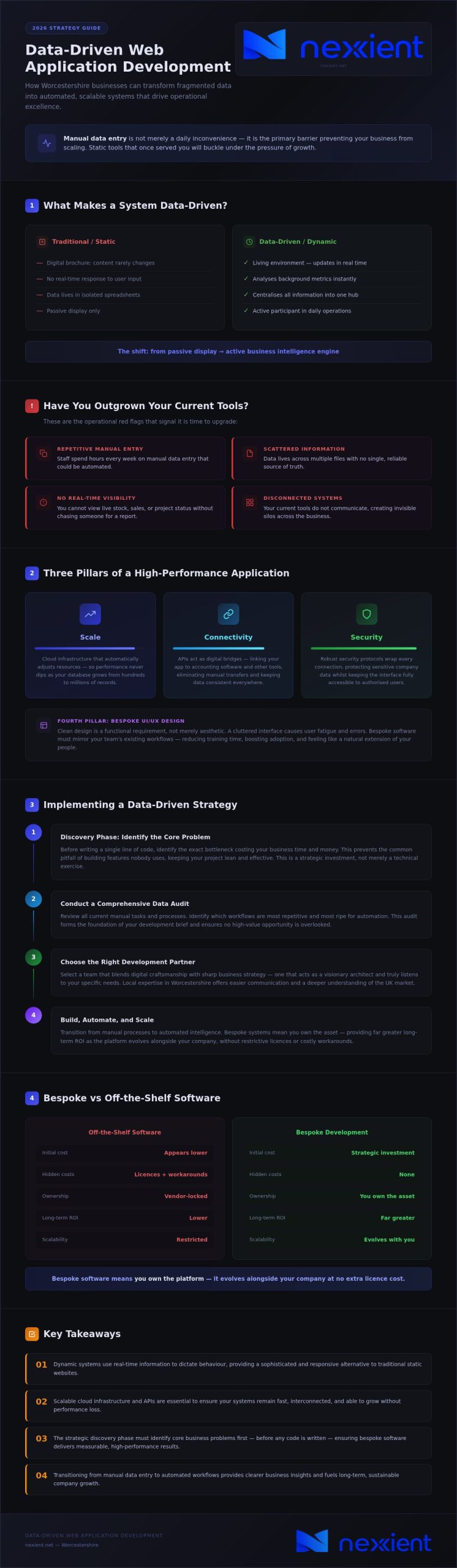
- Understand how dynamic systems use real-time information to dictate behaviour, providing a sophisticated and responsive alternative to traditional static websites.
- Learn why scalable cloud infrastructure and APIs are essential for data driven web application development to ensure your systems remain fast and interconnected.
- Master the strategic discovery phase by identifying core business problems first, ensuring your bespoke software delivers a high-performance solution.
- Recognise how to transition from manual data entry to automated workflows that provide clearer insights and fuel long-term company growth.
What is Data-Driven Web Application Development?
At its core, data driven web application development is the process of building systems where real-time information dictates how the platform behaves. Most traditional websites act as digital brochures, offering static content that rarely changes. In contrast, a data-driven system is a living environment. It processes user input, analyses background metrics, and reacts instantly to provide a unique experience. This technology serves as the sophisticated brain of a modern enterprise, centralising fragmented information from across your organisation into one accessible hub. By integrating these systems, you gain a competitive edge through increased efficiency and clearer strategic foresight.
Moving Beyond Static Information to Dynamic Intelligence
Real-time processing sounds complex, but it’s actually about speed and relevance. It means the application updates what a user sees the very second new data arrives. Transitioning from manual spreadsheets to bespoke data-driven applications allows you to automate reporting and reduce human error. Effective data driven web application development ensures you aren’t just storing rows of numbers; you’re creating a tool that understands them. This shift transforms your digital presence from a passive display into an active participant in your daily operations.
Many businesses in Worcestershire find that their growth is capped by the tools they use. You’ve likely outgrown static tools if you recognise these operational red flags:
- Staff spend hours every week on repetitive manual data entry.
- Information is scattered across multiple files with no “single source of truth”.
- You struggle to get a real-time view of stock, sales, or project status.
- Current systems don’t talk to each other, creating invisible silos.
Core Components of a High-Performance Web Application
Success in data driven web application development relies on three pillars: scale, connectivity, and security. Scale matters. You need a cloud infrastructure that ensures as your database expands from hundreds to millions of records, your team don’t experience frustrating lag. Cloud technology allows the application to adjust its resources automatically, meaning performance never dips during peak usage. Without this flexibility, even advanced tools will eventually buckle under the weight of your growth.
Connectivity is a vital part of data driven web application development, usually achieved through APIs, or Application Programming Interfaces. It’s through these digital bridges that your app talks to other tools, such as your accounting software. By synchronising these systems, you eliminate manual data transfers and ensure information remains consistent. We then wrap these connections in robust security protocols, protecting sensitive company data whilst keeping the interface accessible. If you want to see how these components can work for your firm, you can consult with our technical architects to map out your vision.
Creating Seamless User Journeys with Bespoke UI/UX
Clean design is a functional requirement, not just an aesthetic choice. For complex data tools, a cluttered interface leads to user fatigue and errors. To drive efficiency, custom systems must be built around your existing internal workflows. This ensures the software mirrors your team’s habits, reducing training time and boosting adoption. Bespoke software should feel like a natural extension of your team, not a hurdle they must overcome.
Implementing a Data-Driven Strategy for Business Growth
Success starts with a meticulous discovery phase. You must identify the core problem your business faces before writing a single line of code. Effective data driven web application development isn’t merely a technical exercise; it’s a strategic investment in your future. By focusing on the specific bottlenecks in your current operation, you ensure the final product delivers tangible results. This approach prevents the common pitfall of building features that nobody uses, keeping your project lean and effective.
Selecting the right development partner is equally critical. You need a team that blends digital craftsmanship with sharp business strategy. They should act as a visionary architect, helping you navigate the complex digital landscape whilst listening to your unique needs. Whilst off-the-shelf software might seem cheaper initially, it often carries hidden costs like restrictive licences and clunky workarounds. Bespoke data driven web application development ensures you own the asset, providing a far greater long-term ROI as the platform evolves alongside your company. To ensure you choose the right partner, our bespoke software development company selection guide provides a proven evaluation framework to help you vet engineers and audit code ownership with confidence.
Partnering with Local Expertise in Worcestershire
Working with a local agency provides distinct advantages, from easier communication to a deeper understanding of the UK market. It’s about building a partnership based on trust and shared momentum. To begin your journey, we suggest conducting a comprehensive “Data Audit”. This involves reviewing your current manual tasks to identify which processes are most ripe for automation. You can also explore our Bespoke Web Design Guide to see how high-performance applications and websites work together to fuel growth.
Unlocking Your Business Potential Through Smart Automation
Transitioning from manual processes to automated intelligence is the most effective way to secure your company’s growth. By focusing on a strategic discovery phase and robust cloud infrastructure, you ensure your technology scales as fast as your ambitions. High-performance data driven web application development bridges the gap between raw information and functional beauty, providing the clarity you need to lead your market. As specialists in bespoke software for Worcestershire firms, we bring a dedicated focus on clean design and practical strategy to every project. Our proven experience in custom CRM and business applications ensures your platform is built to last. It’s time to stop fighting with restrictive tools and start building a system that works for you. Discover how Nexient can build your bespoke data-driven application today and take the first step toward a more efficient future.
Frequently Asked Questions
What is the difference between a website and a data-driven web application?
A standard website usually acts as a digital brochure, displaying the same static content to every visitor. In contrast, data driven web application development creates a dynamic system that reacts to user input and real-time information. These applications process and analyse data to change what a user sees, acting as a functional tool for your business rather than just a passive online presence.
How does data-driven development improve business efficiency?
These systems improve efficiency by automating repetitive manual tasks and centralising fragmented information into a single hub. Instead of staff wasting hours on data entry across multiple spreadsheets, a bespoke application handles the heavy lifting instantly. This reduces human error, provides real-time insights, and allows your Worcestershire team to focus on high-value strategic work that actually drives company growth.
Is bespoke web application development more expensive than using ready-made software?
Whilst off-the-shelf software often has lower upfront costs, it frequently carries hidden expenses like monthly subscription fees and restrictive licences. Bespoke development is a long-term investment that eliminates these ongoing costs. You own the software entirely, ensuring it fits your exact workflows without forcing you to pay for redundant features or clunky workarounds that hinder your team’s productivity. Before committing to any platform, it’s worth reviewing how to properly evaluate a bespoke software development company to ensure your investment delivers the results your business needs.
What security measures are included in custom web application development?
Custom development allows for the implementation of security protocols tailored to your specific business needs. We utilise scalable cloud infrastructure with encrypted data storage and multi-factor authentication to protect sensitive company information. Unlike generic software that may have widely known vulnerabilities, a bespoke system is engineered with your unique security requirements at the centre of the design and development process.