
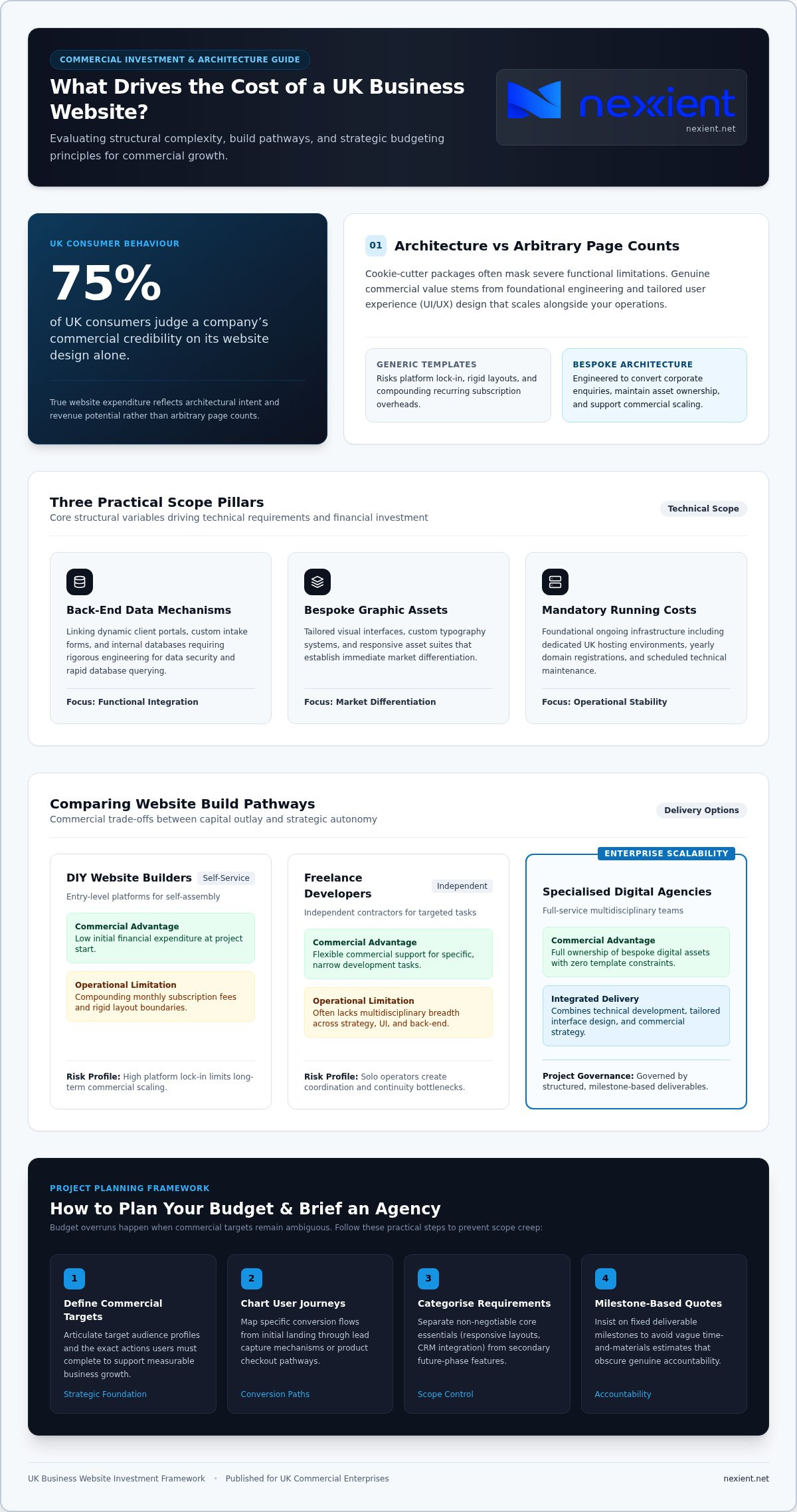
Research shows that 75% of UK consumers judge a company’s commercial credibility on its website design alone. True website expenditure always reflects architectural intent and revenue potential rather than arbitrary page counts. Yet, when exploring how much does a new business website cost UK enterprises, founders frequently face wildly contradictory agency proposals, obscure technical jargon, and fears of hidden ongoing fees. It’s frustrating to assess whether a rigid template will stifle your commercial growth or whether bespoke development is genuinely justified.
This 2026 guide breaks down the foundational components driving modern digital expenditure, outlines viable build options, and reveals practical budgeting steps for your organisation. We’ll examine how to construct an actionable project brief so you can secure transparent, reliable quotes and select the right development partner for your long-term vision.
Key Takeaways
- Learn how much does a new business website cost UK businesses by evaluating core architectural complexity, custom features, and long-term commercial goals.
- Compare the distinct operational limits and strategic benefits of website builders, freelancers, and specialised agencies to identify your ideal development partner.
- Discover how tailored digital builds protect your business from restrictive templates and escalating subscription fees whilst supporting future commercial growth.
- Master the practical steps to draft a precise project brief that separates immediate essentials from future phases to secure transparent, reliable quotes.
What Influences the Cost of a New UK Business Website?
Determining how much does a new business website cost UK organisations begins with evaluating architectural scope. Cookie-cutter packages often seem convenient, but they routinely mask severe functional limitations. Genuine value stems from strategic clarity rather than arbitrary page tallies. When teams analyse the web design process, they quickly realise that foundational engineering and tailored user experience (UI/UX) design require deeper commercial research than off-the-shelf themes can provide.
Investing in bespoke architecture delivers strong long-term commercial returns for UK enterprises. While generic templates trap businesses in recurring plugin fees and rigid layouts, tailored systems scale smoothly alongside your operations. Consider whether your business requires standard promotional pages, an online store, or bespoke brochure websites engineered to convert high-value corporate inquiries.
Core Structural Variables: Content, Features, and Custom Integrations
Three practical pillars drive technical scope and financial requirements during development:
- Back-end data mechanisms: Linking custom intake forms, dynamic client portals, or internal databases demands rigorous engineering to ensure data security and rapid database querying.
- Bespoke graphic assets: Creating tailored interfaces, custom typography systems, and responsive visual assets extends production schedules but establishes immediate market differentiation.
- Mandatory running costs: Factor in foundational operational infrastructure, such as dedicated UK hosting environments, yearly domain registration, and scheduled technical maintenance.
To accurately gauge how much does a new business website cost UK ventures, map your complex technical integrations early. Auditing these requirements upfront protects your commercial budget from scope creep and unforeseen post-launch modifications.
Comparing Website Build Options: DIY Builders, Freelancers, and Agencies
Selecting your production route fundamentally shapes project delivery and long-term capability. Analysis of average website costs in 2026 shows that each build methodology involves clear commercial trade-offs between capital outlay and strategic autonomy:
- DIY website builders: Self-service platforms lower initial expenditure. However, they introduce rigid design boundaries, platform lock-in, and compounding monthly subscription overheads that limit future scaling.
- Freelance developers: Independent contractors offer flexible support for targeted tasks. Even so, solo operators often lack the multidisciplinary breadth needed for combined strategic planning, complex back-end architecture, and bespoke graphic production.
- Specialised digital agencies: Full-service agencies unite technical development, tailored interface design, and commercial strategy under structured project milestones. This route eliminates template constraints and ensures full ownership of your digital assets.
When considering how much does a new business website cost UK companies, balance operational risk against commercial potential. Bespoke engineering avoids the recurring licensing fees that off-the-shelf site builders routinely impose.
Selecting the Appropriate Development Partner for Commercial Growth
Align your build partner with your immediate revenue model. High-performing brochure websites establish market authority for growing firms, converting prospective buyers through tailored user flows. Similarly, growing organisations seeking sophisticated functionality or bespoke web applications require dedicated engineering teams rather than pre-assembled templates.
Take time to define your required commercial outcomes before committing to a contract. If you want objective guidance on selecting the right infrastructure for your goals, you can speak with our technical team to review your requirements.
How to Plan Your Budget and Brief a Web Development Agency
Budget overruns rarely stem from development rates alone. They happen when commercial objectives remain ambiguous at project kickoff. When investigating how much does a new business website cost UK enterprises, clarity begins with defining your commercial targets and ideal customer profiles. Articulating who your platform serves and what exact actions those visitors must complete ensures every invested pound directly supports measurable business growth.
Isolate your non-negotiable operational requirements from aspirational secondary features. Building a modular technical roadmap prevents scope creep, keeping early delivery agile while preserving resources for future expansion. Insist on milestone-based project quotes with defined deliverables, avoiding vague time-and-materials estimates that obscure genuine accountability.
Structuring an Actionable Specification to Prevent Unplanned Budget Creep
Transforming your commercial goals into an actionable project brief requires four practical steps:
- Chart critical user journeys: Map exact conversion paths, from initial page landing to lead capture or product checkout.
- Categorise project requirements: Separate core essentials (such as responsive layouts and CRM integration) from secondary enhancements planned for future phases.
- Establish realistic milestones: Coordinate your target launch schedule with internal marketing campaigns and content preparation cycles.
- Select qualified partners: Assess industry references, technical governance standards, and delivery frameworks outlined across reliable web development benchmarking resources.
Executing this disciplined briefing process gives you full command over project expenditure. It enables agencies to provide accurate, transparent proposals, ensuring your commercial investment achieves sustained competitive value without unexpected cost variations.
Engineer Your Platform for Commercial Growth
Determining how much does a new business website cost UK enterprises ultimately centres on your commercial ambitions, structural requirements, and delivery partner. A disciplined project brief eliminates unexpected budget creep, whilst bespoke architecture protects your organisation from the recurring constraints and fees of off-the-shelf templates.
Partner with Nexient to build a high-performing digital solution aligned with your long-term goals. Our technical capabilities span focused brochure platforms to complex custom web applications, combining clean engineering with strategic design. You gain transparent deliverables engineered specifically to accelerate business performance. Contact our specialists today to start planning your build with confidence.
Frequently Asked Questions
What is the difference between a template website and a bespoke build?
A template website relies on pre-formatted themes with rigid structural limits, whereas a bespoke build provides tailored code engineered specifically around your commercial goals. Bespoke development gives growing Worcestershire businesses full visual ownership, rapid page performance, and clean architecture without bloated third-party plugins. While templates offer initial convenience, custom platforms ensure your digital assets scale smoothly alongside your expansion.
Why do website development quotes vary so significantly across the UK?
Quotes vary widely because providers differ in technical capability, strategic depth, and delivery governance. When investigating how much does a new business website cost UK enterprises, lower figures often indicate pre-built theme installations with minimal testing. Comprehensive agency proposals encompass detailed user journey mapping, bespoke interface design, secure back-end data engineering, and structured project milestones that guarantee commercial results.
What ongoing maintenance and hosting fees should a business anticipate?
Businesses must plan for annual domain registration, dedicated secure hosting environments, and scheduled technical maintenance. Ongoing support covers vital security patches, automated backups, and routine framework updates. Working with an established Worcestershire development team keeps your infrastructure compliant with UK data protection regulations whilst protecting your platform from unexpected performance interruptions or security vulnerabilities.
How long does it typically take to develop a professional business website?
Developing a professional business website typically requires between four and twelve weeks, depending on architectural complexity and asset readiness. Focused brochure platforms move quickly through design and build stages once initial copy is approved. Complex platforms with custom integrations or data-driven applications require thorough discovery, prototyping, and testing phases to ensure seamless post-launch execution.