
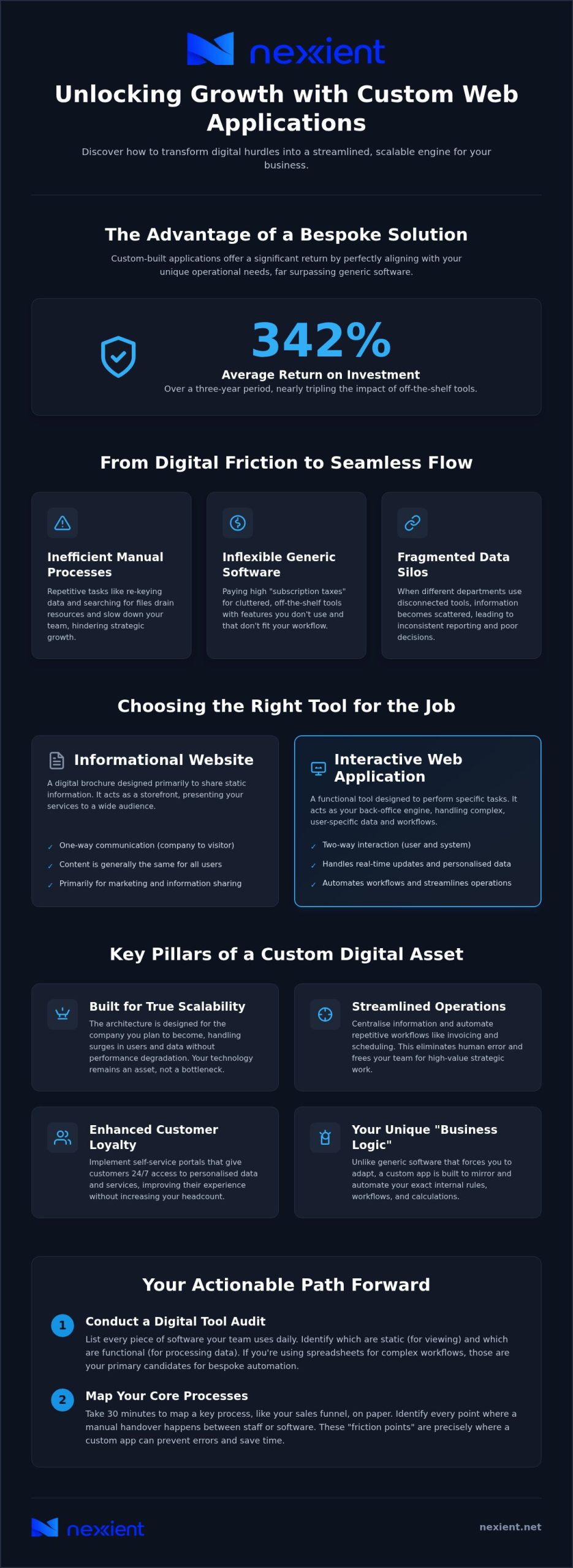
Did you know that custom web applications deliver an average return on investment of 342% over three years, nearly tripling the impact of standard, off-the-shelf software? Whilst many companies settle for generic tools, the most successful organisations recognise that sustainable growth requires a digital asset built specifically for their unique logic. You’ve likely felt the friction of manual processes that slow your team down or high subscription fees for tools that never quite fit your workflow. It’s exhausting to manage systems that refuse to talk to one another. This leaves your data scattered and your scaling efforts stalled.
This 2026 guide explores exactly how a custom web app can grow your business by transforming these digital hurdles into a streamlined, scalable engine. We understand that you need more than just a digital presence; you need a platform that automates workflows, engages customers, and scales operations with precision. We’ll show you how to move beyond simple brochure websites to build data-driven applications that save time, reduce overheads, and provide the clarity needed for bold decision-making. Discover the actionable steps to transition from software that limits you to a bespoke solution that propels you forward.
Key Takeaways
- Learn the fundamental differences between informational websites and interactive web applications to identify which tool solves your specific operational challenges.
- Discover how a custom web app can grow your business by automating repetitive manual tasks and eliminating fragmented data silos that hinder your team’s productivity.
- Compare the long-term financial advantages of bespoke ownership against the hidden costs of inflexible, generic software that often requires expensive workarounds.
- Improve customer loyalty by implementing self-service portals that provide personalised data and 24/7 access to your services without increasing your headcount.
- Follow a structured development path from the initial discovery phase to iterative launches to ensure your digital strategy remains aligned with your growth goals.
Defining the Custom Web Application: More Than Just a Website
Many leaders use the terms “website” and “web app” interchangeably, yet the difference is fundamental to your growth strategy. A website primarily shares information; it’s a digital brochure. In contrast, a Web application is a functional tool designed to perform specific tasks. Understanding this distinction is the first step in seeing how a custom web app can grow your business. Unlike mobile apps, these platforms are accessed through a standard browser. Your team or customers don’t need to visit an app store or manage manual updates. They simply log in and get to work.
At the heart of every bespoke application is your unique “Business Logic”. These are the specific rules, workflows, and calculations that govern how your company operates. Off-the-shelf software often forces you to change your behaviour to fit the tool. A custom app does the opposite. It’s built to mirror and automate your exact internal processes, ensuring the software works for you, not the other way around.
Interactive Functionality vs Static Content
Whilst a brochure website serves as a polished storefront, a data-driven application acts as your back-office engine. These systems handle user-specific data, complex workflows, and real-time updates effortlessly. Imagine the difference between a page that lists your services and a portal where a client logs in, views their project status, and approves an invoice. This interactivity is vital for scaling. It shifts the burden of data processing and status checking from your staff to the system itself, freeing your team for higher-value work.
The Architecture of a Scalable Digital Asset
We adopt the “Visionary Architect” approach to development. This means we don’t just build for your current headcount; we build for the company you plan to become. True scalability is the ability of your software to handle a surge in users or data without crashing or slowing down. It provides a stable foundation for momentum. If your digital foundation is shaky, every new customer becomes a burden rather than a win. A scalable app ensures that your technology remains an asset as you expand. This is fundamentally how a custom web app can grow your business; it provides the infrastructure to double your output without doubling your staff.
Streamlining Operations to Unlock Hidden Revenue
Growth is often viewed solely through the lens of marketing, but true profitability often hides within your internal operations. Inefficient manual processes act as a silent drain on your resources. Every hour your team spends re-keying data or searching for lost files is an hour stolen from strategic growth. This is fundamentally how a custom web app can grow your business; it converts wasted administrative time into productive, billable hours. By centralising information, you eliminate the “data silos” that occur when different departments use disconnected tools. When your teams aren’t forced to act as “human bridges” between systems, your operational speed increases significantly.
Data silos are more than just an inconvenience. They lead to fragmented reporting and inconsistent customer information. Investing in custom systems ensures that your digital infrastructure matches your operational reality. It’s about building a platform that supports your momentum rather than creating friction. When your technology acts as a cohesive backbone, your staff can finally focus on high-value tasks that require human creativity and judgment.
Custom CRM Systems: Managing Relationships Your Way
Whilst many UK businesses start with off-the-shelf Customer Relationship Management (CRM) tools, they often find these platforms cluttered with features they’ll never use. You’re frequently paying a “subscription tax” for complexity that actually slows your team down. A bespoke CRM removes this noise. It focuses on your specific lead tracking needs and provides reporting that actually makes sense for your board meetings. It organises your client behaviour data into actionable insights without the bloat of generic software.
Automating Repetitive Workflows
Workflow automation is the process of letting software handle routine business sequences. Think of the tasks that happen every Tuesday, or every time a new order is placed. Automated invoicing, staff scheduling, and inventory alerts don’t just save time; they eliminate the risk of human error. This precision is vital for maintaining a competitive edge in 2026.
There’s a direct, measurable link between this automation and your profit margins. When your systems handle the “busy work” automatically, your overheads remain stable even as your order volume increases. If you’re ready to see how these efficiencies could work for your organisation, exploring our data-driven solutions is a practical place to start. This level of operational agility is a core reason why bespoke software is a strategic investment for scaling businesses.
Crafting Superior Customer Experiences Through Personalisation
Customers in 2026 expect immediacy. They want answers at 2 AM on a Sunday without waiting for your office to open. This shift in behaviour is a primary reason why understanding how a custom web app can grow your business is essential for modern leaders. By providing a dedicated space for your clients, you move from a reactive service model to a proactive, digital-first partnership. A seamless, high-performance interface doesn’t just look professional; it builds the trust necessary for long-term retention. Clean design and intuitive navigation signal that you are a modern, reliable expert in your field.
Client Portals and Self-Service Tools
A bespoke client portal acts as a private, secure bridge between your business and your customers. These tools allow users to download invoices, check project milestones, or update their preferences instantly. This reduces the volume of repetitive customer service enquiries that clog your team’s inbox. From a security perspective, a custom-built area ensures sensitive information is handled with precision, avoiding the risks associated with generic file-sharing sites. It provides a sanctuary for data that reflects your commitment to client privacy.
Data-Driven Insights for Better Service
Every interaction within your web app provides a window into user behaviour. You can track which features are most popular, where users get stuck, and what services they search for most often. This data is the fuel for your future business strategy. It allows you to offer personalised recommendations that feel helpful rather than intrusive. When you understand exactly what your clients need, you can refine your offerings with surgical precision.
Integrating these insights into your bespoke web design ensures that your brand feel remains cohesive across every touchpoint. When your digital environment is tailored to the specific needs of your audience, you create a frictionless experience that competitors using generic templates simply cannot match. This level of digital craftsmanship signals that you value your customers’ time and security. Ultimately, this tailored experience is exactly how a custom web app can grow your business by turning one-off transactions into lifelong client partnerships.
Off-the-Shelf vs Bespoke: Choosing the Path to Scalability
Choosing between a ready-made platform and a bespoke solution is often a choice between renting and owning. Whilst off-the-shelf software offers a quick start, it frequently leads to “Technical Debt”. This term describes the future cost of reworking or replacing a cheap, inflexible tool that no longer serves your needs. As your company evolves, these generic systems become digital anchors that prevent you from pivoting. Understanding how a custom web app can grow your business involves looking past the initial setup and focusing on long-term agility. Owning your code allows you to adapt instantly to market shifts without waiting for a third-party developer to update their roadmap.
A bespoke platform provides the freedom to innovate. You aren’t restricted by the features a software provider thinks you need. Instead, you build the exact functionality required to outperform your competitors. This flexibility is a core component of how a custom web app can grow your business; it ensures your technology remains a facilitator of your vision rather than a bottleneck to your progress.
The True Cost of Subscription Software
Many organisations find themselves trapped by per-user licensing fees. As your team grows, your software bill inflates, often without a corresponding increase in value. This creates a financial ceiling on your expansion. There is also the significant risk of “Vendor Lock-in”. This happens when your data is stored in a proprietary format that makes it difficult or expensive to move to another system. You are effectively renting your operational infrastructure, which leaves you vulnerable to price hikes and service changes outside your control.
Ownership and Intellectual Property
A custom application is more than just a tool; it is a proprietary asset. When you invest in bespoke development, the resulting code belongs to your company, adding tangible value to your balance sheet and overall business valuation. This is particularly attractive to investors or potential buyers who want to see unique, scalable systems. Beyond the financial benefits, there is a clear security advantage. Off-the-shelf tools are high-profile targets for cyberattacks because one vulnerability can compromise thousands of companies. A bespoke system is a smaller, more specific target, built with your unique security requirements in mind.
Working with experienced website design companies can help you integrate these powerful assets into a cohesive digital strategy. If you are ready to stop renting your growth and start building your own digital legacy, explore our custom systems to see how we can build a platform tailored to your vision. This shift from subscriber to owner is a decisive step in protecting your long-term interests and securing your company’s future.
Executing Your Digital Strategy: From Vision to Launch
Building a digital asset isn’t a “set and forget” project. It’s a strategic evolution. To truly see how a custom web app can grow your business, you must treat it as a living tool that matures alongside your company. This requires a roadmap that balances immediate needs with long-term vision. Starting with a clear execution strategy prevents wasted investment and ensures every feature serves a measurable purpose. A bespoke application should be flexible enough to pivot as your market changes, providing a foundation for sustained momentum rather than a static solution that dates quickly.
The Discovery and Planning Phase
Success begins long before the first line of code is written. The discovery phase is where we align your technical requirements with your commercial goals. By defining specific success metrics early, you create a benchmark for your return on investment. We often recommend starting with a Minimum Viable Product (MVP). This is a version of your app that includes only the essential features needed to solve your primary problem. Launching an MVP allows you to gather real-world user feedback quickly. This informs the next stage of development without over-committing resources to unproven ideas.
Choosing the Right Development Partner
Your choice of partner is as critical as the technology itself. Whilst global platforms offer scale, a local partner in Worcestershire provides a level of accessibility and market understanding that’s hard to replicate. You need a team that acts as a “Visionary Architect”, balancing clean, aesthetic design with robust back-end engineering. A beautiful interface is useless if the data processing is slow; a powerful engine is wasted if your team finds it difficult to use.
Look for a collaborator that prioritises transparency and iterative progress. This approach ensures you remain in control of the project’s direction. It’s also vital to see evidence of their ability to handle complexity. This is another way how a custom web app can grow your business; by having a reliable guide to help you navigate the digital landscape, you avoid common pitfalls and accelerate your path to launch.
Building Your Digital Legacy for 2026 and Beyond
Investing in a custom digital asset is a decisive step toward operational excellence. We’ve explored the fundamental shift from brochure websites to functional applications that mirror your unique business logic. By automating repetitive tasks and centralising your data, you eliminate the friction that stalls growth. This guide has shown how a custom web app can grow your business by transforming your internal workflows into a high-performance engine.
Owning your software is more than a technical choice; it’s a strategic move to build intellectual property and long-term value. As a Worcestershire-based partner, Nexient specialises in crafting bespoke CRM systems and data-driven web applications that combine clean design with practical strategy. We focus on building tools that are as methodical as they are creative, ensuring your digital infrastructure is ready for the challenges of tomorrow.
Ready to scale? Book a strategy call with Nexient to discuss your custom web application.
The future of your business shouldn’t be limited by generic software. It’s time to build a platform that is as ambitious as your vision.
Frequently Asked Questions
What is the difference between a website and a custom web application?
A brochure website primarily shares information with visitors; it is a digital storefront. A web application performs specific tasks, such as processing data or managing user logins. Whilst a website is a passive experience, an app is a functional tool that interacts with your unique business logic. This distinction is vital for understanding how a custom web app can grow your business by automating your internal operations.
How much does it cost to develop a custom web app in the UK?
The cost of developing a bespoke solution in the UK depends on the complexity of your requirements and the number of integrations needed. Factors such as the depth of data processing and the level of custom design will influence the final investment. To manage your budget effectively, we recommend starting with a Minimum Viable Product (MVP). This approach allows you to launch core features first and scale as your revenue grows.
How long does the bespoke web application development process take?
Most bespoke projects take between three and nine months from the initial discovery phase to the final launch. A simple application might be ready in twelve weeks, whilst complex systems with deep integrations require more time. To keep your project on track, organise a clear list of must-have features before starting. This ensures your development partner can provide an accurate timeline and avoid delays during the engineering process.
Can a custom web app integrate with my existing software?
Yes, bespoke applications are designed to communicate with your existing tools via Application Programming Interfaces (APIs). This allows your new app to “talk” to your accounting software, email marketing platforms, or legacy databases. By connecting these systems, you eliminate manual data entry and create a unified workflow. Start by listing all the software your team currently uses to ensure your new application can integrate seamlessly from day one.
Do I own the source code for my custom web application?
When you work with a professional agency like Nexient, you typically own the source code once the project is fully paid for. This makes the application a tangible intellectual property asset on your company balance sheet. Owning your code prevents vendor lock-in and gives you the freedom to move your hosting or modify the system in the future. Always confirm that intellectual property rights are clearly defined in your development contract.
Is a custom web app more secure than off-the-shelf software?
Custom applications are often more secure because they aren’t built on mass-market platforms that hackers frequently target. Off-the-shelf tools have public vulnerabilities that can affect thousands of businesses at once. A bespoke system is designed with your specific security needs in mind, using modern protocols to protect sensitive data. This level of protection is a key way how a custom web app can grow your business by building trust.
Will a web app work on mobile devices and tablets?
Yes, modern web applications are built using responsive design, ensuring they perform perfectly on desktops, tablets, and smartphones. Users access the app through their mobile browser without needing to download anything from an app store. This provides a consistent experience for your team in Worcestershire, whether they are in the office or working remotely. Test your app on multiple devices during development to ensure the interface remains intuitive for all users.
How do I know if my business is ready for a custom web app?
Your business is likely ready if you are struggling with manual processes that lead to human error or if your current software doesn’t fit your workflow. If you’ve outgrown your brochure website and need a tool that handles complex data, it is time to consider a bespoke solution. To decide, calculate the time your team spends on repetitive admin tasks each week. If that time is significant, an app will provide ROI.